e4m TechManch 2026: Marketers see humanoid AI as the next frontier in brand experiences
At e4m TechManch 2026, Coca Cola’s Sumeli Chatterjee and WPP’s Niraj Ruparel explored the future of marketing
 by
by
Published: Jul 28, 2026 12:34 PM | 3 min read
 Follow Us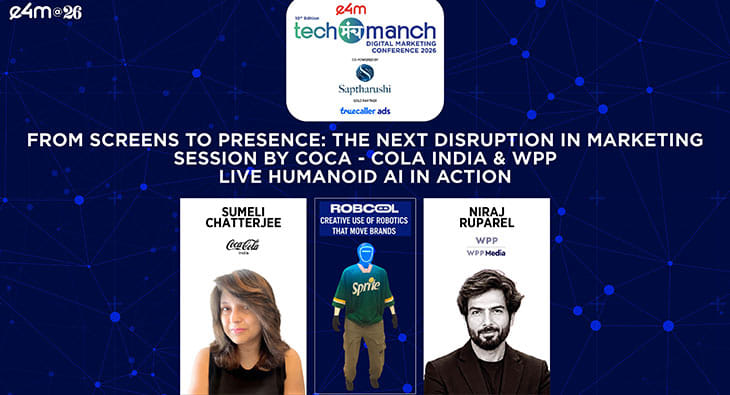

- At e4m TechManch 2026, Coca Cola's Sumeli Chatterjee and WPP's Niraj Ruparel discussed the future of marketing, emphasizing a shift from content production to intelligent, human-like brand interactions in real-world settings.
- They showcased a live humanoid AI developed for a Sprite campaign, illustrating how brands can transition from screen-based storytelling to immersive experiences that engage consumers directly.
- Chatterjee highlighted the need for brands to focus on consumer participation rather than interruption, suggesting that marketing should align with consumer passions, such as sports and entertainment, to enhance experiences.
- Both speakers stressed the importance of responsible innovation in AI, advocating for a consumer-first approach and cautioning against adopting technology for novelty's sake, while emphasizing the potential for AI to create meaningful, personalized brand interactions.
At e4m TechManch 2026, Coca Cola’s Sumeli Chatterjee and WPP’s Niraj Ruparel explored how the future of marketing may shift from producing more content to designing intelligent, human-like brand interactions that consumers can experience in the real world.
The next disruption in marketing may not arrive through another social platform or AI-powered content engine. It could walk into a room, greet consumers by name, switch languages in real time and hold meaningful conversations.
That was the central message from Sumeli Chatterjee, Senior Director Marketing, Sparkling Flavours, India and Southwest Asia at Coca Cola, and Niraj Ruparel, Creative Technology Lead at WPP, during a session titled Meet The Machine at e4m TechManch 2026. The duo showcased a live humanoid AI developed as part of a Sprite campaign, positioning it as an early signal of how brands can evolve from screen-based storytelling to presence-led experiences.
For Chatterjee, the opportunity stems from a widening imbalance between endless digital content and shrinking consumer attention.
"Content is infinite but attention is finite. Consumers only have that much attention to give. Brands are often forgotten because they appear across different platforms and moments but do not truly own the experience," she said.
She emphasised that the next wave of marketing will be defined by participation rather than interruption, with brands embedding themselves into consumer passion points such as sports, music and entertainment instead of merely sponsoring them. Cricket, she noted, became the ideal playground for experimenting with humanoid AI because it allowed the brand to enhance fan experiences rather than simply deliver another campaign.
Ruparel framed the work as part of a broader shift underway across the industry, where AI is moving from generating content to enabling interaction. He highlighted that such breakthroughs rarely originate from traditional briefs, but from deliberate experimentation at the intersection of creativity and technology.
"There cannot be a brief for innovation. It has to be experienced first in the form of a prototype," he said, pointing to WPP’s experience centers as environments where marketers, engineers and creators collaborate to test, learn and scale emerging ideas into real-world applications.
The humanoid demonstrated on stage could recognise people, converse in multiple Indian and global languages, perform gestures and respond contextually based on its surroundings. Beyond the spectacle, Ruparel positioned these capabilities as foundational building blocks for a new interface layer for brands, where physical AI systems can deliver adaptive, culturally relevant and deeply personal experiences at scale.
However, both speakers cautioned against adopting AI simply because it is novel.
"Do not get caught up in the innovation trap," Chatterjee said. "It is important to start with the consumer. The use case is not about the robot. It is about understanding what consumers or fans actually want to experience."
She revealed that Coca-Cola subjected the activation to rigorous governance checks before deployment, with internal AI councils, compliance reviews and standard operating procedures ensuring the technology aligned with brand safety requirements before reaching consumers.
Ruparel echoed the need for responsible innovation, reinforcing a bias toward action grounded in real-world value. "We can spend time overanalyzing AI, or we can start building meaningful use cases with it. This is a transformational era for marketing where the constraints of the past no longer apply. The real opportunity lies in using AI to create work that simply wasn’t possible earlier."
As AI evolves from software into embodied, real-world interfaces, both speakers pointed to a future where brands are not just seen or heard, but experienced. The opportunity is not to replace human connection, but to augment it, making interactions more intuitive, contextual and memorable in an increasingly distracted world. In that shift from screens to presence, humanoid AI may well become one of marketing's most powerful new canvases.
Read more news about Marketing News, Advertising News, PR and Corporate Communication News, Digital News, People Movement News
For more updates, be socially connected with us onInstagram, LinkedIn, Twitter, Facebook, YouTube & Google News