Amazon Ads' Kapil Sharma: Digital-first brands must break ‘inverted funnel trap’ to scale
At e4m D2C Summit 5.0, the Director of Amazon Ads made the case for full-funnel marketing over search-led discovery alone, citing WARC and Kantar data on brand growth
 by
by
Published: Sep 16, 2026 11:19 AM | 2 min read
 Follow Us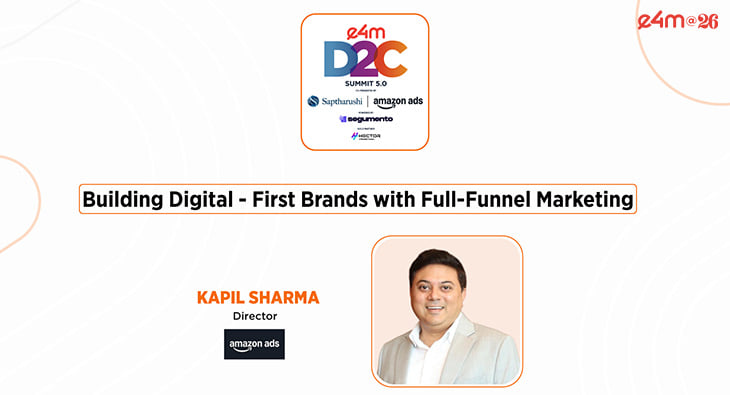

- Kapil Sharma, Director of Amazon Ads, emphasized at the e4m D2C Summit that while search-led discovery has helped digital-first brands grow, it is no longer a sustainable strategy for long-term success.
- He highlighted the limitations of an 80-20 split favoring performance advertising, which can lead to audience fatigue and hinder growth, coining this phenomenon the "inverted funnel trap."
- Sharma advocated for a combined approach of performance and brand marketing, suggesting that brands should utilize Amazon Ads' full-funnel offerings to expand their customer base and create new demand.
- He pointed to the effectiveness of streaming video as a marketing tool, citing research that shows video significantly enhances brand awareness and consumer engagement, while also addressing the challenges smaller brands face in accessing video advertising.
Search-led discovery built India's digital-first brands, but it won't sustain them, Kapil Sharma, Director, Amazon Ads, told delegates at the e4m D2C Summit 5.0, delivering a Spotlight Session on "Building Digital-First Brands with Full-Funnel Marketing."
Sharma, who has spent close to a decade with Amazon Ads, opened by tracing how digital-first brands have evolved from challengers to mainstream players, with several launching IPOs. What remained constant, he said, is their early reliance on "leveraging search-led discovery to build a brand and acquire new customers," an approach that works "when the customers have an intent to purchase the product."
But that engine is running out of road. Citing WARC research, Sharma said brands following an 80-20 split skewed heavily toward performance advertising "actually end up creating a ceiling for themselves," as repeated targeting of the same audiences leads to fatigue. Drawing on INC 42's mapping of D2C 1.0 to D2C 3.0, he argued that today's environment of selective funding and sharper focus on customer acquisition cost and lifetime value has changed the rules. "The brands that are focusing on performance advertising alone... are facing challenges in terms of their growth," he said, describing this as the "inverted funnel trap," where brands harvest existing demand instead of creating new demand, resulting in "stunted growth."
His prescription: combining performance and brand marketing through Amazon Ads' full-funnel offering. "Through Amazon Ads, you are not only harvesting the demand, but you're also expanding your funnel," Sharma said.
At the awareness stage, he positioned streaming video as "the new prime time," pointing to Analytic Partners research showing video has twice the impact of non-video formats, with 79% of consumers saying video keeps a brand top of mind. He acknowledged that high production costs and weak measurement have historically kept video out of reach for smaller brands, a gap Amazon's streaming TV ads and P+ auto-targeting are designed to close across Prime Video, Twitch, Hotstar and others. A Kantar study of 65 video campaigns showed a 28% lift in message association and 23% lift in brand favourability versus industry benchmarks, he said.
Read more news about Marketing News, Advertising News, PR and Corporate Communication News, Digital News, People Movement News
For more updates, be socially connected with us onInstagram, LinkedIn, Twitter, Facebook, YouTube & Google News