How IPL is rewriting India’s quick commerce patterns
Data shared by platforms with e4m indicates that IPL match hours are increasingly emerging as high-intent shopping windows
 by
by
Published: Apr 7, 2026 9:29 AM | 6 min read
 Follow Us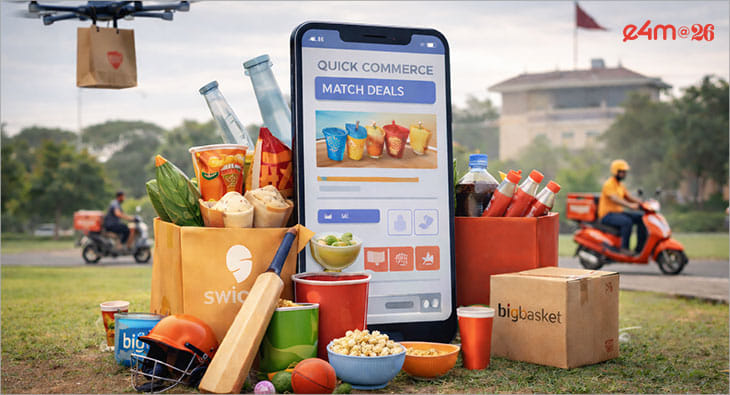

From cashback offers on sixes to match-ready storefronts and flash deals during innings breaks, the Indian Premier League (IPL) is transforming into a high-frequency consumption trigger for India’s quick commerce ecosystem. What was once an advertising-heavy, top-of-funnel sporting spectacle is now evolving into a tightly integrated, real-time commerce opportunity for quick commerce platforms like Swiggy, Zepto, bigbasket and Zomato.
Today, fans are not just watching the match, but simultaneously scrolling, ordering and responding to real-time nudges, turning every boundary or timeout into a potential transaction moment.
Data shared by platforms with e4m indicates that IPL match hours are increasingly emerging as high-intent shopping windows.
“During IPL match hours, impulse-led categories have seen a 29% uplift in orders and about 30% growth in GMV versus regular days,” says Seshu Kumar Tirumala, Chief Buying & Merchandising Officer at bigbasket.
Several industry estimates further suggest that order volumes during IPL evenings rise anywhere between 10% and 30%, with as much as a third of daily GMV getting compressed into the 7 PM to 11 PM match window.
But beyond the scale, it is the shape of demand that stands out. Unlike a typical evening where orders are spread out, IPL consumption arrives in bursts, peaking before the toss, resurging during the mid-innings break, and even reacting instantly to on-field moments such as wickets or momentum swings. The result is a highly reactive, event-driven commerce cycle where speed often matters more than pricing.
Match-hour spikes and shifting baskets
Platforms across the ecosystem are seeing both the scale and spread of demand deepen during this IPL season.
At Flipkart Minutes, the company is anticipating a 6X spike in demand during IPL, with early trends already indicating strong traction not just in food and beverages but also in adjacent categories such as ice cube trays, bar sets, sports gear, smart speakers and casual apparel, pointing to a widening of match-time consumption beyond just snacking, a Flipkart spokesperson told e4m.
This widening basket is also visible across quick commerce platforms, where IPL is increasingly driving occasion-led, group consumption rather than individual, need-based purchases.
Experts have suggested that average order values rise during match hours as users stock up for shared viewing experiences, while repeat ordering within the same match window, especially during innings breaks, adds another layer of demand intensity.
A similar playbook is visible at Amazon Now. The company told e4m that it is leaning into evening-led storefront activations built around IPL consumption moments, with its “Be Match Ready” theme going live daily to capture peak-time demand. The assortment is sharply curated around consumption occasions, ranging from “Watch Party Ready” and “Game Day Eats” to “Match Day Gadgets.” These include chips and munchies, ready-to-cook snacks, disposables, cleaning essentials and even electronics like speakers, alongside experiments such as jersey merchandising in key markets.
In effect, platforms are no longer waiting for demand, they are actively shaping it by nudging users with curated journeys the moment intent spikes.
By packaging products around occasions rather than categories, platforms are nudging users toward quicker decisions and higher basket values during compressed match-time windows.
By combining themed storefronts, bundled assortments and time-sensitive visibility, platforms are effectively reducing decision friction and accelerating conversion during narrow match-time windows.
As Madhav Kasturia, Founder and CEO of Zippee, explains, IPL compresses demand into sharp bursts rather than spreading it across the evening. “You’re not just seeing more orders, you’re seeing them come in very specific, high-intensity windows,” he noted, pointing to spikes around pre-match stocking, mid-innings refills and even real-time match moments.
Category surges reshape the match-time basket
For Zepto, this behaviour is playing out through a mix of both traditional and evolving consumption patterns. The platform told e4m that while staples like chips, crisps, soft drinks, ice and popcorn continue to dominate during match hours, there is a visible uptick in demand for items such as momos, lassi and chaas, reflecting both impulse consumption and the seasonal push from summer.
With consumers opting for combinations that complete the match experience, baskets are becoming more bundled.
Data shared by bigbasket further highlights the scale of these shifts.
Compared to non-match days (during the same hours), Snacking & Indulgence sees a 51% uplift, followed by beverages at 42% and Ice Creams at 39%, reinforcing that match-time consumption is heavily skewed toward impulse and indulgence.
Other categories are also seeing strong momentum. Biscuits, cakes and bakery grow by 31%, while instant noodles, pasta and cup noodles rise by 22%, pointing to demand for quick, convenient meals. Add-ons such as spreads and sauces are up 22%, while sweets and chocolates see a 25% increase, reflecting post-match indulgence.
According to these platforms, overall, these categories see their contribution to the basket increase by around 25% versus regular days, signalling a clear shift from utility-led shopping to match-driven, occasion-based consumption.
Importantly, the shift is not limited to core food categories. The spike in categories like glassware points to a parallel rise in hosting behaviour, suggesting that IPL is as much a social occasion as it is a viewing one. Taken together, these trends indicate that match-time consumption is moving away from routine shopping toward occasion-driven, multi-category baskets.
The race to capture real-time demand
To keep pace with this evolving demand, platforms are reworking both inventory strategies and operational playbooks, moving from static planning to far more dynamic, time-sensitive models.
For instance, platforms like bigbasket are using a hybrid approach. The platform pre-stocks high-demand SKUs based on historical match trends, city-level preferences and match timings, while simultaneously boosting visibility through homepage placements and time-bound campaigns to capture peak demand windows.
The real challenge, however, lies not in stocking more—but in stocking right, at the right time.
At an operational level, the focus has shifted toward micro-slot planning. As Kasturia of quick comm platform Zippee explains, demand is now forecast across specific match phases, pre-match, mid-innings and end-game, allowing dark stores to prepare for sharp, time-bound spikes rather than steady demand flows.
This has significant implications for execution. Platforms are aligning staffing to peak bursts, optimising picking systems for faster turnaround and shortening dispatch cycles to ensure deliveries match the immediacy of consumption. In a scenario where purchases are driven by live moments, even minor delays can lead to missed conversions.
In addition to this, merchandising is also evolving in parallel. Match-specific bundles, watch-party kits and curated assortments are increasingly being deployed to simplify decision-making and drive higher basket values during high-intent windows.
Overlaying these operational shifts is a broader change in how brands are approaching IPL. According to Vejay Anand, Senior Advisor at Prequate, nearly 40–50% of digital spends in relevant categories are now being allocated to quick commerce platforms, marking a decisive shift toward performance-led, conversion-focused channels.
“Quick commerce is no longer just a distribution layer, it has become the conversion engine during IPL,” Anand added, highlighting how brands are increasingly aligning media spends with real-time consumption triggers, leveraging moment-based targeting and in-app visibility to drive instant purchases.
In many ways, IPL is no longer just influencing what consumers watch, it is dictating how they shop, when they shop, and how quickly that intent converts.
Read more news about IPL 2024 News, Internet Advertising, Marketing India, PR and Corporate Communication, Television Media
For more updates, be socially connected with us onInstagram, LinkedIn, Twitter, Facebook YouTube & Google News
