Why jewellery brands are betting big on creators even as India turns cautious on gold
Jewellery brands are tapping creators for authenticity, individuality and cultural relevance; the test is whether these collabs can drive actual purchase behaviour and not just social media engagement
 by
by
Published: May 29, 2026 9:06 AM | 5 min read
 Follow Us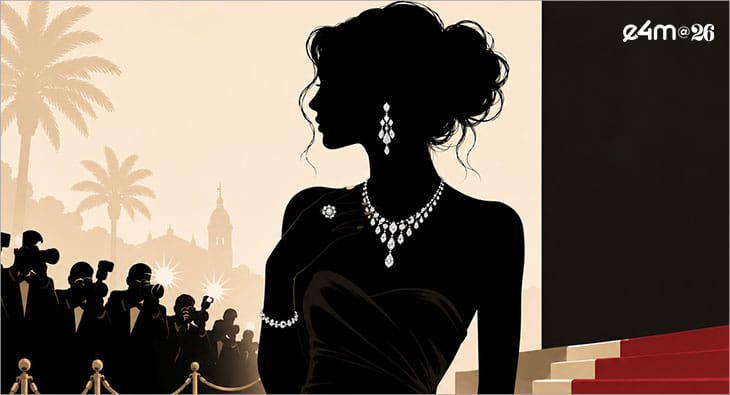

- Rida Tharana's appearance at the Cannes Film Festival in a custom lab-grown diamond piece highlights a shift in India's jewellery marketing, focusing on authenticity and cultural relevance rather than traditional celebrity endorsements.
- Amid economic pressures and changing consumer sentiment towards gold purchases, jewellery brands are increasingly collaborating with creators to promote individuality, craftsmanship, and responsible consumption.
- The rise of men's jewellery is noted, with athletes and fashion creators influencing trends, leading to a more balanced focus on male and female consumers in the jewellery market.
- Initiatives like Kalyan Jewellers' "Nation First – Gold4India Initiative" aim to encourage old gold exchange and shift consumer perceptions of gold from a static asset to a renewable resource, reflecting a broader change in jewellery marketing strategies.
When creator Rida Tharana walked the Cannes Film Festival red carpet this year wearing a custom lab-grown diamond creation by Sennes from The House of Senco, it was not just another fashion collaboration. It reflected how India’s jewellery industry is rapidly rewriting the rules of luxury marketing.
Kalyan Jewellers also collaborated with actress Kalyani Priyadarshan to create a couture-inspired high jewellery moment at Cannes, featuring a 52-carat blue sapphire, pink morganites, and nearly 1,000 natural diamonds.
At a time when the sector is facing economic pressure, slowing sentiment around discretionary gold purchases, and growing scrutiny around imports, jewellery brands are increasingly leaning on creators to shape softer, more culturally relevant luxury narratives.
Commenting on the collaboration, Joita Sen, Head of Marketing and Design at Sennes, said, “Today, luxury jewellery marketing is evolving far beyond traditional celebrity endorsements. Creators like Rida Tharana bring a sense of authenticity, individuality and cultural relevance that deeply resonates with younger luxury consumers. Cannes has become a global intersection of fashion, beauty, jewellery and creator-led influence, making it an important platform for brands looking to shape modern luxury narratives.”
The Cannes push comes before Prime Minister Narendra Modi’s recent appeal—urging Indians to voluntarily avoid non-essential gold purchases and destination weddings abroad for the next year—meaning the ad industry was ready. The statement, aimed at preserving India’s foreign exchange reserves amid elevated crude oil prices and geopolitical tensions in the Middle East, triggered a sharp market reaction.
Titan shares fell 6.4%, Kalyan Jewellers declined 8.3%, Sky Gold plunged 12.2%, while Senco Gold, PN Gadgil Jewellers, PC Jeweller and Tribhovandas Bhimji Zaveri also witnessed steep corrections.
But while stock markets reacted instantly, the larger shift is now unfolding inside marketing departments.
For decades, jewellery advertising in India was built around grandeur. Bridal campaigns, family inheritance, wedding excess and celebrity-led aspiration dominated the narrative. Today, brands are recalibrating luxury messaging toward individuality, craftsmanship, everyday styling and responsible consumption.
Creators have become central to that transition.
Over the past few weeks, creators across fashion, infotainment, parenting, beauty and lifestyle were invited by the De Beers Group for luxury-led masterclasses and diamond education experiences. Rather than relying purely on celebrity visibility, brands are now investing in education-led influence and trust-driven storytelling.
Infotainment creator Rhia Bhatia, who has 1 million followers and recently collaborated with a jewellery brand, said luxury partnerships today are increasingly tied to audience quality rather than sheer scale. “If you have the type of audience which really has a paying capacity, then brands automatically come,” she said.
According to Bhatia, brands are evaluating whether creators can drive actual purchase behaviour and not just social media engagement. “Every brand is selling something. They want people to buy it through you.”
That thinking is changing how jewellery advertising budgets are being deployed. Instead of concentrating on spends only on large celebrity campaigns, brands are building smaller but highly engaged creator ecosystems that offer stronger trust and conversion.
The communication style is evolving too. Rather than aggressively pushing gold accumulation, creators are framing jewellery through styling, emotional storytelling, self-expression, craftsmanship and modern luxury culture.
Garima Malhotra, a child dentist, parenting coach and content creator who attended a De Beers engagement, said informational storytelling has become an important part of luxury collaborations. “If I am working with any luxury brand, like today with De Beers, I really want to understand how a natural diamond is made and give that information to my viewers,” she said.
That shift reflects how luxury marketing itself is changing globally. Aspiration alone is no longer sufficient. Consumers increasingly expect transparency, relatability and authenticity before making discretionary purchases.
Creators are also becoming more selective about partnerships, which brands now see as an advantage in a trust-sensitive category like jewellery. “We do say no to brands that don’t align with our work or content style,” Malhotra added.
Alongside women-led luxury storytelling, brands are also aggressively tapping into the rise of men’s jewellery.
From athletes to fashion creators, jewellery is increasingly becoming part of male fashion identity and self-expression. Cricketers like Hardik Pandya, Suryakumar Yadav and Abhishek Sharma are frequently cited by creators as examples of how jewellery visibility among Indian men has accelerated.
Fashion creator Shiv Khandelwal believes the category has fundamentally evolved over the past few years. “Earlier it used to be more female-focused. Now there is an equal division. Men have also started experimenting with jewellery a lot,” he said.
According to him, celebrity athletes increasingly function as fashion influence engines. “If Hardik Pandya is wearing something, people go to stores asking for similar pieces. It becomes a trend statement.”
The rise of men’s jewellery also aligns with the industry’s larger pivot toward lighter, design-led and lower-carat formats instead of heavy investment-led purchases.
That repositioning is becoming increasingly visible across the industry.
Kalyan Jewellers recently launched its “Nation First – Gold4India Initiative,” a framework aimed at encouraging old gold exchange, activating dormant household reserves and reducing dependence on fresh imports.
T S Kalyanaraman, Managing Director, Kalyan Jewellers India Limited, said the initiative aims to create a behavioural shift in how Indians perceive gold ownership. “The initiative will strive to spark a behavioural shift in consumers, from viewing gold solely as a static asset preserved indefinitely, to recognising it as a renewable domestic resource capable of continuously generating economic value within the country.”
Similarly, Senco Gold Ltd is pushing lightweight and lower-carat jewellery formats while encouraging old gold exchange.
Suvankar Sen, CEO & MD, Senco Gold Ltd, said, “A large part of the industry already functions through old gold exchange and recycled gold.” He added, “At Senco, almost 50% of our business comes through recycled gold.”
This shift is important because it fundamentally changes how jewellery brands may advertise themselves in the coming years. The next phase of jewellery marketing in India may not revolve around persuading consumers to buy more gold. It may revolve around persuading them that buying differently is equally aspirational.
Read more news about Influence Zone, Marketing, PR and Corporate Communication, Internet Advertising, People Movement
For more updates, be socially connected with us onInstagram, LinkedIn, Twitter, Facebook, YouTube & Google News