Global networks scale up in India: Is influencer marketing now a Rs 10,000-cr market?
Experts say what was once a simple process of selecting the largest creators has evolved into a sophisticated, data-led media economy
 by
by
Published: Nov 27, 2025 9:05 AM | 6 min read
 Follow Us

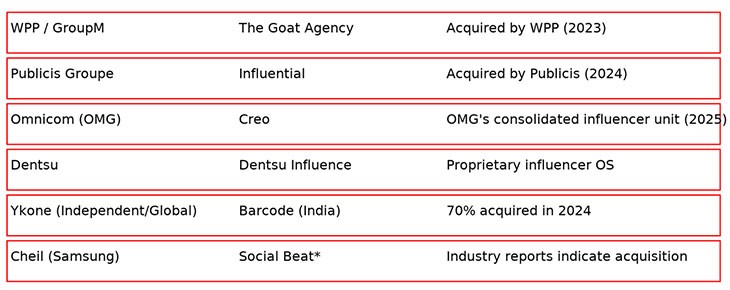
In the last three years, major global network agencies have aggressively expanded their influence in India’s booming influencer marketing (IM) industry. WPP acquired The Goat Agency in March 2023. Publicis took over AI-powered platform Influential in July 2024. Omnicom Media Group consolidated its creator-facing divisions under a new unit called Creo in April 2025. Dentsu strengthened its in-house model through Dentsu Influence.
Independent players have also grown aggressively. Ykone reinforced its India presence after acquiring stakes in Barcode in 2024. Industry experts say these moves mark a shift from influencer marketing being an experimental vertical to a core revenue driver for agencies.
The Numbers Behind the Boom
India’s influencer marketing sector is far larger than commonly cited estimates of ₹3,000–₹4,000 crore.
According to KlugKlug CEO Kalyan Kumar, actual spending has crossed ₹10,000 crore, driven largely by long-tail creators and direct brand deals outside conventional tracking. More than 20 agencies individually generate over ₹20 crore annually from influencer campaigns, yet these visible agencies represent only a fraction of the total ecosystem. Nearly 75 percent of spending occurs outside organised channels—through direct brand-creator relationships, internal brand teams, and long-tail deployments.
Beauty, fashion, and apparel brands alone spend upwards of ₹20 crore annually through in-house influencer teams. When earned media value is included, the sector grows further, with multipliers ranging from 1.8–2.5x for beauty and personal care to 5–7x for home and kitchen brands. Founder-driven campaigns, barter deals, and community-led content expand the market but often remain invisible to traditional tracking.
Two Parallel Agency Worlds Emerge
Harikrishnan Pillai, Founder & CEO of TheSmallBigIdea (TSBI), said, the company is expanding into digital-first content featuring cricketers, TV stars, and film talent. TSBI plans to produce a slate of original projects aimed at engaging audiences across India and the Middle East. The company is also opening the door for brand partnerships, offering opportunities ranging from co-branded content to fully integrated campaigns, allowing brands to connect with fans through premium, high-impact storytelling.
Kunal Ghosh, DGM-Strategy, Cheil SWA Group India, whose parent company recently acquired Social Beat (IM agency), explained that the ecosystem has split into two layers. “Some agencies are dominating influencer marketing for rising creators. Big creators like Bhuvan Bam do not need agencies anymore. They run like full businesses,” he said.
He added that newer creators require structured representation. “It works like old-school celebrity management. Niche creators, such as tech influencers, are largely handled by specialised agencies operating like small ecosystems.”
“Traditional creative and media agencies continue doing what they do best. Influencer-management agencies continue doing what they do best,” Ghosh said. Both arms, he explained, are necessary because they solve different problems for brands.
Agencies Provide Intelligence, Not Just Reach
Influencer marketing has moved from simple exchange to data-led intelligence. Suraj Nedungadi, AVP Strategy at YAAP, said, “What was once a simple process of selecting the largest creators has evolved into a sophisticated, data-led media economy. Agencies track niche communities, emerging formats, platform signals, pricing intelligence, fraud risks, and creator lifecycle trends.”
Internal brand teams often concentrate spends on a few familiar creators. Agencies, however, operate at scale and bring relevance to campaigns. “The value is no longer just in reach but in relevance. Agencies invest in influencer divisions because they see the ecosystem at scale,” Nedungadi said.
At YAAP, influencer intelligence was built from the start. “Our full-fledged influencer team tracks cross-category benchmarks, pricing, fraud, platform innovations, and creator lifecycle trends. That broad view has allowed us to deliver some of the largest campaigns in India and the Middle East.”
Nedungadi added, “Agencies offer what internal teams cannot: pattern recognition, tech infrastructure, and early detection of platform inflection points. The most effective organisations blend the two. Brands set direction and tone; agencies translate that into insights, creative pathways, and engineered outcomes at scale.”
Digital Ad Boom Drives Influencer Marketing
The rise of influencer marketing aligns with India’s digital advertising growth. The Indian advertising industry grew 6.3 percent in 2024 to ₹1,01,084 crore. Digital accounted for 49 percent of total spends and is projected to exceed 61 percent by 2026. Online video, social media, and search are major drivers, and digital advertising is growing at a 19 percent CAGR, expected to reach ₹69,856 crore by 2026.
Influencer marketing followed the same growth trajectory. EY and Collective Artists Network estimate the category reached ₹2,344 crore in 2024 and is projected to touch ₹3,375 crore by 2026.
Brands Build Their Own Teams
Another trend is brands creating internal influencer teams. Yash Lakhanee, Head of Influencer Marketing at Schbang, said, “Earlier, all influencer activations were handled by agencies. Now, big FMCG and cosmetic brands are saving costs and recruiting professionals internally to execute campaigns.”
This shift has significantly reduced campaign timelines. FMCG campaigns that previously took four weeks via agencies are now completed 25–30 percent faster. Cosmetic campaigns, such as Navratri promotions, have turnaround improvements of 25–35 percent. Even in BFSI, campaigns requiring compliance checks are now executed 15–25 percent faster.
“In-house teams work closely with product and creative departments, ensuring faster alignment on influencer content, brand aesthetics, and seasonal marketing calendars,” Lakhanee added.
Pressure on Creators
For creators, these shifts have added complexity. Lifestyle creator Bhavna Jaiswal, with 70K followers, said, “The ecosystem has become complicated and sometimes unfair. Agencies often charge extra commissions even after direct approvals. Brands invite hundreds of creators and not everyone turns up, so they gatekeep who gets paid.”
She highlighted low payments, excessive edits, last-minute additions, and payment delays of up to three months. “Many creators have to chase brands and agencies for months. There should be fixed rates and fair rules. Many current policies work against creators,” she said.
For Some Brands, Nothing Has Changed
Even before “influencer marketing” became a term, FMCG brands were already running creator-led campaigns. Ajay Gupta, founder and MD of Capital Foods, said, “We have been doing this for 14 years. Influencer marketing is a myth if there is no product fit. Earlier, two people managed social media. Now teams have scaled as social media has scaled.”
The goal has always been education and engagement—for example, teaching housewives to cook with desi Chinese ingredients. “Influencer marketing is simply scaled word-of-mouth,” Gupta said, noting that P&G and other FMCG giants used similar approaches long before the term existed.
Influencer campaigns deliver measurable results. Brand attribute recognition rises 10 percent versus 7 percent for traditional digital campaigns, and purchase intent increases 7 percent versus 6 percent. In India’s mobile-first ecosystem, influencer content retains attention longer and drives trust, the most important factor for Gen Z.
With actual spending far exceeding conventional estimates and network agencies consolidating their influencer divisions, the market is now dominated by both established agencies and emerging specialised players. Brands building internal teams and agencies expanding acquisition arms show the competitive intensity of the market.
Read more news about Influence Zone, Marketing, PR and Corporate Communication, Internet Advertising, People Movement
For more updates, be socially connected with us onInstagram, LinkedIn, Twitter, Facebook, YouTube & Google News
