94% of audio streams in the market happen on mobile devices: Arjun Kolady, Spotify
Spotify India’s sales head explains how India’s lo-fi, calm and spirituality listening habits are reshaping advertisers’ creative and mobile-first strategies
 by
by
Published: Dec 23, 2025 10:00 AM | 7 min read
 Follow Us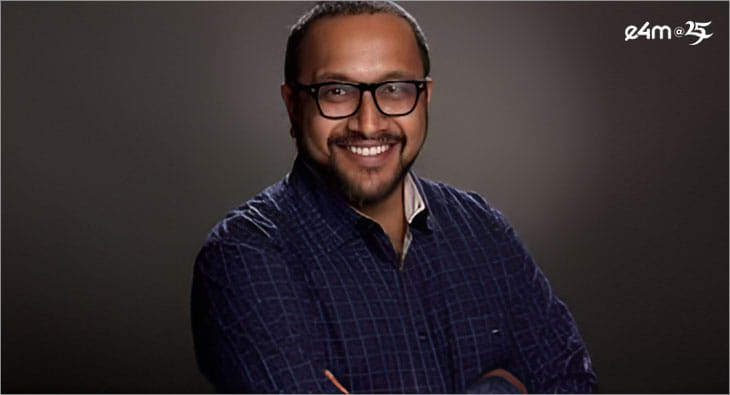

Spotify’s annual Wrapped, released earlier this month, offers insights into listening patterns that are relevant for brands. As Indian advertisers close their 2025 books and plan for 2026, the insights emerging from Wrapped for Advertisers are revealing listening behaviours that demand a fundamental shift in how brands approach audio advertising in the market.
In an exclusive interview with e4m, Arjun Kolady, Head of Sales at Spotify India, notes that the latest Wrapped data shows advertisers that Indian listeners aren't just consuming audio, they're curating it with remarkable intentionality.
"Listeners in India are nearly 3x more likely to stream soul music, 50% more likely to choose folk, and 10x more likely to listen to lo-fi compared to global averages," Kolady explains. "They are also 173% more likely to stream relaxation music and 151% more likely to listen to 'calm' playlists. This is pushing brands to move away from high-decibel advertising and instead create messaging that fits naturally into calmer, more immersive listening moments."
For brands accustomed to high-decibel campaigns designed to break through the clutter, this presents both a challenge and an opportunity. The data suggests that Indian listeners are gravitating toward audio experiences that complement rather than interrupt their daily rhythms. This shift is already influencing how advertisers think about messaging, pushing them away from aggressive, attention-grabbing tactics toward creative that fits naturally into calmer, more immersive listening moments.
"Wrapped for Advertisers is giving Indian brands a very clear playbook for 2026," Kolady explains. "The latest Spotify data shows that listening behaviour in India is deeply intentional, and advertisers are already using these insights to shape both creative tone and media choices."
"Spotify Wrapped 2025 data is also highlighting how podcasts are being used in India," Kolady notes. "Listeners are 163% more likely to stream education podcasts and 427% more likely to stream spirituality content versus global benchmarks. For advertisers, this positions podcasts as high-attention environments where informative, purpose-led and value-driven messaging performs better than traditional spot ads."
The implication is clear: the standard 30-second interruption model that works on radio or video platforms may need significant adaptation for an audience that's choosing podcasts precisely because they offer something more substantive.
Mobile-first India demands contextual thinking
Perhaps the most actionable insight from Wrapped for Advertisers is the sheer dominance of mobile listening in India. According to Spotify's data, 94% of streams in the market happen on mobile devices, nearly 10% above the global average. This isn't just a device preference; it's a signal about when, where, and how Indians are consuming audio throughout their day.
The mobile-first reality is leading brands to fundamentally rethink their approach to audio advertising. Rather than treating Spotify as a lean-back, at-home listening experience, advertisers are increasingly designing for on-the-go moments: the morning commute, the gym session, the lunch break, the evening walk. Each of these contexts demands different creative approaches, different messaging hierarchies, and different calls to action.
"From a media planning perspective, the mobile story is impossible to ignore," Kolady says. "94% of streams in India happen on mobile, nearly 10% above the global average, which is leading brands to prioritize mobile-first formats and contextual delivery designed for everyday, on-the-go moments."
"What stands out in India is not just the growth of Spotify, but the depth of engagement, especially among influential audiences, where Spotify has become a part of their daily routine," Kolady explains. "In fact, 81% of High Net Worth Individuals in India use Spotify daily, which is a strong signal of habit and loyalty. What's more interesting is when they choose Spotify. During self-care moments, 47% turn to Spotify, nearly 2x more than social or video platforms. That makes audio the preferred medium when listeners are most relaxed and emotionally open."
The HNI audience's behaviour across different dayparts reveals multiple entry points for brands. They're 72% more likely to choose Spotify while working out compared to other apps, and 69% listen while commuting, 1.27 times higher than competing platforms. For advertisers targeting premium audiences, this cross-moment presence offers something increasingly rare: the ability to reach the same high-value consumers across different emotional and functional contexts throughout a single day.
Wrapped insights driving full-funnel planning
As the boundaries between music, podcasts, and short-form content blur, Wrapped data is helping advertisers understand Spotify's role across the entire marketing funnel. Trust becomes a crucial differentiator, particularly among younger audiences.
"In India, 82% of Gen Z see Spotify as an antidote to doom-scrolling, and 78% say they trust Spotify with their personal data more than other apps," Kolady notes. "That level of trust is critical at the top of the funnel, where brands are trying to build salience and credibility, not just visibility."
"In an increasingly crowded OTT landscape, Spotify's strongest differentiator for advertisers in India is the quality and depth of engagement we deliver, not just more impressions, but truly incremental reach with one of the country's most premium, intent-driven audiences," Kolady says. "Indian listeners spend 7.8x more time per visit on Spotify than on Instagram, which speaks to something very different from passive scrolling. When people open Spotify, they're tuning in, not skipping, not swiping. It's quality time, not just screen time, and that creates a uniquely powerful space for brands to tell stories."
The sustained engagement that defines Spotify sessions creates space for different kinds of brand storytelling. "Heading into 2026, Indian advertisers will increasingly use Wrapped not just as a cultural moment, but as a strategic input, using first-party insights to inform creative direction, contextual placement and full-funnel planning across music, podcasts and creator-led formats on Spotify," Kolady observes.
This combination of premium audience reach and sustained engagement creates what Kolady describes as a rare opportunity in today's fragmented media landscape. "That combination of premium audience with deep engagement is what sets Spotify apart," he notes. "It gives advertisers a chance to reach people in a mindset that's focused, receptive, and emotionally connected – something that's increasingly hard to find in today's fragmented media environment."
"We're building a new model for how brands and creators work together in India through a mix of innovative ad formats and high-energy live events like I-Pop Icons Live, Rap91 LIVE, and RADAR," Kolady says. "These moments bring emerging talent and highly engaged young audiences together, giving brands a chance to show up in ways that feel native, premium, and culturally relevant across audio, video, display, and interactive formats."
Brands including KitKat, Allen Solly, Max Urban, OnePlus, and Asian Paints have already leveraged these opportunities to move beyond traditional advertising into co-created content and event-led activations.
Trust becomes a crucial factor in how Wrapped insights translate into campaign effectiveness. "Engagement reinforces this further," he adds. "Users in India spend 7.8x more time per visit on Spotify than on Instagram, which tells us Spotify isn't a background platform, it's an immersive one. This creates space for longer-form storytelling, contextual messaging and sustained brand presence across both music and podcasts, rather than fleeting exposure."
As the lines between music, podcasts, and short-form content continue to blur, Spotify's integration across connected devices, from cars to wearables to smart speakers, allows brands to maintain consistent touchpoints across different contexts and stages of the consumer journey. The listener who encounters a brand during their morning commute can hear it again during their evening workout and once more while unwinding before bed, each time in a context that aligns with the messaging and the moment.
"As we look into 2026 and beyond, the formats gaining traction are those that blend seamlessly into these experiences, audio-first storytelling, podcast integrations and context-led placements that respect the listener's journey," Kolady explains.
Read more news about Industry Briefing, Internet Advertising, Marketing, PR & Corporate Communication, Television Media
For more updates, be socially connected with us onInstagram, LinkedIn, Twitter, Facebook YouTube & Google News