Prasoon Joshi explains why vulnerability, not certainty, is advertising’s strength
At AAAI Lifetime Achievement Award ceremony, Joshi delivered a deeply personal address on creativity, confusion, and the power of imperfection
 by
by
Published: Dec 22, 2025 4:37 PM | 9 min read
 Follow Us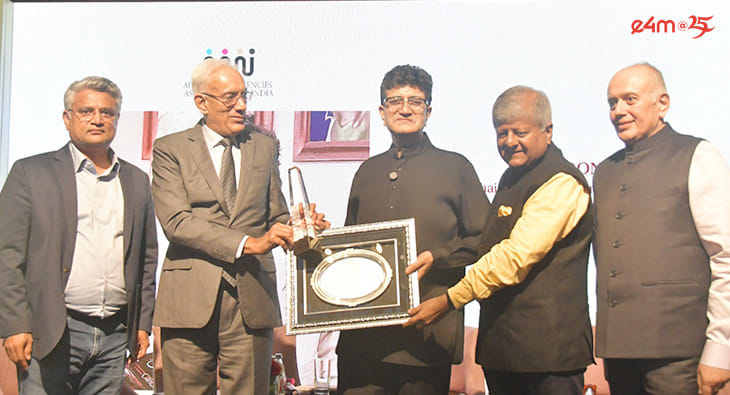

When Prasoon Joshi took the stage to receive the AAAI Lifetime Achievement Award for 2025, the advertising industry expected a career retrospective. What they received instead was something far more profound: an intimate exploration of vulnerability as advertising's greatest strength, delivered by one of India's most celebrated creative minds.
The December 19 ceremony at Mumbai brought together advertising's elite and marketing leaders from brands including Air India, ITC, Perfetti Van Melle, Reckitt, and Dabur. But the evening transcended a typical industry celebration when Joshi began not with gratitude, but with grief. "People we lost this year, first Piyush Pandey, and I deeply miss him today, and God bless him where he is. We also lost Ram Sehgal, and we also lost Neil French," Joshi said, his voice laden with emotion. This opening set an unusual tone that would define the entire address.
It was characteristic of Joshi's approach: leading with humanity rather than professional polish. His family sat in the audience, a rarity he acknowledged. "My wife, my support system, someone who has always been bearing the brunt of being with me," he said with affectionate candor, alongside his two sisters, daughter fresh from London studies despite jet lag, and other family members.
Joshi, currently CEO and CCO of McCann Worldgroup India and Chairman, Asia Pacific, deployed a striking metaphor for his journey: "I am such a rolling stone, which has reached here rolling from the mountains of Uttarakhand, and I have been scratched by those thugs, I have been scratched by those experiences."
Those "thugs" and "experiences" shaped a creative philosophy rooted in the tension between opposing forces. Born to a civil servant father who valued order and an artist mother who sought effervescence, Joshi found advertising to be the perfect synthesis. "My father wanted an order for me. My mother wanted effervescence for me. And I tell you, I found advertising," he explained, crediting a Philip Kotler chapter during his MBA for this revelation.
The metaphor deepened as he described his inability to rebel against loving parents. "I can't take my guitar out and go out and say, I will prove them wrong. Who is there to prove wrong? They are for you. So, I had to manifest both of them."
Then came the evening's most provocative assertion, one that challenged advertising's increasingly data-driven, performance-obsessed culture. "We are all kind of drifters in this profession,” he said. “We came here by searching and searching. We are fundamentally very, very vulnerable people. When a creative person tells you a story, be patient, be kind. Because that person is exposing something very personal to you. That person has taken something from his own life and dared to bring it out as a short story form in front of you."
He continued with even greater force: "If we become well-rounded as a profession, clients will stop coming to us. Because they are well-rounded. We are vulnerable. And that's how it works. And vulnerability is what connects with the consumer."
This wasn't mere sentiment. It was a strategic philosophy honed over decades of work across major brands: Coca-Cola, Nestle, ITC, Dabur, Britannia, and Perfetti. Hemant Malik of ITC, speaking at the ceremony, credited Joshi with building the Aashirvaad brand from naming and packaging to brand world and communication, noting it is now India's number one atta brand worth nearly Rs 10,000 crores in consumer spend.
The vulnerability Joshi described isn't a weakness. It's the courage to expose one's inner life in the service of connection. It's what transforms a television commercial into "Tu Dhoop Hai" from Taare Zameen Par, or a radio spot into "Har Ek Friend Zaroori Hota Hai" for Airtel. Equally unconventional was Joshi's defense of confusion—that uncomfortable space most professionals rush to exit. "I feel confusion is very good. I feel confusion is the space where you get ideas. The most fertility is in the time of confusion. Confusion is the liminal space where ideas reside. Finality kills creativity. Confusion has potential. And that's the time we have to stay with confusion," he said.
This philosophy explained his notorious habit of providing multiple creative options. A practice that frustrated some colleagues but consistently yielded breakthrough work. "Whenever I work with the creative team, I say, stay here. There will be another route. There will be another thing. We might be confused, but that's where the ideas are."
He used a musical metaphor to explain the productive tension: "Jab sitar jo hai usko bhi toh kasna hi padta hai, tension toh hota hi hai (even the sitar needs to be tightened, there is always tension). Over-tension will break the wire, less tension will make it limp but the right amount of tension will create music."
Joshi's address became a cascade of gratitude, revealing the collaborative nature of creative genius. He traced his evolution from trainee at Trikaya Grey under Freddie and Naveed, where Sandeep Goyal was his manager and Nakul Chopra a senior colleague, to his transformative years at Ogilvy.
"Suresh Malik is the one I owe a lot," Joshi said with deep feeling. "He told me that listen, all these things you hum and sing, these things are your strength. You can brief music directors with this. You know the raag, why don't you use it?"
The late Piyush Pandey taught him the "economics of writing,” making copy pithy and concise. Neil French, conversely, argued that long copy wasn't dead. "I had these two people talking contrarian, but I think immensely powerful, learnt a lot," Joshi reflected, illustrating how creative excellence emerges from navigating opposing philosophies rather than choosing sides.
He remembered Satti Chandran, an elderly language expert at Ogilvy who "adopted me like a son" and mentored him through early confusions. He spoke of filmmaker Ram Madhvani with particular warmth: "There are very few Rams you know. He can outshine himself. Every time I see him, he has broken the mold and a different Ram in front of you."
The list expanded to include directors Dadu, Pradeep Sarkar (deceased), Sujit Sarkar, Prasoon Pandey, Vinil Mathew, and Rajiv Menon. Musicians BTR Rahman, Shankar Mahadevan, Ehsan Loi, Shantanu Moitra, and the underappreciated Vaidyanathan. Colleagues at McCann, including Santosh Desai, Ashish Chakravorty, Pradyumna Chauhan, and many others. Each name carried weight, each acknowledgment a reminder that creativity is never solitary.
Central to Joshi's philosophy is understanding India as "a very continuous civilization" where ideas don't need to be imposed but awakened. "People have experienced all kinds of thoughts in this country. They might be lying latent, but they have existed here. So rather than being condescending and descending upon people and saying that is the thought, is the thought already there? It's just that it's not been dialed up."
He articulated a crucial distinction: "There is a difference between challenging people and saying you don't know, you should think like that, then saying that you know, but you have forgotten. There is a different approach. I feel that striking that chord can make a big difference."
This cultural sensitivity—this respect for what already lives in the collective consciousness—has allowed Joshi to create advertising that enters the national lexicon while building brands. It's the difference between creating culture and writing culture, between manipulation and resonance.
Joshi also shared hard-won wisdom about brands in crisis, having navigated Coca-Cola's pesticide controversy and Nestle's Maggi crisis. "Your real test is in the time of crisis," he said. "The brands at that time, how transparent they have to be, how confident, honest they have to be."
During the Maggi crisis, his advice was simple but profound: remind the nation you're a hundred-year-old company, and talk to mothers who feel they've betrayed their children. "The transparency, that hundred-year commitment, together we communicated. It was a multi-pronged approach. And that's the time we realized that real partnership comes to test at these times."
"I have a little love for and weakness for murmur brands, what I call murmur brands is those who have less or are starting or are not very big. I feel that in the sound of drum you can't hear the flute. And if the sound of drum is there then to hear the flute you have to create an environment to hear the flute."
The metaphor was characteristically poetic: major brands are drums, their advertising loud and unavoidable. Smaller brands are flutes; delicate, requiring silence and attention to be heard. "To hear the flute, you have to sit in the corner of the hill and hear the flute because in the sound of the drum, you can't hear the flute."
Joshi concluded with verses from his work on Satyamev Jayate and favorites from poet Dushyant Kumar, each line celebrating possibility against improbability. The recurring refrain: "Mumkin hai" (It is possible).
He recited in Hindi: "Kaun kahta hai aasmaan mein chhed nahi ho sakta, ek patthar toh tabiyat se uchalo yaaron (Who says there can't be a hole in the sky, at least pick up a stone with conviction, friends)."
Another verse captured his philosophy perfectly: "Beechon beech haatheli ke ek narangi angara rakhna, rooh talak phir sulakte jaana, mumkin hai (Holding an orange ember in the middle of your palm, letting it burn through to your soul, it is possible)."
The metaphor was unmistakable: great advertising requires accepting the pain of vulnerability, the burning coal of exposed humanity, the courage to stay with discomfort until it transforms into connection.
Established in 1988, the AAAI Lifetime Achievement Award recognizes individuals who have contributed significantly to Indian advertising through sustained creative leadership. Past recipients include legends like Subhas Ghosal, Alyque Padamsee, Piyush Pandey, Sam Balsara, and Ramesh Narayan.
But as the applause faded and Joshi's words lingered, it was clear this ceremony had transcended a typical industry celebration. The hall wasn't just applauding a portfolio of successful campaigns; it was acknowledging a philosophy that centers humanity in an increasingly mechanized profession.
In an era of metrics, algorithms, and optimization, Joshi offered a countervailing truth: that advertising's greatest power lies not in data or technology, but in the vulnerable, confused, deeply human act of one person trying to connect with another.
"I would not like to be born as a creator," he said near the end. "I want to be born as a creation. That oneness, one degree of separation from my creation, I don't like. I would like to be my own creation." It was a fitting aspiration from someone who has spent his career not just making advertising, but becoming it; a living embodiment of the vulnerable, searching, profoundly human art that moves millions without losing its soul.
Read more news about Internet Advertising India, Marketing News, PR and Corporate Communication News, Digital Media News, Television Media News
For more updates, be socially connected with us onInstagram, LinkedIn, Twitter, Facebook YouTube & Google News
