#e4mExclusive: We refuse to let India become a passive consumer of foreign AI tools: Dr Sandeep Goyal
Dr. Sandeep Goyal, Chairman of Rediffusion, speaks exclusively to e4m about the AI Association of India’s positioning as an architect, his take on ‘ethical AI’ and more’
 by
by
Published: Nov 24, 2025 9:13 AM | 6 min read
 Follow Us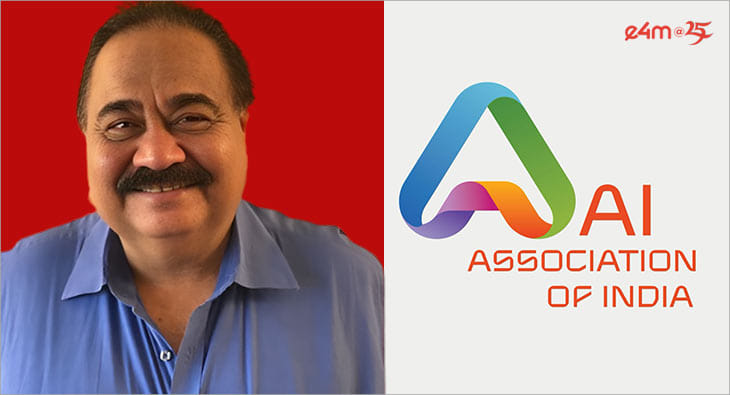

India’s AI revolution has outpaced its institutional armour and the country’s creative, cultural and policy ecosystems are feeling the tremors. In response, some of India’s most influential industry leaders have come together to launch the AI Association of India (AIAI), a first-of-its-kind forum that aims to define India’s ethical, cultural and regulatory guardrails for artificial intelligence.
Spearheaded by Dr. Sandeep Goyal, Chairman of Rediffusion and one of the most seasoned voices in India’s media and tech landscape, AIAI is positioning itself not as a watchdog, but as an architect.
In this interview he explains the rationale behind the formation of AIAI.
Excerpts:
India’s AI ecosystem is expanding faster than its regulatory guardrails. What was the core gap or threat you and fellow industry leaders identified that made the creation of AIAI an urgent priority?
We saw the writing on the wall.While India is rapidly adopting generative AI, from courtroom arguments written by bots to Bollywood scripts massaged by machine learning, the frameworks to guide, protect or even calibrate this momentum are largely absent. The core gap wasn’t innovation, it was institutional trust and ethical scaffolding.
AIAI was born out of a very specific threat: that India, the world’s largest creative democracy, would inadvertently become a passive consumer of foreign AI tools, unable to define its own cultural, ethical and legal redlines. We fear the weaponization of deepfakes, the vanishing of artistic credit and a deluge of black-box tools flooding our markets without accountability.
So, we have stepped in not as alarmists, but as architects. AIAI is our response to the urgent need for a nationally rooted, industry-led body that marries innovation with sovereignty.
AIAI positions itself at the intersection of innovation and ethics. What does “ethical AI” tangibly mean for India today, and how does the forum plan to translate that into enforceable or adoptable standards?
“Ethical AI” in India today means three things: Cultural alignment, ensuring AI systems do not erase or misrepresent India’s diversity.
- Transparency and attribution – especially in creative outputs, where originality, consent, and authorship are key.
- Inclusion by design, so our AI tools serve everyone, not just the digitally elite. At AIAI, we are going to build a standards framework that will do the following:
- Certify AI tools for ethical compliance in media, design, advertising, and music.
- Create open datasets that reflect India’s linguistic, regional, and artistic nuance.
- Develop audit guidelines for bias, provenance, and IP integrity.
Importantly, we are not doing this in isolation, we are going to be co-developing these with startups, legal scholars, cultural institutions and government bodies so they can be adopted, not just admired.
As National Convenor, how do you envision AIAI becoming a credible voice in policy-making, not just another industry association, but a body that the government meaningfully consults on AI regulation?
The soon-to-be-announced Governing Board of AIAI will have some of India's top captains of industry, cultural experts, technology leaders and more.
Credibility isn’t claimed, it’s earned through work that precedes regulation.
Our goal is not to become an echo chamber of industry jargon. Instead, AIAI is positioning itself as India’s “first-mover forum”—publishing actionable policy briefs, developing draft guidelines, and piloting ethics charters before the government needs to.
Already, we are starting to build bridges with MeitY, NITI Aayog and the Ministry of I&B. But unlike traditional lobbies, we bring something unique: creative industry insight fused with technical depth. We understand how AI affects India’s 5 million creative professionals: writers, directors, designers, influencers—not just coders and CTOs.
AIAI’s vision is to be the policy lab India turns to when innovation needs grounding, and governance needs pace.
India faces unique AI challenges around data sovereignty, cultural bias, IP protection and workforce disruption. Which of these will AIAI address first, and why?
We are tackling IP protection in creative work as our first strategic priority.
Why? Because it’s the frontline battleground. Generative AI is already being used in ad campaigns, screenplays, social media filters, and fashion prototypes—often without attribution, consent, or traceability. If we don’t address this now, we risk eroding not just jobs, but identity.
We are actively working on:
- Establishing a Creative AI Attribution Protocol
- Supporting legal frameworks around AI-generated content ownership
- Guiding creators on how to license, watermark, or protect their work
Once this foundation is secure, we’ll expand to data sovereignty and inclusion—because without control over our datasets, even our ethics can be outsourced.
How will AIAI build trust among startups, big enterprises, creators and policymakers, groups that often approach AI with conflicting expectations and anxieties?
Trust is not a byproduct, it’s a design goal of AIAI.
We are structuring the association as a collaborative architecture, not a top-down bureaucracy. Every working group, whether on policy, research, skilling or ethics, will include at least:
- A startup founder
- A big tech representative
- A creative professional
- A legal/policy expert
This multi-stakeholder model ensures no single worldview dominates the narrative.
We also plan to launch the AIAI Trust Index, a first-of-its-kind framework to assess how AI tools score across transparency, fairness, and compliance for Indian users. Over time, this will become a reputational currency that companies and creators value.
Given the pace of AI evolution, traditional regulatory cycles may already be too slow. What dynamic, adaptive mechanisms is AIAI planning to introduce to keep its guidance relevant in real time?
You are right—the old rhythm of regulation won’t survive the AI age.
That’s why AIAI is building what we call “living frameworks”, modular, editable, and version-controlled policy blueprints updated quarterly through expert consultation.
Key mechanisms include:
- A Real-Time Ethics Sandbox: where startups can test AI tools and receive feedback from AIAI on ethical, cultural, and legal blind spots.
- An AI Incident Registry: to track and respond to misuse or bias in public-facing creative AI tools in India.
- Flash Panels: agile, 48-hour expert groups to draft guidance on emerging threats (like deepfakes in elections, or synthetic influencers).
This way, AIAI can stay ahead of the curve—not chasing headlines, but shaping how India writes the next chapter of its AI journey.
Read more news about Digital Media, Internet Advertising, Marketing News, Television Media, Radio Media
For more updates, be socially connected with us onInstagram, LinkedIn, Twitter, Facebook, YouTube & Google News