Marketers bet big on AI & ML to drive efficiency and personalisation
At the e4m Real-Time Programmatic Advertising Conference, industry leaders from BFSI, FMCG, and digital sectors highlighted how AI drives personalization, compliance, and outcome-focused campaigns
 by
by
Published: Sep 22, 2025 8:45 AM | 4 min read
 Follow Us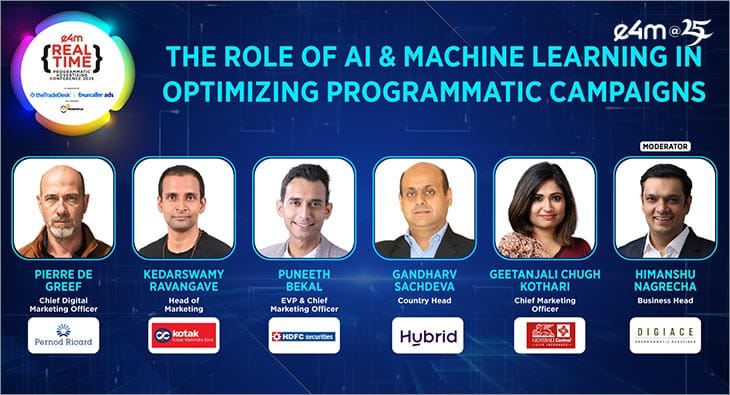

At the e4m Real-Time Programmatic Advertising Conference, an elite panel of marketing leaders gathered to deliberate on “The Role of AI & Machine Learning in Optimizing Programmatic Campaigns.” The discussion, moderated by Himanshu Nagrecha, Business Head, Digiace, featured Pierre de Greef, Chief Digital Marketing Officer, Pernod Ricard India; Kedarswamy Ravangave, Head of Marketing, Kotak Mahindra Bank; Puneeth Bekal, EVP & Chief Marketing Officer, HDFC Securities; Geetanjali Chugh Kothari, Chief Marketing Officer, Generali Central; and Gandharv Sachdeva, Country Head, Hybrid.
The session opened with the crucial question, 'are AI and ML mere buzzwords or real tools driving transformation?' Panelists were quick to dismiss the “buzzword” tag, emphasizing how deeply integrated these technologies already are in marketing functions. Kothari pointed out that artificial intelligence is not new; for the past two years, hyper-personalization has been a part of her arsenal, allowing insurance, a complicated BFSI category, to streamline one-on-one client interactions. Sachdeva added that AI ensures sharper bidding strategies, stronger targeting, and more effective message delivery, all of which help brands reach the right audience at the right time.
Bekal noted a paradigm shift in marketers’ time and focus. “I don’t remember the last time I spent significant hours with my creative agency,” he admitted, pointing out how AI partnerships and tech collaborations now dominate the function. He described efforts to build an internal nudge engine and voice-enabled agentic AI to enhance acquisition and monetization. Ravangave divided the effects of AI into three phases: automation, augmentation, and acceleration. He said that the true magic happens in acceleration, where hyper-personalized content and multi-agent workflows coordinate not only media but also results. De Greef emphasized efficiency, consumer insights, and creative agility. AI, he said, allows Pernod Ricard to compress campaign production timelines from ten days to five minutes while also unlocking real-time consumer feedback loops.
Moving from theory to practice, the panel shared case studies. Kothari described AI-led video avatars in customer engagement campaigns, which boosted renewals by 15% in insurance policies, while also helping launch an AI-powered advisory website. Sachdeva explained how Hybrid deploys image-recognition AI to scan 15,000 objects within articles, enabling ads to be placed contextually, which drove engagement rates far higher than industry benchmarks.
Bekal showcased how HDFC Securities uses AI to transform dense research reports into snackable infographics and avatar-led video explainers for retail customers. Ravangave highlighted Kotak’s Solitaire program for affluent customers, where AI reduced content creation timelines drastically and produced over one lakh hyper-personalized video messages dynamically generated from CRM data. De Greef pointed to Pernod Ricard’s Sunburn festival campaign, where influencer content was enhanced in real time through AI video-to-video tools, resulting in a 13x higher view-through rate compared to benchmarks.
Regulation emerged as another key theme. De Greef underlined that in highly regulated categories like alcohol, AI plays a vital role in compliance by using machine learning to analyze past campaigns across multiple touchpoints to predict and safeguard future messaging. “We will not compromise on relevance or compliance,” he stated, noting that Pernod Ricard will never expose messages without 100% certainty of age appropriateness. Ravangave and Bekal echoed that regulations in BFSI are not constraints but opportunities, with AI creating watertight flows that protect consumer data and reinforce trust. Kothari emphasized that compliance with data privacy norms is not optional but central to consumer trust, extending far beyond BFSI into e-commerce and other industries.
On how AI optimizes client KPIs, Sachdeva said the technology is helping CTRs climb from 0.5% to over 2%, thanks to better targeting and messaging relevance. The broader consensus was that AI helps marketers move from impressions to meaningful engagement and outcomes.
Looking to the future, the panel was unanimous that AI will expand beyond campaigns to reshape entire organizations. Kothari noted its role in governance, talent acquisition, and salesforce monitoring, while Bekal foresaw a fundamental shift from buying audiences to building relationships, and from optimizing inputs to orchestrating outcomes. Ravangave argued that semi-autonomous systems will be the next big leap, while De Greef concluded with a striking fact: consumers today engage with visual content for an average of just 5.1 seconds, making AI indispensable in securing that fleeting attention span.
There was broad agreement at the end of the discussion that AI and ML are essential to rethinking efficiency, compliance, personalization, and customer interaction across industries and are no longer experimental or futuristic. They are not just catchphrases; rather, they are influencing the structure of marketing strategy and implementation.
Read more news about Digital Media, Internet Advertising, Marketing News, Television Media, Radio Media
For more updates, be socially connected with us onInstagram, LinkedIn, Twitter, Facebook, YouTube & Google News