'Auto as a category needs large canvases'
Speaking during a fireside chat with Dhruv Dhawan at the e4m Real-Time Programmatic Advertising Conference, Amrit Baid shared insights on advertising strategies and evolving consumer behaviour
 by
by
Published: Sep 20, 2025 8:25 AM | 4 min read
 Follow Us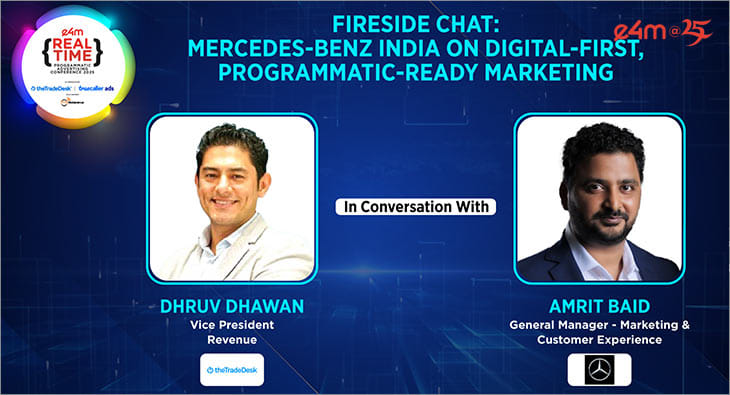

Mercedes-Benz India is gearing up for significant growth following the recent GST relief measures, with the luxury automaker expecting substantial consumer benefits when new rates take effect from 22 September, according to Amrit Baid, General Manager - Marketing and Customer Experience at Mercedes-Benz India.
Speaking during a fireside chat with Dhruv Dhawan, VP of Revenue at The Trade Desk, at the e4m Real Time Programmatic Advertising Conference 2025 in Mumbai, Baid revealed that the company achieved record sales of 20,000 vehicles last year and expects similar performance this year, despite macroeconomic challenges.
The new GST structure will provide direct benefits to luxury car buyers, with duties reduced from an average of 48 percent (28 percent GST plus 20 percent cess) to a flat 40 percent. "If you go out and buy a ₹50 lakh car, you would after 22 September save roughly ₹3 lakhs on it, and if you go upwards of ₹4-5 crores, you'd save a hefty ₹25-30 lakh rupees on a purchase," Baid explained during the interactive session.
Read On: Amrit Baid: Driving Marketing Excellence At Mercedes-Benz India
However, the executive cautioned that currency fluctuations have posed challenges. "The Euro is right now at 100-102, which has jumped almost 10 percent this year alone, and what we are doing is we're trying to absorb most of it but pass on a little bit back to the consumer," he said.
Addressing questions about potential benefits from an India-EU Free Trade Agreement, Baid clarified that immediate price reductions shouldn't be expected. "If there's an FTA, India-EU FTA and people start thinking that car prices will come down or German car prices will come down substantially, it's not going to happen," he stated.
Instead, he emphasized the importance of local manufacturing scale. "Right now we sell 20,000. If you have to really manufacture in India, I think the minimum viable would be upwards of 80,000 to 100,000 cars."
The company already localizes several components in India. "All the glass that is on the E-Class, whether it's a windshield or the mirrors or any other windows, all of them are made in India," Baid noted.
Discussing evolving consumer preferences at the Mumbai conference, Baid highlighted a significant shift toward experience-driven purchases. "Five years back, if I had to sell a car, I would say buy a car and I would take you on a paddock pass of a Formula One race. Today the consumer is experienced first and he wants to experience first and the product is secondary."
This change is reflected in the company's track experience programs. "We did a track experience where every track slot was ₹1 lakh and we had 84 slots all sold out in 45 minutes," he revealed, demonstrating strong demand for premium experiences.
On digital marketing strategies, Baid emphasized the importance of large-format advertising for luxury automobiles while acknowledging the shift toward programmatic approaches. "Auto as a category needs large canvases. Still a Times of India front page is a Times of India front page, and that's something that we need because I want to show the car in all its glory."
However, he noted a fundamental change in media planning: "Today the media buying is no longer platform-first, it is maybe DSP-first, it is audience-first. It is who can give me that audience in the right way and then where can the audience be targeted."
For Mercedes-Benz's targeted approach, precision is crucial. "To sell 20,000 cars, I need to reach 200,000 people at a 10 percent conversion ratio. Getting those 200,000 more effectively and not targeting 5 million is the work."
Take A Look: ‘Dream Days’ Campaign From Mercedes-Benz India
Discussing artificial intelligence applications during the fireside chat, Baid shared insights about Mercedes-Benz's R&D operations in India, which employs approximately 10,000 engineers working on AI-enhanced consumer experiences.
"Now, everybody would have seen dash cams in cars, but today's cars are also coming with a small camera on the hood of the car," he explained, describing AI-powered safety features. "The AI layer, when added to that camera, is instrumental for safety because it can detect if you are wearing a seat belt or not, if your driving position is okay, and give signals back to the car."
Despite global uncertainties, Baid expressed optimism about the Indian luxury automotive market during the conference session. "We define the luxury landscape of India, and that's true in several ways," he said, noting that post-COVID consumer behavior continues to favor experience-driven purchases.
The executive concluded by emphasizing Mercedes-Benz's commitment to the Indian market through both local manufacturing initiatives and enhanced customer experiences, positioning the brand to capitalize on the growing premium automotive segment.
The e4m Real Time Programmatic Advertising Conference 2025 brought together industry leaders to discuss the evolving landscape of digital advertising and marketing strategies in the Indian market.
Read more news about Marketing News, Advertising News, PR and Corporate Communication News, Digital News, People Movement News
For more updates, be socially connected with us onInstagram, LinkedIn, Twitter, Facebook, YouTube & Google News