There’s a need for privacy-compliant, federated data sharing: Ashwin Padmanabhan
Ashwin Padmanabhan, Chief Operating Officer of WPP Media, spoke at the e4m Real-Time Programmatic Advertising Conference on how AI has been reshaping campaign strategy, execution & optimisation
 by
by
Published: Sep 19, 2025 9:22 AM | 3 min read
 Follow Us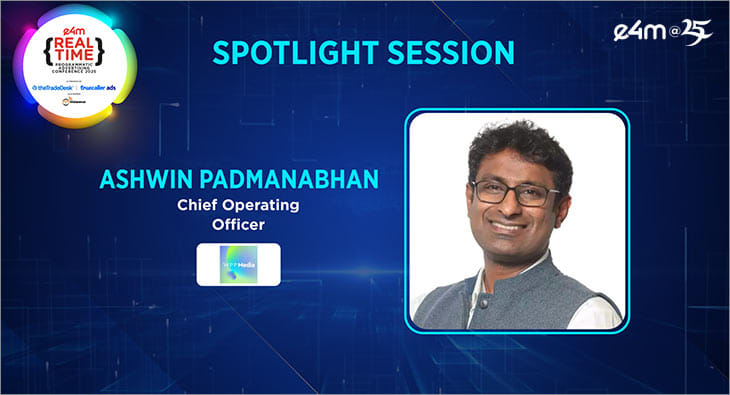

Programmatic advertising, which started gaining traction around 2010, has now become mainstream. Today, AI has emerged as the core driver of programmatic operations, transforming how campaigns are planned, executed, and optimized. WPP Media aims to lead this evolution with its proprietary Large Marketing Model (LMM) and Open Intelligence platform.
Speaking at the e4m Real-Time Programmatic Advertising Conference and Awards, Ashwin Padmanabhan, Chief Operating Officer of WPP Media, introduced us to its Large Marketing Model and elaborated on how AI is reshaping campaign strategy, execution, and optimisation, while tackling traditional challenges such as data silos, scale, and privacy concerns.
“The goal of our LMM is to unify fragmented data, automate labor-intensive processes, and enable real-time, personalised campaign activation—all while ensuring data privacy,” he said.
Check out the winners of the e4m Real-Time Programmatic Advertising Awards
During the session he explained that AI is enabling agencies to automate tasks that were traditionally labor-intensive. “Whether it’s scaling content development, adapting creative ideas into multiple languages, or producing numerous versions for different audience segments, AI allows us to do it efficiently and at scale,” he noted. This automation frees creative teams to focus on higher-level strategy and campaign planning rather than routine execution.
Padmanabhan also highlighted the limitations of traditional programmatic approaches. Historically, matching audience data across advertisers, retailers, and platforms was time-consuming, inefficient, and fraught with privacy concerns. “In a world where AI is allowed, we now have the opportunity to do things differently,” he said, pointing to the need for privacy-compliant, federated data sharing that enables real-time insights and campaign activation without physically exchanging sensitive data.
WPP’s Large Marketing Model and Open Intelligence platform, combines first-party data from brands, campaign learnings, and partner data in a clean-room environment to generate synthetic audiences. At its core, the model is designed to unify fragmented data sources, enabling a single, holistic view of audiences while maintaining strict data security.
It allows marketers to derive actionable insights from disparate datasets, automate labour-intensive campaign processes, and execute highly personalised creative at scale. The platform also supports real-time testing and optimisation, adapting creatives, messaging, and media placements dynamically based on audience response. By integrating AI-driven analytics, federated data sharing, and predictive modelling, the model not only improves targeting accuracy but also reduces wastage in media spend.
By creating a unified programmatic stack, it allows brands to access insights and activate campaigns across platforms without being locked into a single ecosystem.
In practice, the model works by ingesting first-party data from brands, learnings from past campaigns, and anonymised partner data into the clean-room environment. AI then analyses trillions of signals to build synthetic audiences, which can be targeted in real time with personalised creatives. Campaign performance is continuously monitored, tested, and optimised, enabling a feedback loop that refines audience targeting, messaging, and delivery automatically.
Padmanabhan emphasised that this approach enables brands to reach audiences more effectively and efficiently. By integrating AI, federated data, and real-time activation, WPP Media aims to create a neutral, unified programmatic environment, reducing dependency on walled gardens and legacy platform silos.
Read more news about Digital Media, Internet Advertising, Marketing News, Television Media, Radio Media
For more updates, be socially connected with us onInstagram, LinkedIn, Twitter, Facebook, YouTube & Google News