‘AI solves for the how and what is what humans have to define’
Industry experts discussed the use of AI in depth, uncovering how it can transform strategy into impact in an unpredictable media landscape at the e4m Confluence The Media Investments Summit 2024
 by
by
Published: Nov 12, 2024 12:13 PM | 4 min read
 Follow Us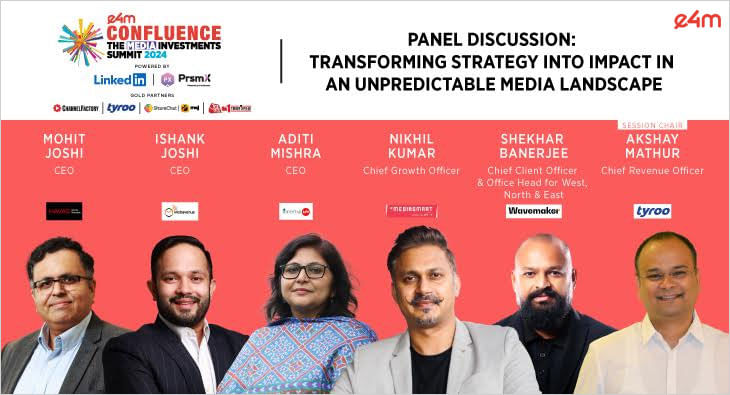

At the e4m Confluence The Media Investments Summit 2024, a panel of industry experts discussed the use of AI in depth, uncovering how it can transform strategy into impact in an unpredictable media landscape.
Akshay Mathur, Tyroo's Chief Revenue Officer, moderated the session. The panel included Mohit Joshi, CEO of Havas Media Network India; Ishank Joshi, CEO of Mobavenue; Aditi Mishra, CEO of Lodestar UM; Nikhil Kumar, Chief Growth Officer of mediasmart; and Shekhar Banerjee, Chief Client Officer and office Head for West, North, and East Wavemaker.
Mohit Joshi, CEO, Havas Media Network India talked about the importance of getting educated on the use potential and implications of AI. “We found a very smart tool and we are trying to implement it everywhere. That’s not how it will work! We have to find a tool as per the client’s requirements and then take the solution to the client,” he added, explaining that it’s important to find strategic areas where AI can really work for the client and the agency. “It has to be meaningful AI for the client, the agency and whoever is engaging with that AI,” he added.
Ishank Joshi, CEO of Mobavenue, took the conversation further, saying, “As a platform, you need to be AI-enabled, but for the clients, it’s AI-assisted.” He also spoke about the importance of building autonomous AI agents and the larger AI infrastructure to support the talent and the clients in taking it to the next level.
“If you are feeding GenAI the right data then it can give you really meaningful insights,” said Aditi Mishra, CEO, Lodestar UM. She added, “Moving forward, AI will always be something that’s assistive. I don’t see AI replacing the merging of your creativity with data. If you allow AI to take over, all plans will eventually look the same.”
Nikhil Kumar, Chief Growth Officer, mediasmart said, “When it comes to realising the importance of advertising context in AI, I think it’s not a fad. There’s a lot more depth to it when it comes to coding and the science of it.” Further, he explained, “AI solves for the ‘how’ and ‘what’ is what humans have to define,” adding that eventually you will get to the part of the question, ‘How much is enough?’
“At this point, we don’t see AI playing any strategic role. What it does is a lot of assistance work,” said Shekhar Banerjee, Chief Client Officer & Office Head for West, North & East Wavemaker. He explained, “When we look at AI in our system, we see it solving 3 problems for us. AI as creative support, AI for large data processing and AI for process optimization.”
On a lighter note, the panel delved into how AI tools need a lot of human assistance.
“I think it’s just about allowing human beings to be faster, better. You could use a cycle to move faster but it won’t solve a strategic issue,” said Mishra, to simplify the understanding around the use of AI today.
Banerjee took that thread further with: “If you want to solve the traffic woes of Mumbai, AI can at max do the route optimization for you. It will not solve the traffic issue.” Kumar added to the conversation: “Strategy is a function of what input you are giving to the AI algorithm.”
The panel then touched upon the importance of developing AI that would allow advertisers to create campaigns across languages without missing out on the cultural and linguistic nuances.
The conversation also touched upon the balance between creativity and execution when it comes to the use of ads for driving sales. AI is helping bring teams together to solve problems, explained Kumar. Joshi added, “It’s all about convergence,” explaining that all teams today have resources to create and not just execute. He explained how the teams at Swiggy and Havas work together collaboratively to create and execute campaigns faster in real-time.
The panel concluded with a conversation on the ethical aspects of using AI. Mishra shared a perspective from the operations at Lodestar UM. “There is a high level of training on what data should you collect, for how long the data can be stored and where, when should the data be destroyed and if you want the data to be carried forward, is there an option to reach out to the consumer once again to get that acceptance. There is also a fair amount of training on spam testing.” Joshi added a perspective that large companies today are making it a practice to use aggregated data to train LLM models instead of their first-party data.
Read more news about Digital Media, Internet Advertising, Marketing News, Television Media, Radio Media
For more updates, be socially connected with us onInstagram, LinkedIn, Twitter, Facebook, YouTube & Google News
