TV advertising contracts 5% in 2025: PMAR
Pitch Madison Advertising Report 2026 shows structural shifts across categories, signalling a more selective and premium future for television
 by
by
Published: Feb 24, 2026 5:11 PM | 3 min read
 Follow Us

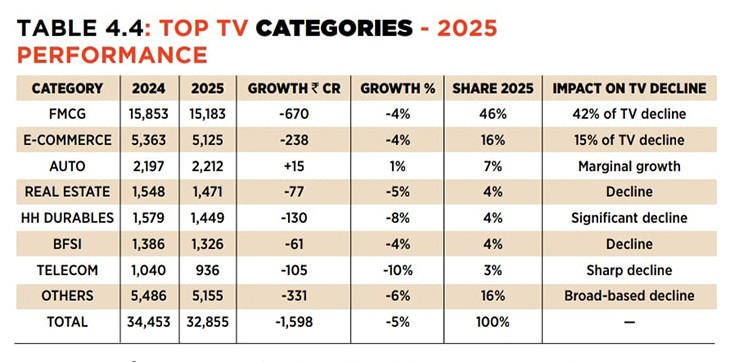
India’s television advertising market closed 2025 with a clear contraction, but the story beneath the topline numbers is far more nuanced. According to the Pitch Madison Advertising Report 2026, total TV AdEx declined 5% year on year, falling from ₹34,453 crore in 2024 to ₹32,855 crore in 2025. The absolute drop stood at ₹1,598 crore.
The decline was broad based. FMCG, which remains the backbone of television with a 46% share in 2025, saw spends fall from ₹15,853 crore to ₹15,183 crore, a drop of ₹670 crore or 4%. Significantly, FMCG alone accounted for 42% of the overall TV decline. E-commerce, the second largest category with a 16% share, declined 4% as well, slipping from ₹5,363 crore to ₹5,125 crore, contributing 15% to the overall fall.
Auto stood out as the only major category to register growth. Spending rose marginally from ₹2,197 crore to ₹2,212 crore, up 1%, translating into a ₹15 crore increase and a 7% share of total TV advertising. All other key sectors recorded declines. Real estate fell 5% to ₹1,471 crore. HHI durables dropped 8% to ₹1,449 crore, marking one of the sharper contractions. BFSI was down 4% at ₹1,326 crore. Telecom saw the steepest fall among major categories, down 10% to ₹936 crore. The Others category declined 6% to ₹5,155 crore, reflecting what the report describes as a structural and broad-based slowdown rather than a cyclical blip confined to a handful of sectors.
Yet, amid falling volumes, a paradox emerges. TV volumes crashed 10%, but Large Screen grew around 4%. The report frames this as premiumisation in action. Fewer impressions, higher value, better targeting and tighter integration with digital systems are reshaping the medium.
The strategic role of Large Screen in 2026 is being redefined. It is no longer positioned as a blanket mass reach vehicle. Instead, it is described as a high impact, high attention canvas deployed when stakes justify the cost. Linear television is best used around premium genres such as sports, premium GEC and key FTA properties, and in high intensity bursts rather than as a 52 week continuity vehicle.
Connected TV plays a complementary role, delivering affluent and digitally savvy households with better measurability and deeper integration into wider digital journeys. The optimal mix is category specific. FMCG and Auto are expected to lean on LTV sports and tent poles for mass impact. Digital first brands and BFSI may weigh more heavily towards CTV and targeted premium content. Regional brands are advised to leverage regional impact properties and FTA reach engines.
For TV heavy advertisers, particularly FMCG, the prescription is sharp. Tighten TV to its most productive uses such as launches, new variants and major brand events. Focus on a limited set of high ROI properties. Shift low yield continuity spends into performance centric digital, retail media and data rich CTV environments.
Digital first advertisers are encouraged to treat Large Screen as a powerful second step rather than a prerequisite. It can be layered onto established digital systems, deployed selectively via sports and tentpoles, and used to create cultural impact and trust.
The common thread is selectivity. Advertisers who continue to treat TV as a default year round GRP machine may struggle to justify ROI. Those who approach Large Screen as a precision impact tool and integrate it tightly with digital are likely to extract greater value from every rupee invested.
To download the full Pitch Madison Advertising Report (PMAR) 2026, click on this link: https://e4mevents.com/pitch-madison-advertising-report-2026/download-report
Read more news about Internet Advertising India, Marketing News, PR and Corporate Communication News, Digital Media News, Television Media News
For more updates, be socially connected with us onInstagram, LinkedIn, Twitter, Facebook YouTube & Google News
