Hall of Ads: When men tucked in their bellies and advertising changed forever
From elevator moments to anniversary blunders, how Imperial Blue’s ‘Men Will Be Men’ became Indian advertising's most enduring campaign over 25 years
 by
by
Published: Jan 26, 2026 10:00 AM | 5 min read
 Follow Us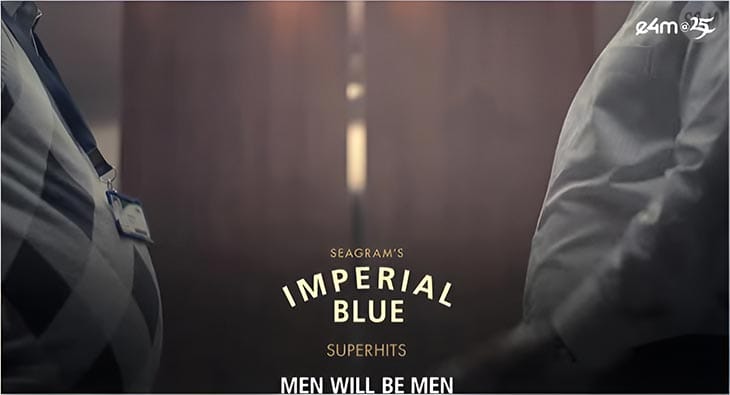

In 1997, when Pernod Ricard launched Imperial Blue in the Indian whisky market, nobody could have predicted that a simple tagline would become one of the most recognizable phrases in Indian advertising history. The "Men Will Be Men" campaign didn't just sell superhit music CDs; it carved out a unique space in the country's creative consciousness, one witty 20-second spot at a time.
The campaign's genius lay in its brutal honesty about everyday male behavior. It took moments that men recognized instantly: the stomach-sucking-in-when-an-attractive-woman-walks-by moment, the pretending-to-like-classical-music-on-a-date moment, and turned them into laugh-out-loud advertising gold. This wasn't aspirational advertising that promised you'd become more successful or attractive. This was advertising that said, we see you exactly as you are, and that's perfectly fine.
https://youtu.be/wE8AsupuJAI?si=18jx4yEamCG1n78s
Ajay Gahlaut, the creative force behind Imperial Blue's early campaigns during his tenure at Ogilvy, understood something fundamental about Indian men in the late 1990s. The whisky market was dominated by themes of success, achievement, and masculine bravado. Imperial Blue needed to stand apart in the lower-premium segment, and Gahlaut's insight was simple yet powerful: men wanted to unwind and be themselves after a hard day's work.
"Pyaar ki raah mein chalna seekh, ishq ki chaah mein jalna seekh," the two-line ghazal Gahlaut penned, sung by Mangal Mishra, became as iconic as the ads themselves. So much so that viewers constantly searched for the full version online, never realizing it was always meant to be just those two poignant lines.
The partnership between Ogilvy and Pernod Ricard began in 1996 with Royal Stag, but Imperial Blue became the crown jewel of their collaboration. The first "Men Will Be Men" ad aired in 2000, two years after the whisky's launch, and the campaign has been running successfully for over two decades now. According to industry estimates compiled by Pitch Madison, the whisky category in India has grown at approximately 7-8% annually over the past decade, with Imperial Blue holding its position as one of the largest whisky brands globally by volume. This success is inextricably linked to the consistency and recall value of the campaign's creative work.
Among the 17-odd films in the series, one stands out for capturing the campaign's essence perfectly: the elevator ad featuring Disha Patani. In this 20-second masterclass, two formally-dressed men stand in a lift with an attractive young woman, their stomachs visibly tucked in, their postures impeccable. The moment she exits, they exhale in relief, letting their bellies hang out again. It's devastatingly simple, universally relatable, and genuinely funny without being crude.
Disha Patani, who was still a relatively unknown face before her Bollywood debut, brought an effortless charm to the role. The ad worked because it didn't rely on dialogue or complicated setups. The visual storytelling was pure, the insight razor-sharp. Men don't just recognize this behavior, as they've lived it. That's what makes the ad iconic: it holds up a mirror to everyday vanity with such gentle humor that nobody feels attacked; instead, they laugh at themselves.
What truly elevated Imperial Blue's work was Ogilvy's discipline in maintaining brand consistency while finding fresh situations. From the anniversary ad where a husband frantically bargains for "5 carats, princess cut" after forgetting his anniversary, to the store ad where husbands eye each other's wives, to the bike ad and the gym ad. Each execution brought a new situation, but the same underlying truth about male behavior. The campaign never felt repetitive because life never runs out of these moments.
YouTube Link - https://youtu.be/RId_UXL3rI8?si=Vx8WT4PT4qKnrM-O
Creating surrogate advertising for alcohol brands in India presents unique challenges. After the Cable Television Network (Regulation) Amendment Bill in 2000 banned direct alcohol advertising, brands had to become more creative. Imperial Blue's music CD proposition became the perfect vehicle. It was legitimate enough to pass regulatory muster, transparent enough that everyone understood what was really being advertised.
But the campaign's longevity also owes much to its evolution. When Ritu Sharda, Chief Creative Officer at Ogilvy North, took over the brand's creative leadership after Gahlaut's move to Publicis in 2019, there were understandable concerns. Could a woman lead a campaign built on understanding male psychology? Sharda's response was characteristically sharp. "A woman knows exactly how a man would think," she said, adding that she drew from observations of men in her own life. The 2020 "Heartbeat" ad, featuring a hospitalized man whose pulse quickens when touched by a female doctor, proved she understood the assignment perfectly.
https://youtu.be/MGrjU_VcO5E?si=qUJOyDGwi3WgPP2W
The brand hasn't just survived; it's thrived. Imperial Blue won the Monde Selection Gold Award for product quality in 2018, combining creative excellence with product credibility. The campaign also represents a masterclass in brand-building through consistency. While other brands chased trends and changed creative directions every few years, Imperial Blue stayed true to its positioning.
That discipline created a brand property so strong that simply hearing the ghazal's first notes triggers instant recognition. In Ogilvy parlance, they achieved the holy grail: you can't miss this series as anything other than Imperial Blue.
Read more news about Internet Advertising India, Marketing News, PR and Corporate Communication News, Digital Media News, Television Media News
For more updates, be socially connected with us onInstagram, LinkedIn, Twitter, Facebook YouTube & Google News