Ads fuel one-third of eComm giants’ earnings
The advertising revenues of Amazon and Flipkart have outpaced their overall marketplace growth, reveal financial reports
 by
by
Published: Oct 7, 2025 8:50 AM | 6 min read
 Follow Us

Advertising has transitioned from a supplementary income stream to a core revenue pillar for major Indian e-commerce players, now driving roughly one-third of their earnings. Amazon India and Flipkart are leading this transformation, with ad revenues surging over the past five years, underscoring retail media’s growing dominance within India’s digital advertising ecosystem.
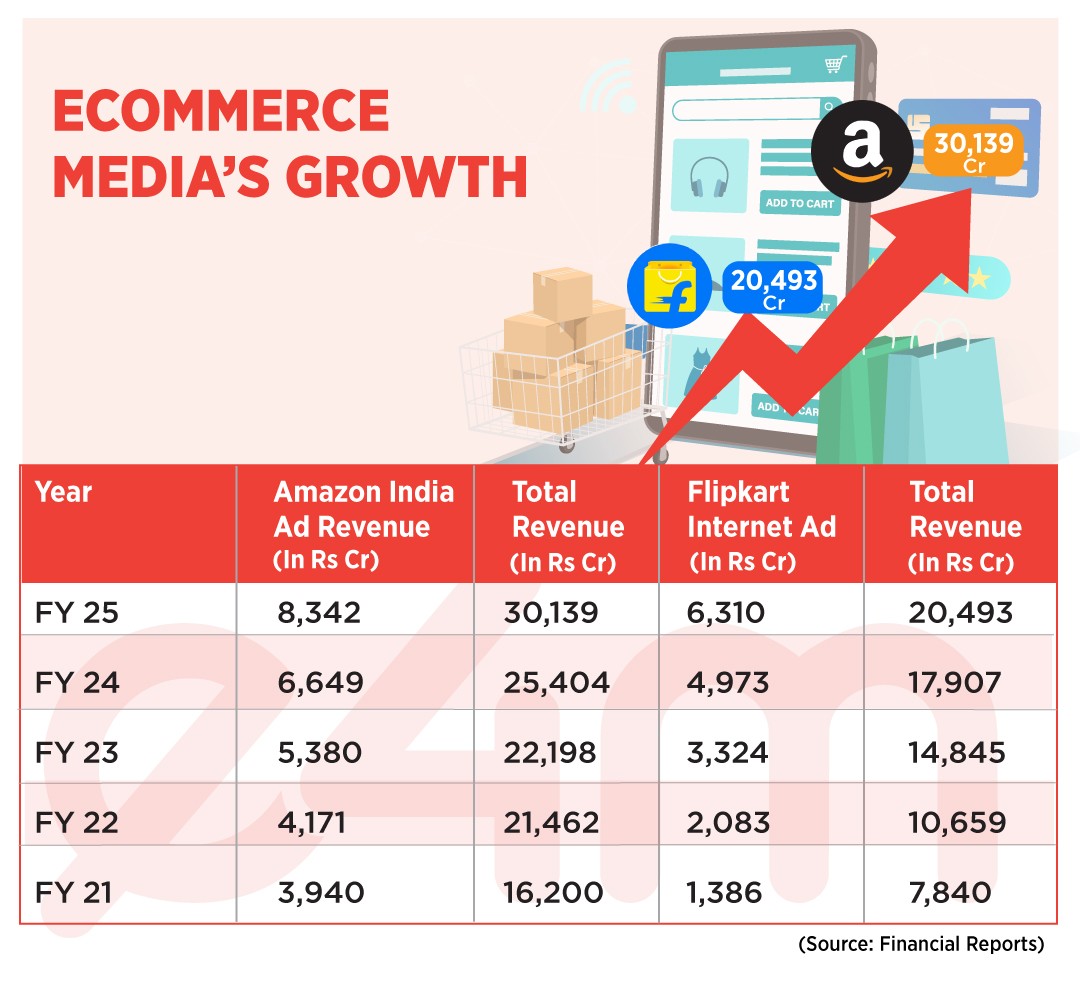
In FY25, advertising accounted for 28% of Amazon India’s total revenue and 31% of Flipkart’s, highlighting the strategic significance of retail media in their business models, according to RoC filings compiled by business intelligence platform Tofler. Together, they command nearly ₹15,500 crore (around $2 billion) in ad revenues, cementing retail media as the third pillar of digital advertising in India after search and social media.
Over the past five years, advertising revenue for Amazon and Flipkart has outpaced their overall marketplace growth, underscoring how retail media has evolved from a supplementary line item into a strategic growth engine and a core pillar of their business models.
Read more on retail media AdEx
Amazon’s advertising revenue surged from ₹3,940 crore in FY21 to ₹8,342 crore in FY25, a 110% increase, while total revenue grew about 86% from ₹16,200 crore to ₹30,139 crore. Flipkart’s ad revenue grew even more sharply, from ₹1,386 crore in FY21 to ₹6,310 crore in FY25—a rise of over 350%—while total revenue increased roughly 161% from ₹7,840 crore to ₹20,493 crore.
Read e4m reports on:
With deep integration of ads into the shopping journey, scale, reach, and measurability, these platforms have become indispensable for brands, making retail media the beating heart of India’s digital advertising economy. Etailers get ad revenues along with a margin on the sale also—a double benefit vis-à-vis Google and Facebook, which only make money through advertising.
“Retail media represents an ancillary outcome of the primary operations of an e-commerce platform. In the course of their core activities, the e-commerce business generates valuable data, which serves as the foundational asset for any advertising enterprise. The resulting advertising revenue subsequently provides an incremental benefit to the profit and loss statement,” says Sajal Gupta, CEO of Kioas Marketing, explaining the rise of retail media around the world.
Read e4m Deep Dive on eCommerce festive ad spends
E-commerce media has evolved from being purely performance-led to becoming a brand-building platform. Advertisers are investing across the shopper journey - not just at checkout - using sponsored listings, video ads, and contextual placements to drive visibility and influence, says Vaibhav Jain, Head of Media, First Economy.
Globally, retail media ad spend is projected to reach $125 billion by 2025, and India is growing in parallel as platforms expand their ad-tech and attribution capabilities, he noted.
Fintech to D2C
“FMCG, beauty, and electronics continue to lead, drawn by retail media’s precision targeting and measurable ROI. With first-party data at its core, the model offers accountability unmatched by many digital channels”, Jain shares.
Beyond FMCG, beauty, and electronics, sectors like fintech, mobility, home décor, wellness, and D2C brands are investing heavily on e-comm, say experts.
“These categories now view e-commerce media not just as a conversion tool but as a discovery and trust-building channel. Financial services, in particular, are using retail media for verified, intent-led targeting. The advertiser mix has broadened significantly - from category-specific to cross-industry - signalling that e-commerce platforms have evolved into mature ad ecosystems serving both product and service-based brands,” Jain noted.
Echoing the sentiments, Nimesh Shah, Head Maven, Windchimes Communications, said: “There has been an increasing trend of ad monies moving away from pure play social media platforms to e-commerce and more so quick commerce platforms. It has been led by two factors. Firstly, brands believe that they are closer to their customers and that makes it easier and cheaper to convert their surfing into shopping. Secondly, due to several online festivals, the sheer time spent by users on these sites is increasing day by day, thereby generating more opportunities to reach out to them.”
Experts believe the advertisers’ shift towards e-tailers will deepen this year, driven by renewed consumer enthusiasm following the recent GST reduction.
Meanwhile, quick commerce platforms are also emerging as powerful media channels. Zepto crossed ₹1,000 crore in annual ad revenue, Blinkit pulled in over ₹400 crore in FY25 and is expected to soon enter the four-digit crore range. Together with Swiggy Instamart and Dunzo, the sector is estimated to have generated close to ₹4,000 crore in FY25.
Innovative formats
Retail media is especially attractive because it reaches consumers at the moment of intent. Unlike social or video platforms, which largely drive awareness or recall, retail media influences purchase decisions within seconds.
According to Jain, formats like shoppable video, live commerce, and dynamic product ads are transforming how consumers discover and purchase in real time. AI and machine learning are powering predictive targeting, personalisation, and instant optimisation. Besides, recipe-led content, and gamified offers—are also making these platforms sticky for users and advertisers alike, says a marketer.
Somdutta Singh, serial entrepreneur, Founder and CEO, Assiduus Global, says, “It’s not just about search and sale-time ads anymore. Brands are using videos, display spots, and even ads on streaming platforms to reach more people. And what’s nice is that even smaller and mid-size brands are joining in, especially during big sale events, because they can track how their ads turn into sales right on the platform.”
Sharing similar thoughts, Gupta said, "Ecomm’s latest advertising offering involves expanding inventory beyond on-platform search to include video formats via proprietary platforms such as Prime Video, as well as partnerships with Netflix etc. in select international markets.”
According to him, it is essential for ecommerce businesses to obtain explicit consent for advertising communications within their terms and conditions, given the heightened significance of privacy in the current environment.
Unified measurement?
E-commerce ad revenues are largely performance-driven, measured by clicks or impressions. This accountability appeals to marketers under growing pressure to prove ROI and gives e-tailers a structural edge over Google and Meta.
According to Jain, “Measurement, too, is evolving - brands are prioritising incrementality to gauge true sales impact and adopting unified attribution models that connect online and offline touchpoints. Even in-store digital screens are now linked to e-commerce analytics, enabling a full-funnel view of the shopper journey. Together, these advancements are making retail media both more creative and accountable - a rare blend in the digital landscape.”
However, many experts believe that measuring the effectiveness of e-commerce ads still needs a lot of work.
“Each platform has its own way of counting views, clicks, and returns, so it’s hard to compare results. If there's one simple and common system that everyone follows, brands can understand what’s really working in a much simpler way,” says Singh.
She adds, “Brands also need to look beyond just the last click. They should test and track how ads help at every step before a sale happens. As e-commerce ads spread to video, offsite, and even in-store screens, there has to be one fair way to measure all of it together. Otherwise, everyone keeps seeing a different picture of what success really means.”
Read more news about Internet Advertising India, Marketing News, PR and Corporate Communication News, Digital Media News, Television Media News
For more updates, be socially connected with us onInstagram, LinkedIn, Twitter, Facebook YouTube & Google News