Role of OOH will evolve from awareness-building to commerce-driving: Vinkoo Chakraborty
Speaking at the e4m OOH Conference 2025, Vinkoo Chakraborty, President of Rapport Chrome, said 2024 saw a whopping 52% growth in out-of-home advertising over 2023
 by
by
Published: May 8, 2025 4:05 PM | 4 min read
 Follow Us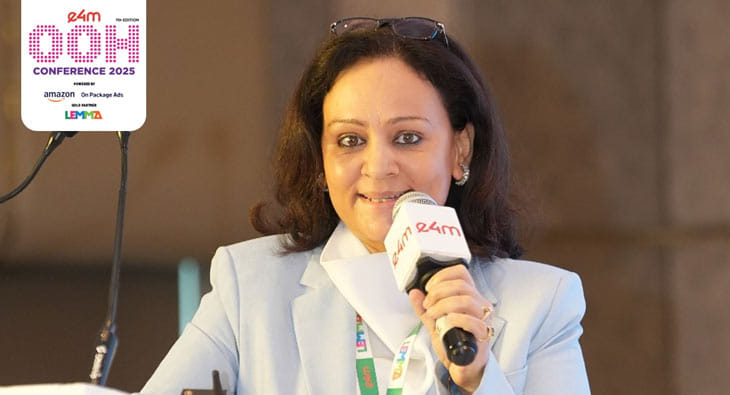

Out-of-home (OOH) advertising in India recorded a sharp 52% growth in 2024 over the previous year, marking one of the most significant expansions for the medium in recent times, according to Vinkoo Chakraborty, President of Rapport Chrome. He said the surge was primarily fuelled by the deep cultural and commercial integration of Indian festivals into consumer marketing strategies.
Speaking at the e4m OOH Conference 2025 during a session titled “Activation and OOH Ads: Brands Making Best Out of Indian Festivals,” Chakraborty emphasized the rising role of festivals as economic engines and their growing impact on OOH and activation strategies.
“The year 2024 saw a whopping 52% growth in out-of-home advertising over 2023. This is not a seasonal spike — this is a structural shift in how brands are leveraging India's cultural calendar to plan and amplify their messaging across touchpoints,” said Chakraborty.
She added that more than 500–600 advertisers were active during the festive season last year, cutting across over 40 product categories — from real estate to FMCG, electronics to BFSI.
These brands, she said, are no longer treating OOH as an ancillary format but as a frontline medium for consumer activation.
Citing historical and economic context, Chakraborty outlined how festivals have evolved into organized consumption cycles rooted in India’s cultural ethos. Each festival, she explained, brings with it a specific set of rituals and consumption behaviour, allowing marketers to plug into hyperlocal demand cycles.
“Every Indian festival is a localized economy in itself. Whether it is Pongal, Eid, Navratri, or Diwali — each of these events generates economic activity across sectors. If you look at Diwali alone, it contributes between ₹2 to ₹4 lakh crore to the economy. That kind of magnitude inevitably reshapes how and where brands invest in media,” she stated.
According to Chakraborty, the total retail sales during the 2024 festive year touched ₹4.25 lakh crore, a 27% increase over 2023. E-commerce made up 26% of this volume, with growth being led by grocery (60%), beauty and personal care, and home merchandise. Despite the rise of digital, the tactile and physical nature of festivals ensures that OOH remains highly relevant.
“Out-of-home today is no longer just about visibility. It’s about presence. It’s in real life, not just URLs. It is a sensory playground — something you can see, touch, and remember. That’s why brands are building larger-than-life activations in community spaces, temples, and market streets,” she explained.
Chakraborty said the playbook for festive OOH now rests on four pillars: sensory storytelling, cultural customization, technology-driven amplification, and predictive planning. From 3D anamorphic creatives and drone light shows to QR-code-based purchase triggers, OOH advertising is no longer static.
“We are seeing high-scale customization of creatives across states. Everything is rooted in tradition — in the rituals, language, and cultural symbolism of that specific festival. At the same time, there is an unprecedented infusion of technology — whether it’s through drones announcing launches or QR codes converting footfall into commerce,” said Chakraborty.
To illustrate this evolution, she showcased interventions during Durga Puja, Kumbh Mela, and Diwali — such as projection mapping on pandals, drone-based launch events, and contextual integrations with digital platforms. One example involved a campaign that turned metro stations into kitchen settings to promote kitchenware brands.
Looking ahead, Chakraborty said the role of OOH will evolve from awareness-building to commerce-driving. As digital public infrastructure expands and consumers seek instant gratification, she expects OOH to increasingly contribute to mid- and lower-funnel marketing outcomes.
“The biggest shift that I foresee is in the role of out-of-home. It will move beyond just creating awareness. It will become instrumental in conversions as well. Because what you see, you now desire, and you want to act on it immediately. That immediacy is where OOH is headed,” she said.
She also noted that the future of OOH planning would become increasingly predictive — powered by AI, machine learning, and blockchain. Campaigns will be optimized not just on impression metrics, but on contextual, seasonal, and community-based signals.
“Sustainability too will no longer be an afterthought or a CSR sidebar. It will be integrated into planning, deployment, material usage, and post-campaign reporting. Everything — from carbon emissions to material waste — will be questioned and optimized,” Chakraborty said.
She concluded by calling on the industry to collaborate in conducting more research on OOH's evolving impact across consumer categories. With over 40 sectors now actively engaging with the format, Chakraborty believes that OOH and activations are poised to claim over 10% share in the overall media mix — a significant jump from current levels.
“If we truly embed culture-first creativity, technology integration, predictive planning, and sustainability into our OOH and activation strategies, I have no doubt that this medium will become a critical pillar for most advertisers. That’s not a distant dream — it’s already unfolding in front of us,” she said.
Read more news about Out of Home, Internet Advertising, Marketing, Digital Media, TV Media
For more updates, be socially connected with us onInstagram, LinkedIn, Twitter, Facebook, YouTube & Google News