HUL vs BECO: FMCG’s billboard tussle boils over
As the case comes up before the Delhi HC today, Beco doubles down with new hoardings built around the controversy
 by
by
Published: Aug 21, 2026 2:23 PM | 4 min read
 Follow Us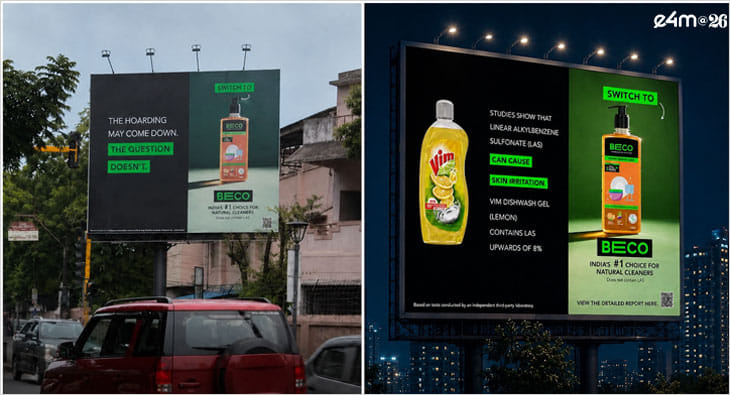

- A legal dispute is ongoing between Mumbai-based D2C brand Beco and Hindustan Unilever (HUL) over Beco's comparative advertising campaign that directly names HUL's products, a rarity in Indian FMCG marketing.
- Beco alleges that its outdoor advertising partners faced pressure to remove its campaign, which it claims highlights the influence larger advertisers can exert on smaller competitors.
- In response to the removal of its hoardings, Beco launched new advertisements that incorporate the controversy, emphasizing its position as "India's #1 choice for natural cleaners."
- The case, which includes allegations of commercial disparagement and trademark infringement by HUL, remains before the Delhi High Court, with no interim injunction granted yet, raising questions about the limits of comparative advertising in India.
A hoarding dispute between a Mumbai D2C brand and India's largest FMCG company is turning into a public test of how far comparative advertising can go, and how a purely local medium like outdoor advertising ends up living a second, much larger life online.
The case, still pending before the Delhi High Court, pits Beco, the home-care and sustainability brand, against Hindustan Unilever, the company behind Surf Excel and Vim. At its centre is a single advertising campaign that named its rivals directly, a rarity in Indian FMCG marketing, and the running battle over hoardings that has followed since.
View this post on Instagram
While the legal proceedings continue, the dispute has played out just as visibly on the street. Beco co-founder Aditya Ruia has alleged that the company's outdoor and digital advertising partners came under pressure to remove the campaign, and that several hoardings were taken down as a result, a claim Beco has framed as evidence of the pressure larger advertisers can exert on smaller rivals, independent of any court order.
“Our claims were backed by testing from NABL-accredited laboratories. The communication was reviewed for compliance. We put our name on every clawim because we were prepared to stand behind it. And then, the hoardings started coming down. Not because of a court order. Not because a regulator asked us to withdraw them. But because, as communicated to us, our outdoor vendors, OTT and digital partners were being pressured by a much larger advertiser with far greater commercial weight. That is what bothers me,” said Ruia on LinkedIn.
Rather than withdraw, Beco replaced the removed hoardings with new creative addressing the removal directly. One hoarding, photographed in Chennai, read: "The hoarding may come down. The question doesn't" placed beside an image of its cleaning product and the claim that Beco is "India's #1 choice for natural cleaners." The effect is to fold the controversy itself into the campaign's messaging, turning a takedown into further material rather than an endpoint.
What makes this episode notable is less the legal question than the way it has travelled. Outdoor advertising is, by design, geographically limited, a hoarding is seen by whoever happens to pass beneath it. But once a hoarding becomes contentious, that limitation stops applying. Within hours of the removals, social media accounts had circulated footage of both the original campaign and Beco's follow-up creative! The matter remains before the Delhi High Court, with no injunction yet in place and no ruling on the underlying disparagement claim.
How it all began
HUL has filed suit against Kwick Living (I) Pvt. Ltd, Beco's parent company, alleging commercial disparagement, trademark infringement and passing off. The complaint centres on Beco's #WarOnWhatsHidden campaign, which compared its laundry and dishwashing liquids to Surf Excel Matic Liquid and Vim Dishwash Gel, citing lab tests that found ingredients such as Benzisothiazolinone (BIT) in Surf Excel and Linear Alkylbenzene Sulfonate (LAS) in both products. The campaign linked these chemicals to skin irritation and allergic reactions.
HUL's counsel, senior advocate Amit Sibal, has not disputed the presence of these ingredients but has challenged the inference drawn from them. His argument is that identifying a chemical in a formulation is not equivalent to proving the finished product causes harm, and that a prescribed safety standard exists for exactly this kind of assessment, one Sibal says Beco did not apply. He has also pointed out that LAS is a common surfactant used broadly across the cleaning products industry for its grease-cutting properties, not an ingredient unique to Vim.
Justice Anup Jairam Bhambhani has so far declined to grant HUL's request for an interim injunction, opting instead to hear Beco's formal response before ruling on whether the campaign should be restrained.
That decision is still pending, and In the meantime, Beco continues to treat each development in the dispute as material for further campaign content, a strategy that has kept the story circulating well beyond the courtroom. Whether the court ultimately restrains the campaign or allows it to continue, the case is likely to be read as a marker for how much latitude Indian advertising law affords D2C brands making direct, evidence-based claims against their competitors.
Read more news about Out of Home, Internet Advertising, Marketing, Digital Media, TV Media
For more updates, be socially connected with us onInstagram, LinkedIn, Twitter, Facebook, YouTube & Google News
