We are focused on reigniting the momentum for print advertising: Rakesh Sharma
Rakesh Sharma, who till recently was President of the Indian Newspaper Society, spoke to e4m on the print industry’s challenges, maintaining its relevance and more
 by
by
Published: Oct 17, 2024 2:40 PM | 4 min read
 Follow Us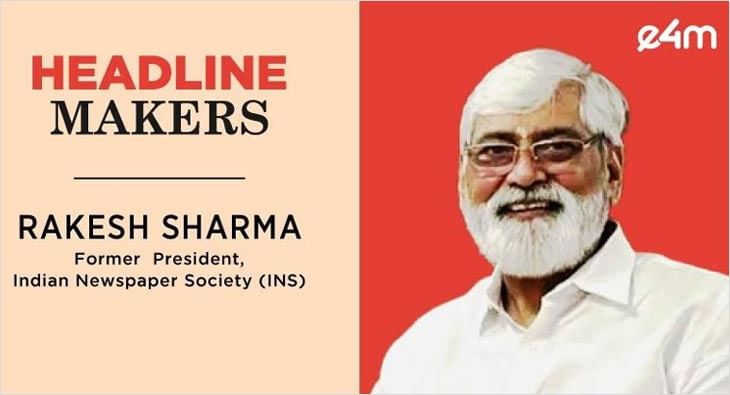

Rakesh Sharma, seasoned journalist and author, recently concluded his one-year term as the President of the Indian Newspaper Society (INS).
During his presidency, Sharma navigated a dynamic landscape for the print industry, balancing the rise of digital platforms and the evolving role of newspapers.
In this interview with e4m, Sharma speaks about his accomplishments, the ongoing challenges facing the industry, and the future of print media.
Excerpts:
What will you call your major achievements as the President of the Indian Newspaper Society?
In my one-year tenure, there were certainly moments of satisfaction, while other areas left room for improvement. One of the most significant achievements was the inauguration of the INS Tower in the Bandra-Kurla Complex in Mumbai, a project realized with the help of our members.
Having Prime Minister Narendra Modi inaugurate the tower was particularly special. Additionally, resolving issues stemming from the Supreme Court's Strictly Truth Promotion (STP) order was another major success. We collaborated with the Ministry of Information and Broadcasting to limit the STP order’s impact on the food industry, thus providing relief for other sectors.
We tackled several issues in cooperation with the Ministry and the Central Bureau of Communication (CBC). A key accomplishment was the amendment of the Audit Bureau of Circulation (ABC) law, which provided much-needed relief to small and medium publishers. We also engaged with the new Information and Broadcasting Minister, who assured us of support in resolving our industry's concerns.
Were there any issues you couldn’t resolve?
Unfortunately, we couldn’t succeed in reducing customs duty to below five per cent, which remains a significant concern. Additionally, the issue of CBC rate revision is still pending despite multiple requests. If this revision happens soon, it would greatly benefit the entire industry.
In the face of growing digital platforms, what steps did INS take to maintain the relevance of print media?
One of our key proposals was to rename INS to the Indian Newspaper and Digital Society. Today, almost every newspaper has a digital counterpart, and it’s essential for the two platforms to complement each other. Our efforts focused on taking both print and digital forward together, ensuring that newspapers remain relevant in this digital-first era.
It’s a misconception that print media advertisements are on the decline. While COVID-19 severely impacted the industry between 2019 and 2022, we’ve seen strong recovery since. We are actively working to restore confidence among advertisers and agencies, with the goal of bringing back the momentum for print advertising.
In your opinion, what challenges will print media face in the coming years, and how should the industry address them?
Challenges are inevitable, but the key to overcoming them is remaining relevant. In the age of digital and television media, the role of newspapers has evolved beyond simply delivering news. We must explain the reasons behind events and their broader impact. For instance, understanding the global economic consequences of the Russia-Ukraine war or the implications of the Israel-Palestine conflict. Print media can offer depth and analysis, something other mediums often lack.
Small and medium newspapers face considerable challenges, particularly due to the rising invitation price and the near extinction of circulation revenue. The lack of advertising further jeopardizes their existence. During my tenure, we worked towards eliminating the discrimination small newspapers face in government advertisements, advocating for fair opportunities.
How can print media differentiate itself by providing deeper analysis and insight to attract a more informed audience, particularly the younger generation?
Technology and digital platforms should not be seen as competitors to print, but rather as complementary forces. By encouraging cooperation and synergy between the two, we can strengthen print media.
In today’s world, print must adapt and evolve alongside digital advancements. The future of print media is promising. With a population of over 1.4 billion, as literacy and awareness increase, so will the demand for well-researched news. To attract the younger generation, newspapers must offer more than quick updates—they should provide in-depth analysis and deeper insights into the issues that shape the world. Digital platforms may deliver speed, but print can provide the nuance and depth that makes news truly valuable. give me a good question for this
What message would you like to convey to the newly appointed INS President?
My successor, M V Shreyams Kumar, is a very capable individual. My only advice to him would be to stay vigilant and continuously provide guidance that safeguards the interests of the industry.
Read more news about Print Media, TV Media, Advertising India, Digital Media, Marketing
For more updates, be socially connected with us onInstagram, LinkedIn, Twitter, Facebook, YouTube & Google News