'India’s journalism crisis': Uday Shankar on what went wrong
Uday Shankar, Co-Founder of Bodhi Tree Systems and Vice Chairman of JioStar, was addressing a gathering of journalists at an event organised by the Editors Guild
 by
by
Published: Mar 28, 2025 11:51 PM | 6 min read
 Follow Us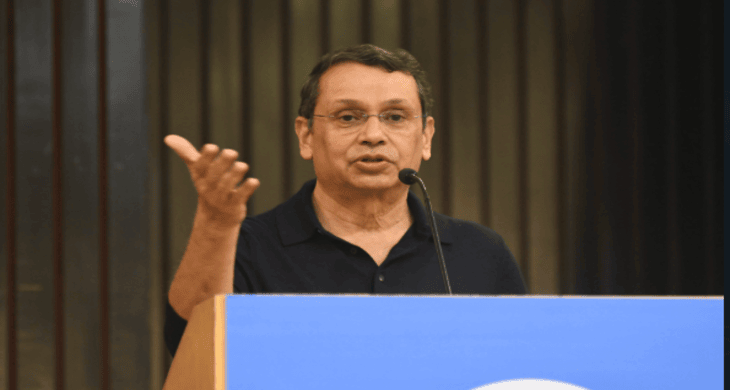

“Journalism as we know it is dead,” said Uday Shankar, Co-Founder of Bodhi Tree Systems and Vice Chairman of JioStar, addressing a gathering of journalists at an event organised by the Editors Guild.
In an unflinching, provocative address that was equal parts eulogy and critique, Shankar took the industry to task, not as an outsider, but as one of its most influential insiders. “I'm not a speaker,” he began. “I'm a practitioner.” And for the next 40 minutes, the veteran media executive laid bare the slow erosion of journalism’s soul and its business.
It wasn’t the politicians or the governments, he said. The rot ran deeper. It was the journalists themselves.
Shankar, once a trainee at The Times of India, reflected on the power journalism used to hold. “There was a time when a journalist’s presence at a press conference could change the tone of the room,” he said, recounting how, as an intern, he was treated with deference by a chief minister merely for showing up with a Times of India card.
“Back then, journalism was the most powerful business of intermediation. You couldn’t be at Lords to watch a match or in Chile during an earthquake, but the journalist could. We were the link.”
Then the world changed and journalism didn’t.
“When Steve Jobs put a camera in every pocket, everyone became a journalist,” he said. “Instead of innovating, journalists started sourcing stories from the same places as their readers, Twitter, Facebook, WhatsApp.” The power of journalism, he said, began to vanish the moment journalists stopped being distinct from the audience they served.
A Crisis of Identity and of Relevance
According to Shankar, the deeper crisis is conceptual. “We kept imagining that we still held the same power, even as the ground shifted beneath our feet,” he said.
He described how newsrooms, once the custodians of editorial judgment, were sidelined by logistics. “The satellite truck, the OB van, became more important than the editor. The anchor’s only job became: ‘Tell me, what is the atmosphere there?’ It was the rise of ‘mahaul’ journalism,” he said.
Shankar recalled the early days of Aaj Tak, where the content led and audience impact was visible, without metrics. “Then came ‘reach.’ Newsrooms started chasing ratings and we began curating news based on what would drive reach, not relevance.”
A large part of the problem, he said, lies in the newsroom’s disdain for business. “Journalists want good salaries but don’t want to talk about how the money comes in. They think monetization is a betrayal.”
He recounted how, when he became CEO, many of his journalist colleagues saw him as a turncoat. “But what’s journalism without a viable business model?” he asked. “We can’t keep pretending someone else will pay the bills.”
According to Shankar, this distance between editorial and economics has been catastrophic. “Advertising became our lifeline. But advertisers don’t care about content, they care about reach.”
The race to please advertisers has eroded trust and led to formulaic, diluted storytelling. “Even the cost of newsprint wasn’t being recovered,” he pointed out. “That’s how cheap we sold our value.”
The Death of Distinction
As all channels began to look and sound the same, brand loyalty disappeared. “Why would anyone pay for content they can get for free, everywhere, all the time?” he asked.
The result? “No one listens to anyone in particular anymore. And journalists are no longer the reason people come to a platform.”
He warned that journalism has lost its uniqueness, and with it, its power. “We’re not indispensable anymore. And the world won’t wait for us to become relevant again.”
Shankar also addressed what he called a “silent crisis of talent.”
“In the '70s and '80s, we got great minds because there were few options. Today, the best go elsewhere and journalism draws what’s left,” he said. “And bad talent attracts worse talent. That’s the rule.”
He added, “We have a 65% young country. But it feels like 65% of newsroom leadership is 65 years old. There’s a refusal to make space for the new — just like Bollywood. And both industries are paying the price.”
In a stinging rebuke to policy, Shankar questioned why foreign direct investment in news media remains prohibited.
“It was a Cabinet resolution from 1948 that blocked FDI in journalism. It still stands. The sectors that opened up have grown. We didn’t. The irony is- editors who championed FDI in every sector refused to allow it in their own.”
The lack of capital, he argued, has stifled innovation. “There’s no money for tech, for talent or for risk. All we do now is cut costs. But you can’t cut your way to greatness.”
The AI Train Is Coming. Are We Ready?
Shankar ended with a warning that could define journalism’s next existential moment: artificial intelligence.
“There’s a train coming. It’s called AI. We either board it or get run over.”
He urged media professionals to stop chasing recycled content and opinion. “We need to design a new paradigm. Because right now, everyone has a point of view. Why should they pay for ours?”
Uday Shankar’s speech was not comforting. It was not diplomatic. But it was something rarer in today’s media landscape, it was honest.
“Journalists are not running the country anymore,” he said. “And we are not even running our companies.” What is dying, he argued, isn’t just a profession, it’s an entire compact between the press and the public.
“And unless we face these truths, head-on,” he said, “we won't be writing journalism’s next chapter, we will just be writing its obituary.”
Read more news about Digital Media, Television Media, Out of Home Advertising, Print Media, Latest Advertising India
For more updates, be socially connected with us onInstagram, LinkedIn, Twitter, Facebook, YouTube & Google News