If women don’t raise millions or fail spectacularly media doesn’t care
Shaili Chopra was speaking at the inaugural edition of 'e4m Women In Media, Digital & Creative Economy'
 by
by
Published: Mar 17, 2025 3:31 PM | 5 min read
 Follow Us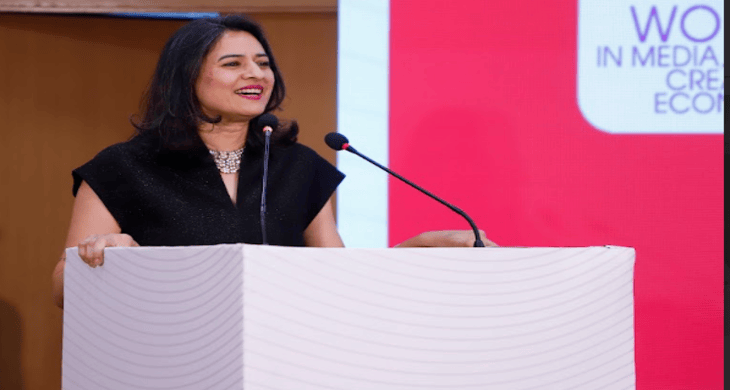

The economic value of women, their contributions, and their often-overlooked labor took center stage as Shaili Chopra, Founder of SheThePeople.TV and Gytree, delivered her keynote on the Sisterhood Economy—a concept she believes has the power to redefine how women are perceived in economic and social structures at the inaugural edition of e4m Women In Media, Digital & Creative Economy.
Drawing from her book- The Sisterhood Economy, Chopra’s address was a compelling call to recognize and amplify the role of women in shaping businesses, industries, and communities, not just as contributors but as economic powerhouses in their own right.
Chopra began by reflecting on a defining moment in her career, an interview she conducted with investment mogul Warren Buffett in 2013. During the conversation, she asked Buffett what he carried in his wallet, expecting perhaps a rare business insight or a financial anecdote. Instead, Buffett pulled out a simple, well-worn wallet containing photographs of three women—his daughter, his ex-wife, and his current wife. He spoke of how these three women had been the true sources of his strength and success. That moment, Chopra admitted, changed her perspective on the role of women in economic narratives.
Returning to her newsroom after that interview, she looked back on her career of interviewing over 587 CEOs, realizing that a mere 18 of them were women. Even among those, several were leaders by virtue of inherited businesses or associations rather than having carved independent paths. This realization struck a deep chord, making her question why women remained largely absent from mainstream economic discussions despite their significant contributions. It was then that she decided to leave behind her high-profile career in journalism to create a platform where women’s achievements, struggles, and stories could take center stage.
This decision led to the birth of ‘SheThePeople.TV’ in 2015, a platform dedicated to telling the stories of women who were making meaningful contributions in various fields but were rarely recognized as "achievers." Chopra highlighted how this endeavor had grown into a thriving digital community of over six million women across Asia, demonstrating a clear demand for narratives that celebrated the real, everyday victories of women in business, technology, media, and beyond. She noted that despite the rise of influencer culture and commercialized content, SheThePeople.TV had maintained a strong, organic engagement, attracting nearly 500 million video views per month without focusing on traditional glamour-driven content.
A major theme of Chopra’s keynote was the economic invisibility of women’s work. She pointed out that every woman is a working woman, only a few are paid for it. From household labor to small-scale businesses, women contribute significantly to economies, yet their work is often excluded from formal financial valuations. The capitalist model, she argued, places excessive emphasis on companies that secure large venture capital investments or IPO valuations, disregarding smaller enterprises that sustain families and communities.
Chopra illustrated this with stories of real women who defied odds to create successful businesses. One such woman was Anjali from Lucknow, who started with just two workers making jute bags. Initially struggling to find customers, she gradually built her business through local networks, eventually expanding to employ 90 women and run a full-scale factory. Another was a young woman from Satara, Maharashtra, who was once discouraged from pursuing higher education as her family believed it would make her "overqualified for marriage." Left to fend for herself when her husband moved away for work, she began experimenting with selling honey sourced from local farmers. Over time, she used WhatsApp and digital platforms to brand and expand her business. By the time Chopra met her again years later, her honey brand had become a recognized seller on Amazon, and she had built a thriving business by leveraging digital tools that were once beyond her reach.
Chopra emphasized that these examples were not isolated success stories but proof of a much larger economic transformation. Women, she argued, supporting and uplifting each other is not just a social movement but an economic force. The traditional belief that women compete with or undermine each other, she said, needs to be dismantled in favor of recognizing how women mentoring, financing and collaborating with each other can generate tangible economic value.
Another key point in her address was the role of media in shaping perceptions of women’s economic contributions. She criticized the mainstream media’s tendency to highlight women only in extreme circumstances—either as victims of unfortunate incidents or as leaders of billion-dollar companies. There was little to no coverage of the everyday small victories that drive economic change. She argued that if media narratives shifted to regularly showcasing women-led enterprises, small businesses, and social initiatives, it would encourage a cultural shift where women’s economic power is recognized at every level.
In concluding her keynote, Chopra stressed that women's empowerment is not just about gender equality; it is about economic prosperity. The Sisterhood Economy, she reiterated, is about women investing in women, mentoring each other and building sustainable economic ecosystems that benefit not just individuals but entire societies. The challenge, she noted, was changing mindsets and systems that continue to overlook the economic force that women represent.
She left the audience with a powerful thought: “We often talk about women changing the world by launching rockets and leading corporations. But women change the world in far more fundamental ways—by building businesses, raising families and strengthening communities. That, too, is an economic revolution.”
The Sisterhood Economy, Chopra believes, is not just an idea, it is an economic powerhouse waiting to be fully realized.
Read more news about Digital Media, Television Media, Out of Home Advertising, Print Media, Latest Advertising India
For more updates, be socially connected with us onInstagram, LinkedIn, Twitter, Facebook, YouTube & Google News