Gaurav Banerjee calls for India’s own ‘Silicon Valley of creativity’
At FICCI Frames 2025, Gaurav Banerjee, MD-CEO of SPNI, said India’s media and entertainment industry must move to the centre of the country’s economic and cultural growth narrative
 by
by
Published: Oct 7, 2025 7:58 PM | 5 min read
 Follow Us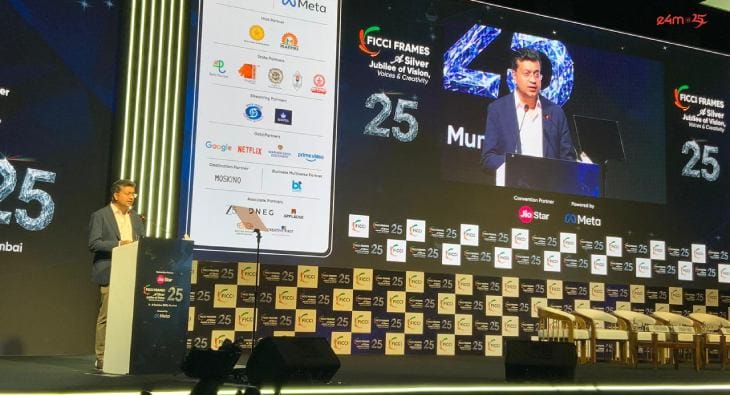

Gaurav Banerjee, Managing Director and CEO of Sony Pictures Networks India, has called for a bold reimagination of India’s creative economy, urging policymakers, investors and industry leaders to build what he described as a “Silicon Valley of creativity.” Delivering a keynote address at FICCI Frames 2025, Banerjee said India’s media and entertainment industry must move from the margins of policy to the centre of the country’s economic and cultural growth narrative.
“India’s media and entertainment sector today is worth nearly $30 billion, contributing about 0.7% to our GDP and growing at 7–8% annually,” Banerjee noted. “But nearly all of this is domestic demand. The question before us is simple — what will it take to grow this astronomically and build something truly global in its quality and scale, anchored in Indian stories?”
In his address titled ‘Regulating the Orange Economy of the Creative Universe’, Banerjee posed two fundamental questions to the industry. The first — what is stopping India from creating an at-scale global content benchmark, an “Airtel or IPL of entertainment”? And the second — how can India build an institutional framework to scale private investments in content creation, much like what happened in sectors such as pharmaceuticals or IT services? “We’ve done it in technology and pharma. Why can’t we do it for creativity? What will it take to fuel massive content investments that can nurture creativity in every major Indian language?” he asked.
Banerjee highlighted that Indian content has witnessed three major inflection points in the past 25 years — the launch of Kaun Banega Crorepati at the turn of the century, the birth of the IPL in 2008, and the rise of pan-India shows and films such as Satyamev Jayate, Anupamaa, and Baahubali. However, he pointed out that the last major leap of this scale happened a decade ago. “We’ve been waiting for the next innovation in entertainment that audiences will truly root for — and it’s time to make that happen,” he said.
Emphasising the need to aggregate human capital, Banerjee said India’s creative ecosystem must mirror the IPL model, which thrives on talent scouting, training and continuous engagement. “Every IPL season produces six new names we’ve never heard of before. That’s the result of talent scouting, year-round engagement and investment in nurturing skill. We need a similar ecosystem for storytellers — one that can find and support authentic creators from across India,” he said. Referring to The New Geography of Jobs by Enrico Moretti, he added that prosperity today depends on regions that attract and retain skilled talent and innovation-driven firms. Banerjee asserted that India already possesses the cultural depth to power global storytelling if its creative talent is given the right institutional support. “Our films, music and digital creators should be watched and celebrated globally. We shouldn’t have to wait decades for the next Lagaan or Baahubali — we should be creating that kind of impact every year,” he said.
Banerjee cited the Malayalam film industry as an example of how strong creative ecosystems can drive commercial and critical success. “Just this weekend I watched Lokaam Chapter 1 — no film has enthralled me as much since Baahubali,” he shared. “A film made for less than ₹30 crore has already crossed ₹300 crore at the box office. That’s the kind of creative and commercial success possible when the ecosystem works.” He added that this success follows a consistent trend set by films such as Aavesham, 2018 and Manjummel Boys, which reflect the Malayalam industry’s commitment to innovation and storytelling depth.
Laying out a roadmap to accelerate India’s creative growth, Banerjee said the first step is to build creative institutions and centres of excellence that nurture emerging talent through structured recruitment and scouting systems. He acknowledged that some government initiatives in this direction are promising, but added that much more needs to be done. The second step, he said, is to foster stronger collaboration between academia and industry. Drawing parallels with the United States, Banerjee said, “In the U.S., Silicon Valley followed Stanford. In India, we must build these partnerships between creative education and industry.”
The third critical step, according to Banerjee, is to reimagine regulation so that it enables rather than restricts creativity. “Creativity is human capital at its purest,” he emphasised. “Yet, it’s often overregulated through colonial-era rules. If the future of this industry is built on creativity, its regulation must be future-ready.” He urged policymakers to take a “light-touch” approach to creative regulation, just as governments have done with new technology sectors, allowing innovation to flourish.
Concluding his address, Banerjee underlined that creative industries are no longer peripheral to India’s economy. They are engines of employment, innovation, and soft power that reflect India’s identity on the global stage. “Creative industries generate jobs, fuel innovation, export identity and amplify imagination,” he said. “If India is to write the next chapter of global leadership, we must invest in creativity with the same boldness we invest in technology.”
Banerjee ended with a clear call to action. “Let’s make sure India’s creative economy doesn’t sit at the margins of policy — it should stand at the very heart of our growth story,” he concluded.
Read more news about Digital Media, Television Media, Out of Home Advertising, Print Media, Latest Advertising India
For more updates, be socially connected with us onInstagram, LinkedIn, Twitter, Facebook, YouTube & Google News