Why FMCG giants are betting big on D2C
Guest Column: Ganapathy Viswanathan, Independent Communication Consultant & Author, explores how FMCGs are embracing digital commerce, quick commerce, social media and direct consumer relationships
 by
by
Published: Aug 25, 2026 8:08 AM | 6 min read
 Follow Us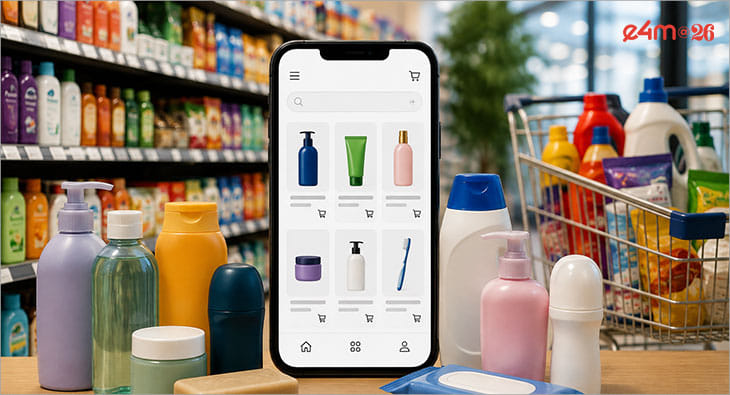

- The Direct-to-Consumer (D2C) channel is transforming India's FMCG landscape, with established companies increasingly engaging in digital commerce and direct consumer relationships, exemplified by Colgate-Palmolive's partnership with Bombay Shaving Company for its Palmolive brand.
- The beauty and personal-care sector has led the D2C revolution, with younger brands successfully building consumer loyalty through digital channels, prompting traditional FMCG firms to acquire or partner with these brands for their digital expertise and consumer insights.
- D2C allows brands to quickly identify consumer needs, launch products online, and gather immediate feedback, representing a strategic shortcut for large FMCG companies to enhance their market relevance without extensive traditional investment.
- The future of consumer engagement is expected to be omnichannel, blending D2C with traditional retail, as companies aim to stay relevant to younger consumers by combining the agility of D2C brands with the scale and resources of established FMCG firms.
The new battleground is not just the supermarket shelf. It is the consumer’s smartphone.
The Direct-to-Consumer (D2C) channel has emerged as one of the most significant shifts in India's FMCG landscape. What began largely with digital-first beauty, skincare and grooming brands has now become much bigger. Established FMCG companies across categories are recognising that the future of consumer engagement will increasingly be shaped by digital commerce, quick commerce, social media and direct relationships with consumers.
The recent move by Colgate-Palmolive India is a good example. The company has partnered with Bombay Shaving Company to drive the D2C and e-commerce business of its Palmolive personal-care brand. While Colgate continues to control product innovation, quality and supply, Bombay Shaving brings digital-first expertise to the consumer-facing side of the business.
This is significant because it shows that D2C is no longer simply a playground for beauty start-ups. It is becoming a strategic capability that large FMCG companies are willing to acquire, partner for or build independently.
Beauty Was the Early Laboratory
The beauty and personal-care category has been at the forefront of the D2C revolution. Brands such as Bare Anatomy, Chemist at Play, SunScoop, Minimalist, Beardo, Just Herbs, Mother Sparsh and The Man Company demonstrated how relatively young brands could build strong consumer franchises through digital channels.
The attraction for large FMCG companies is obvious. These brands have often developed strong communities among younger consumers, built their identities through social media and influencers, and created products around specific consumer problems rather than broad demographic segments.
For a traditional FMCG company, acquiring or partnering with such a brand can be a way of buying something that takes years to develop internally: digital understanding.
They are not simply acquiring a product. They are acquiring consumer insight, digital capabilities, speed, credibility and, importantly, a relationship with a younger generation of consumers.
Buying Time Instead of Building It
Traditionally, creating an FMCG brand required significant investment in product development, advertising, distribution and retail presence. Television and print built awareness, while distributors and retailers provided scale.
D2C has changed the sequence.
A new brand can identify a consumer problem, develop a product, launch it online, communicate directly with its audience and receive immediate feedback. Social media can create awareness without a conventional mass-media budget, while e-commerce provides national distribution without having to immediately build a physical retail network.
For a large FMCG company, therefore, a D2C brand can represent a shortcut.
Instead of spending years experimenting with products and communication, the company can acquire or partner with an organisation that has already demonstrated consumer acceptance.
From Skincare to Toothpaste
What is particularly interesting is that this logic is now moving beyond beauty.
Toothpaste, toothbrushes, oral care, personal hygiene, grooming and other everyday FMCG categories are increasingly being influenced by digital discovery and e-commerce.
Colgate itself acknowledges the growing importance of digital commerce. Its FY26 annual report says e-commerce delivered strong double-digit net sales growth, while quick commerce has become an important growth opportunity.
The Colgate-Bombay Shaving arrangement therefore represents a larger strategic shift. It suggests that even companies with enormous distribution networks are recognising that being available everywhere is not the same as being relevant everywhere.
The physical distribution network remains critical. But digital channels provide something different: direct access to consumer behaviour.
D2C Is Not About Eliminating the Middleman
There is a tendency to assume that D2C automatically means higher margins because the traditional distributor-wholesaler-retailer chain is bypassed.
That is not necessarily true.
Digital advertising, influencers, technology, fulfilment, warehousing, logistics and customer acquisition can be expensive. Several D2C companies have discovered that acquiring a customer online can become increasingly costly.
The real value of D2C for a large FMCG company is therefore not simply margin.
It is information.
Traditional FMCG companies have historically been excellent at moving products through distribution networks. D2C allows them to understand what consumers are searching for, what they buy, how frequently they repurchase, what they say about products and which innovations are gaining traction.
This can make the entire brand-building process smarter.
The Power of Combining Scale with Agility
This is where the partnership model becomes particularly interesting.
A company such as Colgate brings manufacturing expertise, product science, quality systems, brand equity and a powerful distribution network. A digital-first company brings agility, consumer understanding, online merchandising, performance marketing and a different way of engaging with consumers.
The combination can be more powerful than either capability on its own.
The same principle explains why FMCG companies have been attracted to D2C beauty brands. The start-up has the agility and cultural understanding; the large company has the scale.
The challenge, however, is not to kill the very entrepreneurial culture that made the D2C brand successful in the first place.
The Future Will Be Omnichannel
The idea that D2C will replace traditional retail is unlikely to materialise.
The future will be omnichannel.
A consumer may discover a skincare product on Instagram, research it on Google, buy it from a quick-commerce platform, purchase it again from a supermarket and eventually subscribe to it through the brand's own website.
The consumer does not think in terms of channels. Brands and companies do.
This is why the strategic importance of D2C is increasing even for companies that already have extraordinary physical distribution.
The Real Acquisition: Tomorrow’s Consumer
Ultimately, the D2C opportunity for FMCG companies is not just about online sales.
It is about staying relevant to the next generation of consumers.
Large FMCG companies already possess scale, manufacturing strength, distribution and financial muscle. D2C businesses bring speed, experimentation, consumer intimacy and digital-native thinking.
The future therefore may not belong to pure-play D2C brands or traditional FMCG companies alone. It may belong to companies that can successfully combine the two.
The supermarket shelf will remain important. Toothpaste will still sit beside other oral-care products, and shampoo will continue to occupy shelf space.
But the consumer journey increasingly begins somewhere else — on a smartphone.
That is why the D2C opportunity is becoming too important for FMCG companies to ignore. From skincare and grooming to Palmolive and potentially even traditional oral-care categories, the message is becoming clear: the next battleground for FMCG is not just distribution. It is the direct relationship with the consumer.
Read more news about Marketing News, Advertising News, PR and Corporate Communication News, Digital News, People Movement News
For more updates, be socially connected with us onInstagram, LinkedIn, Twitter, Facebook, YouTube & Google News
