We still start with the story first: Nikhil Sharma on balancing digital & creativity
At e4m Screenage Conference 2025, Nikhil Sharma, MD of Perfetti Van Melle India, shares why storytelling, instinct, and consumer insight still drive growth in a mobile-first world
 by
by
Published: Dec 3, 2025 5:04 PM | 7 min read
 Follow Us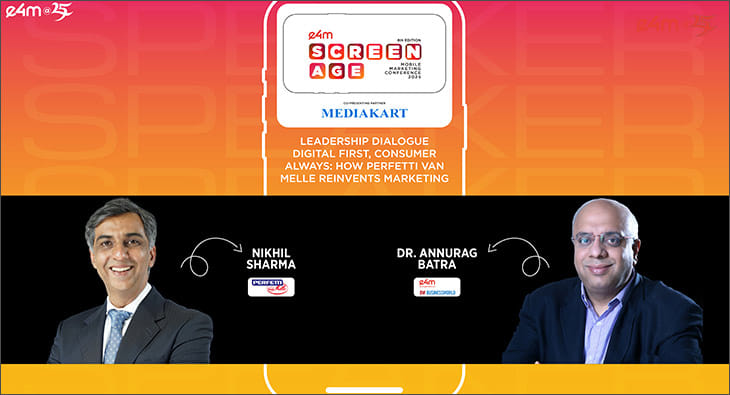

In a candid and insightful Leadership Dialogue session at exchange4media Screenage Conference 2025, which was moderated by Dr. Annurag Batra, Nikhil Sharma, Managing Director of Perfetti Van Melle India, unpacked how the iconic confectionery company balances digital evolution with unwavering consumer focus staying relevant in a mobile-first, impulse-driven marketplace while preserving the creative storytelling that built its brands.
A culture that builds leaders
The discussion opened with a reflection on leadership longevity at Perfetti Van Melle, a company that has nurtured leaders across markets, including its Global CEO, Suneja, and Sharma himself, who has spent over two decades within the organisation.
Recalling his early days, Sharma shared, “When I moved to Perfetti in 1999, and by 2002 we were making very cool ads. For a young marketer, it was a really happening place to be. Every campaign we created was discussed and remembered.”
For him, the aspiration to eventually lead marketing kept the spark alive. “The only job I really wanted was the head of marketing role. That was the one I craved, and that journey kept me here.” Sharma believes it is this freedom to build creative impact, alongside continuous opportunities across roles, that glues leaders to the organisation.
Consumer first always, even before digital
While the session theme highlighted “Digital First,” Sharma made it clear that Perfetti’s true north remains the consumer. “For us, it’s important to first understand who the consumer is and what she is doing when she is buying confectionery,” he noted. He illustrated the brand’s real decision moment: “This is a girl coming back from school with five or ten rupees in her pocket, choosing what to buy. We have to be relevant in that moment.”
In this highly impulsive category, brand visibility and mental availability are crucial. “She is not searching for a brand online. She sees what’s inside the shop, and that’s where we must be top-of-mind,” Sharma explained. As a result, the sales network’s task of ensuring brand presence across millions of outlets works hand-in-hand with marketing storytelling.
“We try to create advertising which is enduring, appealing and talked about, and that’s why we believe in telling proper stories first, before building digital around them.”
Digital-first audiences, integrated-first marketing
Perfetti’s core consumers remain children, though advertising is often aspirational, aimed at young adults. “From a consumption perspective, our consumers are children. From an advertising perspective, we target aspirational young adults so the behaviour becomes visible to kids.”
Sharma acknowledged that today’s audience is inherently digital-native. “These consumers are digital first. They were born with mobile phones, internet access and social media. Communication has to be mobile-first by definition.”
However, he pushed back on the idea of digital operating in isolation. “I’m sorry to push back on the ‘digital-first’ perspective but we still start with the core creative idea first. Then comes integrated marketing communication (IMC). Digital comes after that as a powerful amplifier.”
Storytelling over formats
Using the recent Center Fresh ‘Overthinking’ campaign as an example, Sharma explained how large ideas become multi-platform narratives. “The first insight was that people overthink everything, and that became the TVC. After that, the digital ecosystem was built around it with reports, conversations and extensions.” For Sharma, format is secondary to story. “Long-form content is here to thrive, not die. We believe people still engage with deeper narratives in journalism and video alike.” He warned against chasing buzz without foundation: “Marketers sometimes fall in love with formats or stunts but without insight, the idea doesn’t land.”
On whether the role of the CMO will survive disruption, Sharma was unequivocal: “If the CMO’s role is communication-led, it will survive. But if the CMO is business-first—deeply understanding manufacturing, sales and distribution—then the role becomes even more valuable.” He stressed that modern marketing leadership must move beyond messaging alone toward full business stewardship bridging brands with cost management, product development, and operational realities.
Growth amidst complexity
As Managing Director, Sharma now balances creative ambition with economic discipline. “The first hat I wear is managing sticky price points how do you keep selling ₹1, ₹5 and ₹10 candies while managing rising costs? ”Innovation remains Perfetti’s lifeblood, especially across new categories like jellies, sour candies, gums, and lollipops. “We’re continuously innovating. Our hope is that the next big innovation will come from PVM,” he said.
However, Sharma offered a marketer’s reality check. “There’s a temptation to keep adding flavours, but most sales still come from just one or two mass flavours usually strawberry or peppermint.” Indian flavours, though appealing conceptually, remain niche. “Mango should logically be our biggest Indian flavour but everyone likes a different mango. Coconut or elaichi experiments remain marginal.”
Learning across categories and from AI
Inspiration often comes from observing adjacent markets. “We study how other categories distribute their ₹10 chocolates and ask why our ₹5 brands can’t do the same.” Agencies and creative partners frequently spark cross-industry learning as well. On AI, Sharma emphasised curiosity over automation: “AI is about asking the right questions. If you prompt correctly, you’re more likely to find meaningful answers.”
Rising sponsorship costs especially in cricket have challenged legacy media strategies. “The cost has become astronomical, dictated by acquisition prices, not unit economics,” Sharma admitted. Supporting six brands within finite budgets makes such visibility unsustainable. “We still believe cricket delivers impact but right now, for us, it’s impossible to advertise there.”
While experiential marketing continues to grow industry-wide, Sharma pointed out a pragmatic reality. “From cost per contact, experiential is expensive for us,” considering the brand already operates across 6 million retail touchpoints nationally. Still, selective sampling and festival activations support premium product launches. “Whenever we introduce higher-value packs, we activate through sampling and experiential routes.”
Health, wellness and responsibility
Addressing sugar concerns and Gen Z wellness trends, Sharma acknowledged the tension between indulgence brands and nutrition narratives. “We’re working on low-sugar formats but our advantage is portion size. A three-gram candy cannot contain more than three grams of sugar.”
Yet repositioning established fun brands as wellness players remains difficult. “None of our current brands can truly carry the health platform. They are fun brands. To do health properly, we would need a completely different brand.”
When instinct beats convention
One of the most compelling revelations was Perfetti’s willingness to defy advertising norms. “In our ads, we often don’t show the pack in the first five seconds which every marketer says is a mistake.”
He cited the classic Centre Shock and Happydent commercials as examples: “People remember them decades later because of storytelling and authenticity, not formula.” Sharma acknowledged marketing science frameworks yet argued for instinct. “It’s not all science. Some of it has to be gut. You have to back yourself in changing times.” And perhaps the most telling line of the session:
“Because we sell ₹1 and ₹5 products, we can afford to fail fast and fail cheaply. But every communication needs a risk, because not taking a risk is a risk in itself.”
Read more news about Marketing News, Advertising News, PR and Corporate Communication News, Digital News, People Movement News
For more updates, be socially connected with us onInstagram, LinkedIn, Twitter, Facebook, YouTube & Google News