Q2 FY26 FMCG performance: GST reforms lift long-term outlook despite monsoon disruptions
With FMCG toplines under pressure, marketing discipline became a differentiator, and advertising and promotion spends reflected a cautious but forward-looking approach
 by
by
Published: Nov 13, 2025 9:29 AM | 6 min read
 Follow Us

Q2 FY26 delivered a paradox for India’s FMCG sector: a structurally positive GST reform cycle but a tactically difficult operating quarter. As companies adjusted to new tax rates and erratic monsoons disrupted rural demand, trade witnessed short-term volatility. Even so, most FMCG majors posted stable revenues, protected margins, and maintained advertising intensity, reflecting confidence that demand will rebound once channels stabilise.
Management commentaries across HUL, ITC, GCPL, Dabur, Tata Consumer, Emami, and others pointed to the same reality: the turbulence is temporary, the reform tailwinds are durable.
Across the board, large and mid-sized FMCG firms reflected a mix of cautious optimism and near-term strain.
Read e4m analysis of FMCG growth slowing down
Revenue from operations: Growth steady but uneven
The impact of this mixed quarter is visible across the financials of India’s largest FMCG companies. Starting with the bellwether, Hindustan Unilever (HUL), India’s largest FMCG company, reported revenue from operations of Rs 16,034 crore and total income of Rs 16,388 crore for the quarter.
Executive Director Priya Nair said the macroeconomic environment during the quarter was shaped by three key factors, the most significant being the government’s GST reforms. “Prolonged and intense monsoon conditions across several regions disrupted supply chains and temporarily dampened demand,” she said.
Mirroring the pressure but maintaining scale leadership, ITC posted the highest topline among peers, with revenue from operations of Rs 23,129 crore and total income of Rs 23,611 crore. The company said that excessive rains in many parts of the country and the transition to new GST rates posed operational challenges for its FMCG categories, causing short-term business disruptions.
Among diversified consumer goods players, Tata Consumer Products (TCP) recorded revenue from operations of Rs 4,965.9 crore and total income of Rs 5,003.9 crore. Managing Director and CEO Sunil D’Souza said, “We delivered a strong topline growth of 18 per cent in Q2 FY26. Despite short-term challenges posed by the GST transition, Capital Foods and Organic India recorded steady growth and strengthened their portfolio with innovative launches.”
Dabur India also reflected this duality, Dabur India reported revenue from operations of Rs 3,191.3 crore and total income of Rs 3,331.4 crore. Managing Director Mohit Malhotra said that nearly 66 per cent of Dabur’s portfolio benefited from GST rate reductions, including juices, toothpaste, hair oils, shampoos, glucose, and proprietary Ayurvedic medicines. “While the GST reduction is structurally positive, it led to a temporary disruption in trade as the channel anticipated forthcoming rate reductions following lower MRP,” he said.
For Godrej Consumer Products (GCPL), weather nuances were particularly notable.. They posted revenue from operations of Rs 3,825 crore. CEO Sudhir Sitapati said that the widespread monsoon had an impact on seasonality, particularly in categories such as incense sticks.
“The GST rate reduction is a welcome structural reform that will strengthen long-term consumer demand, but the transition led to short-term trade disruptions as the channel adjusted to new pricing,” he said.
Food majors continued to show relative stability. Nestlé India reported revenue from operations of Rs 5,643.6 crore and total income of Rs 5,645.3 crore. Britannia Industries recorded Rs 4,840.6 crore in revenue and Rs 4,892.7 crore in total income. Both companies maintained stable growth in their core food portfolios.
ITC revenue rises in Q2. Find out more
In personal care and oral care, Colgate-Palmolive (India) posted revenue from operations of Rs 1,507.2 crore and total income of Rs 1,534.5 crore. The company acknowledged that GST-related adjustments temporarily affected trade channels.
Among mid-sized players, Bajaj Consumer Care reported revenue from operations of Rs 265.3 crore and total income of Rs 273.1 crore, while Patanjali Foods posted Rs 9,798.8 crore in revenue and Rs 9,850.1 crore in total income.
Emami also reflected this mixed outlook, recording revenue from operations of Rs 798.5 crore and total income of Rs 819.9 crore. Vice Chairman and Managing Director Harsha V Agarwal said, “The quarter’s performance was a temporary impact of trade disruptions linked to the pending GST revision and weak summer. With improving market sentiment and a favourable season ahead, we remain confident of strong growth in the coming quarters.”
Rounding off the set, Procter & Gamble (P&G) Hygiene and Health Care recorded revenue of Rs 324.9 crore and total income of Rs 329.9 crore for the quarter.
Bajaj Consumer Care raises ad spends in Q2
Ad spends: Selective rise amid volatility
With toplines under pressure, marketing discipline became a differentiator, and advertising and promotion spends reflected a cautious but forward-looking approach. Most companies maintained or increased marketing investments to sustain brand visibility during the demand slowdown.
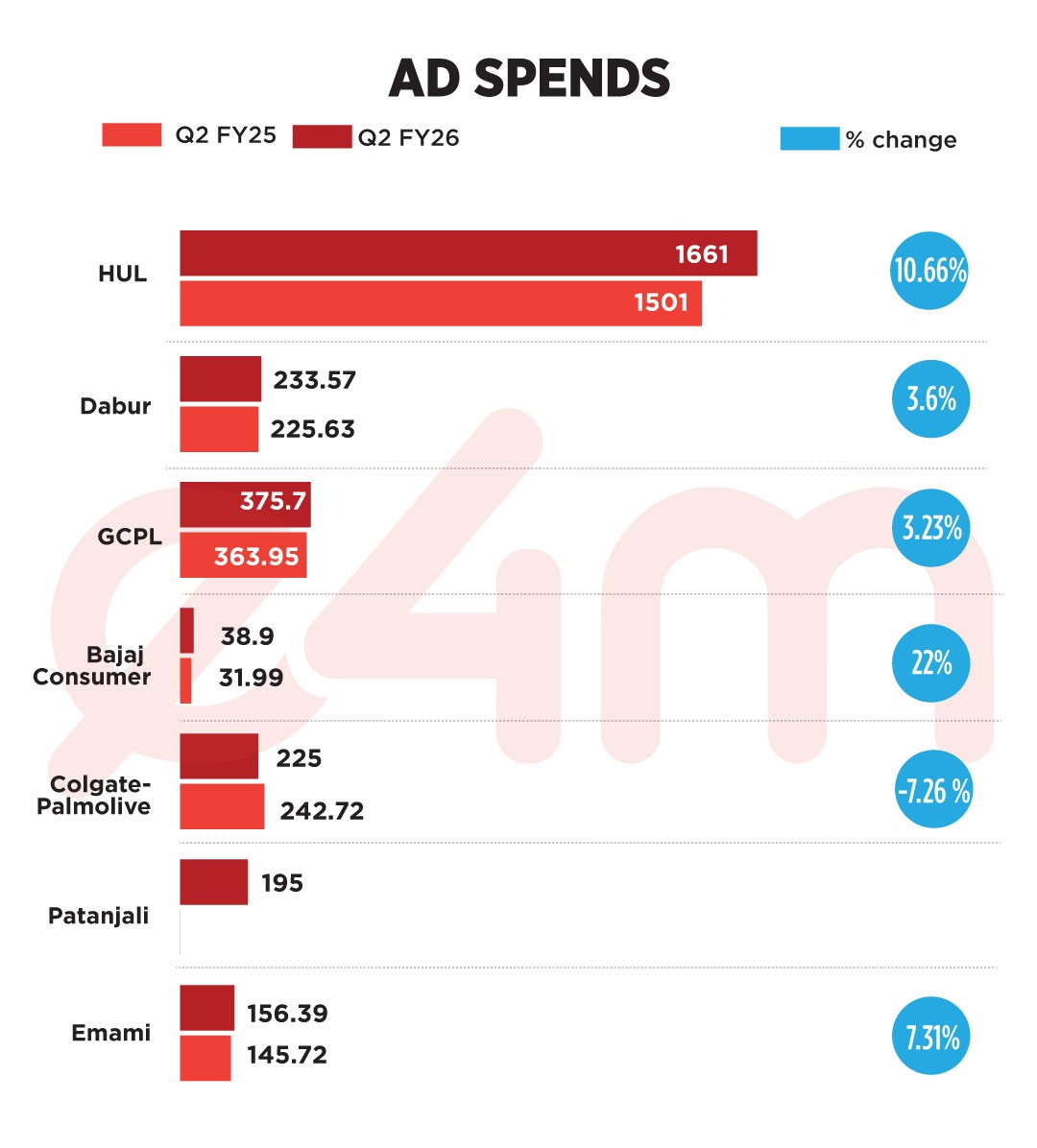
Leading the pack, HUL deployed advertising aggressively, with Rs 1,661 crore in ad spends, an increase of 10.66 per cent year-on-year, intensifying efforts in digital and quick-commerce channels.
Nair said, “We will drive more social-first demand generation to enable brand discovery online and continue to allocate more resources to fast-growing channels such as digital commerce and quick-commerce.”
Colgate-Palmolive ad spends down
Other large players also opted for strategic spending, with Dabur allocating Rs 115 crore on advertising, marking a 3.6 per cent rise year-on-year, while GCPL increased spends to Rs 375.7 crore, up 19.7 per cent.
Mid-sized companies followed varied strategies. Bajaj Consumer allocated Rs 38.9 crore, a 22 per cent rise, and Colgate-Palmolive reduced spends to Rs 225 crore, down 7.26 per cent year-on-year.
Emami’s advertising expenditure stood at Rs 156.4 crore, a 13 per cent decline compared to the previous year, reflecting a cautious approach amid trade disruptions and muted summer demand.
Patanjali reported ad spends of Rs 195 crore, indicating continued investment behind its food and personal care portfolio.
Other players, including ITC, Nestlé, Britannia, P&G, and Tata Consumer, did not disclose detailed ad expenditure figures.
Profits: Resilience through disruptions
The quarter’s profit performance demonstrated the sector’s ability to protect margins despite weather-related and operational disruptions.
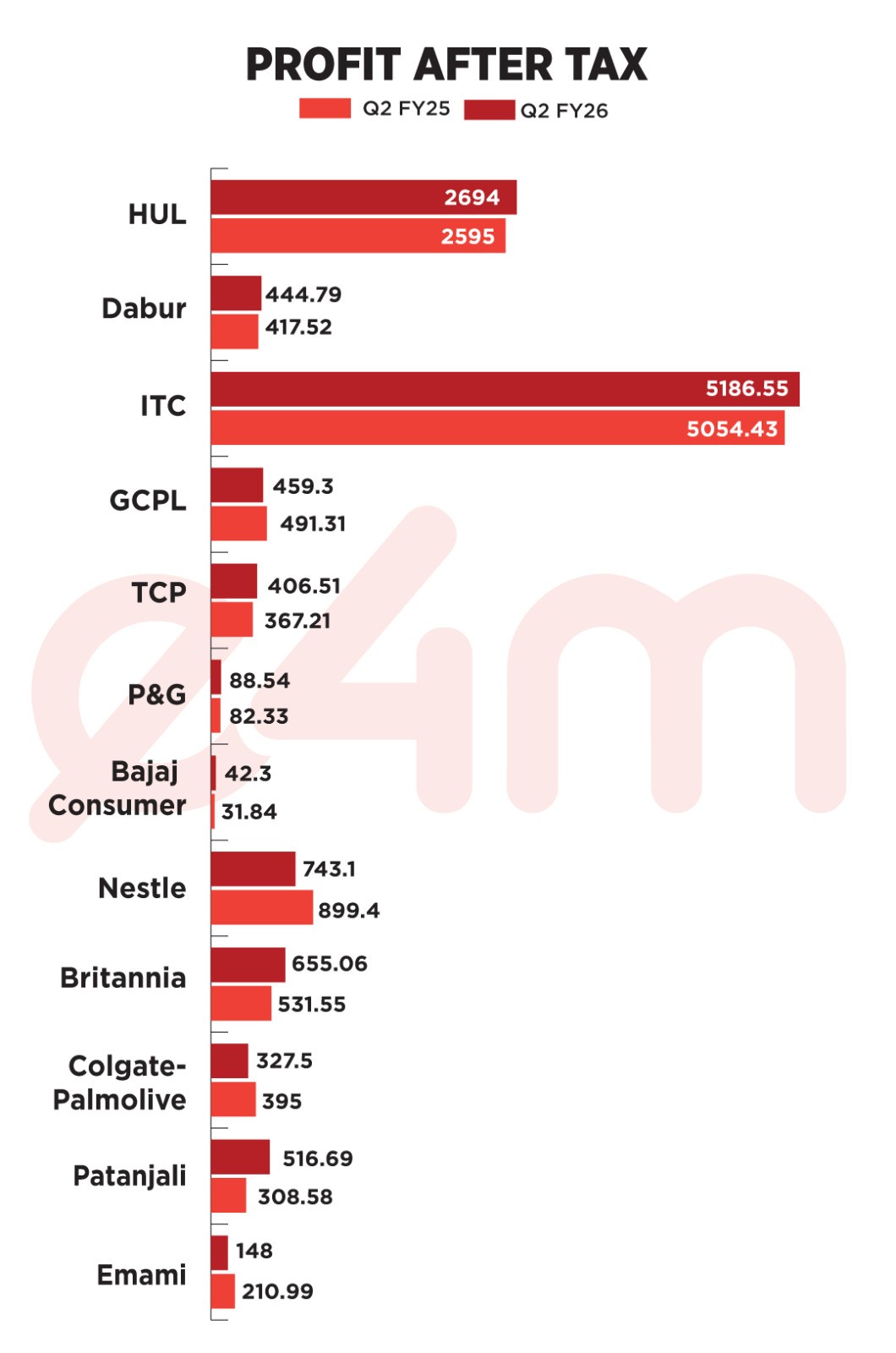
ITC’s Rs 4,927 crore profit remained the highest in the sector, followed by HUL at Rs 2,694 crore. Food-focused majors Nestlé (Rs 743.1 crore) and Britannia (Rs 655.1 crore) reported steady profitability, while Tata Consumer at Rs 406.5 crore and Dabur at Rs 508.3 crore showed resilience during the GST transition.
GCPL reported Rs 459.3 crore in profit, Colgate-Palmolive Rs 327.5 crore, Patanjali Rs 355.7 crore, and Emami Rs 148 crore. Bajaj Consumer posted Rs 42.3 crore, each maintaining profitability despite varying degrees of disruption.
Looking ahead: Reform-driven optimism, cautious near term
Across management commentaries, FMCG leaders voiced optimism about long-term growth despite short-term headwinds. Companies expect that GST reforms, which have reduced tax rates for several categories, will enhance affordability and drive stronger consumption once trade channels normalize.
Dabur’s Mohit Malhotra summed up the sector’s sentiment, saying, “Looking ahead, we remain optimistic about sequential recovery in demand supported by improving macros, good monsoon, recent GST rate reductions, and expectation of a strong winter season.”
With the festive period underway and weather conditions stabilizing, FMCG companies anticipate a more balanced second half of the fiscal year. For now, Q2 FY26 stands as a quarter defined by resilient earnings amid rains and reforms, where operational adaptability kept the sector steady through shifting conditions.
Read more news about Marketing News, Advertising News, PR and Corporate Communication News, Digital News, People Movement News
For more updates, be socially connected with us onInstagram, LinkedIn, Twitter, Facebook, YouTube & Google News
