Agility, Accountability & Alignment: The three pillars of modern marketing
At e4m Confluence 2025, industry leaders decode how brands, agencies, tech, and platforms must unite with purpose, agility, and shared vision to shape the next era of creative convergence
 by
by
Published: Nov 12, 2025 3:31 PM | 6 min read
 Follow Us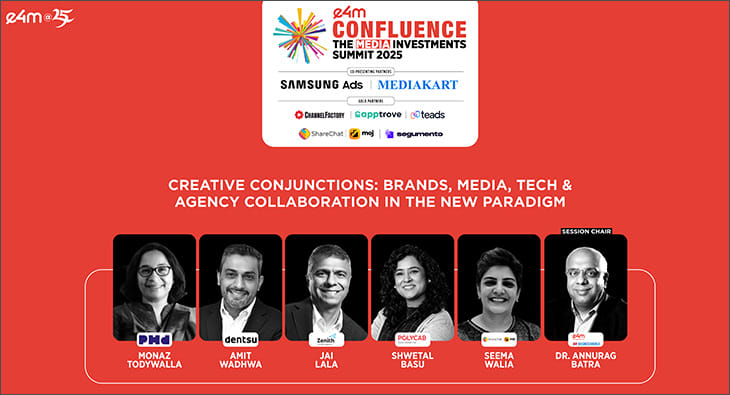

The stage at e4m Confluence 2025 lit up with one of the day’s most stimulating sessions, “Creative Conjunctions: Brands, Media, Tech & Agency Collaboration in the New Paradigm.” Moderated by Dr. Annurag Batra, Chairman and Editor-in-Chief, BW BusinessWorld and Founder, exchange4media, the panel brought together some of the sharpest minds redefining the creative ecosystem: Monaz Todywalla (CEO, PHD India), Amit Wadhwa (CEO, dentsu Creative & Media Brands South Asia), Jai Lala (CEO, Zenith India), Shwetal Basu (Sr. Vice President, Brand and Marketing Communication, Polycab India Ltd.), and Seema Walia (National Sales Head Agency and Govt, ShareChat & Moj).
The conversation navigated how creative thinking, technology, and data now intersect more deeply than ever before and how agility, collaboration, and purpose are shaping the next era of marketing.
Collaboration as the Core of Creativity
Kicking off the dialogue, Shwetal Basu underscored the importance of collective alignment in achieving campaign excellence. “The more you work collaboratively, the better the success of any campaign,” she said. “It’s okay to go with 90% perfection if there’s 100% alignment, because shared conviction ensures the campaign lands beautifully at the last mile.”
Basu expanded the definition of stakeholders beyond the traditional agency-client dynamic, highlighting how electricians, retailers, and even MEP consultants play vital roles in Polycab’s brand journey. Her message was clear collaboration today must include everyone contributing to the brand’s narrative.
Simplifying Complexity: One Ecosystem, One Responsibility
Jai Lala, CEO of Zenith India, reflected on how marketing has evolved from the simple Doordarshan era to an overwhelming digital universe. “It’s becoming extremely difficult for CMOs to navigate this complex world,” he said. “They want one person or one ecosystem to have complete ownership of one throat to choke, as I call it.”
He pointed out that brands like PepsiCo and Diageo are already consolidating creative, media, and commerce under unified networks to ensure consistency and accountability. “CMOs today are more responsible for business outcomes than ever before,” Lala noted. “Integration isn’t just convenient, it's essential for survival.”
The Football Analogy: Team Play Over Silos
From the Dentsu camp, Amit Wadhwa added a striking metaphor to the mix. “The business of creativity, media, and tech is no longer a tennis match it’s a football match,” he quipped. “You have to play as a team. If you don’t, you won’t survive tomorrow.”
He explained Dentsu’s One Dentsu philosophy, where integrated teams co-create using a “toolkit approach” rather than a single-template solution. “Integration isn’t about squeezing costs or process efficiency—it’s about elevating our collective craft,” Wadhwa said. “When you combine creative, media, and data thinking, the result is far more powerful than any siloed effort.”
Integration: Where 1 + 1 = 11
Monaz Todywalla, CEO of PHD India, captured the spirit of synergy with a sharp insight. “Integration isn’t 1 + 1 = 2. It’s 1 + 1 = 11,” she said. “But clients must realize they are the ultimate integrators—agencies can only co-create that vision.”
She observed that while agencies have evolved into agile, cross-functional partners, client-side structures often remain divided between e-commerce, performance, and retail marketing. “Agility in client structures needs to move faster,” Todywalla emphasized. “Agencies are ready for convergence—clients must match that pace.”
From Platforms to Partners: Velocity with Vision
Offering a platform perspective, Seema Walia of ShareChat & Moj said the lines between clients, agencies, and platforms have all but disappeared. “Those clear-cut boundaries have merged completely,” she remarked. “Brands today expect agility and co-creation; they want velocity with vision.”
She cited Maybelline’s campaign on ShareChat, where the brand collaborated to create eight vernacular versions of a single English creative. “That’s where the future lies, speaking the audience’s language, not just linguistically but emotionally,” she explained. “The best campaigns now come from rooms where creators, brands, and platforms ideate together.”
The CMO’s Expanding Universe
Returning to the conversation, Basu highlighted how the CMO’s role has evolved from a brand custodian to a strategic growth driver. “It’s no longer about making a beautiful ad,” she said. “It’s about representing your organization’s purpose and values.”
She noted that marketing today sits at the core of business strategy, requiring a shift in how partnerships are viewed. “The evolution was from vendors to partners,” she said. “Now, it’s from partners to becoming an extended team that’s when true collaboration happens.”
Balancing Agility and Structure
While the power of integration was celebrated, the panel acknowledged its inherent challenges. Large network agencies offer scale and consistency but risk slowing down innovation. “When agencies get locked into too many processes, agility takes a hit,” Basu admitted. “Startups often bring fresh energy and nimbleness that established players can learn from.”
Wadhwa agreed, emphasizing the need to retain an entrepreneurial spark. “Every transformation requires a restless mindset,” he said. “The moment you get comfortable, you stop evolving.”
Marketing’s Identity Crisis
Dr. Batra pointed out that the average CMO tenure has dropped from nearly five years to just under three a sign, perhaps, of marketing’s shifting identity. Todywalla acknowledged this turbulence. “Marketing is going through an identity crisis,” she said. “Even CMOs sometimes question what their core function really is.”
She stressed the need for clarity in integration, especially regarding ownership. “Every campaign must define who leads and who supports,” she explained. “Without that, the integration becomes a power struggle instead of a partnership.”
Integration with Intention
As the discussion wrapped up, the consensus was clear true collaboration isn’t about merging functions, it’s about merging purpose. Dr. Batra summarized the spirit of the session: “The holy grail of integration is consistency of storytelling across every touchpoint. But the real magic happens when everyone brand, agency, and platform plays as one team.”
In an age ruled by data, AI, and speed, the panel reminded everyone that creativity remains a team sport. Integration, they agreed, is no longer an ambition it’s the only way forward.
Read more news about Marketing News, Advertising News, PR and Corporate Communication News, Digital News, People Movement News
For more updates, be socially connected with us onInstagram, LinkedIn, Twitter, Facebook, YouTube & Google News