'Premiumisation is not only by price, but also by value'
Young entrepreneurs share their entrepreneurial journey, learning and challenges they learnt to tackle along the way at the 3rd edition of e4m’s D2C Revolution
 by
by
Published: Sep 24, 2024 11:30 AM | 6 min read
 Follow Us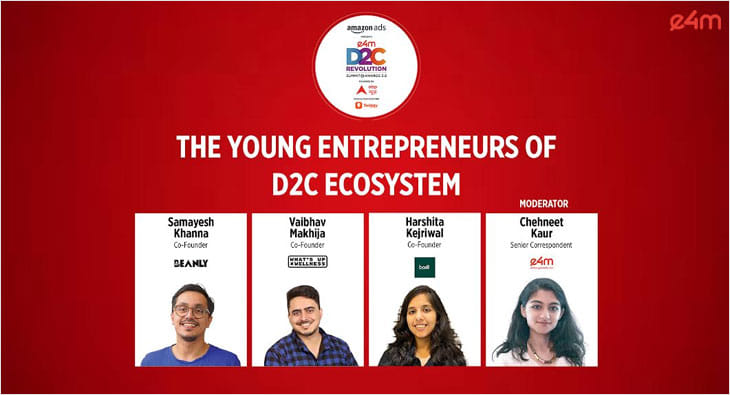

In recent years, the Direct-to-Consumer (D2C) market has emerged as a hotbed of innovation, driven by a new generation of young entrepreneurs redefining how brands connect with consumers.
In this fast-growing space, where agility and innovation reign supreme, young founders are proving that a fresh perspective, coupled with a keen understanding of digital ecosystems, can spark monumental shifts in consumer behaviour.
At the e4m D2C Revolution Summit 3.0, Samayesh Khanna, Co-Founder, Beanly; Vaibhav Makhija, Co-Founder, What’s Up Wellness; and Harshita Kejriwal, Co-Founder at Basil spoke to Chehneet Kaur, Senior Correspondent, exchange4media to discuss their journey as a young entrepreneur in the D2C space.
All three of the panellists were engineers first and then decided to become entrepreneurs.
Kejriwal shared how she was motivated to take the entrepreneurial route. She said, “I clearly remember the first class at IIT, the professor walks in and he does a one-hour lecture on the story of Kiran Mazumdar. And then ends the whole lecture with just one sentence that, ‘Do you want to be job creators or job seekers?’ So that struck me very hard.”
Sharing his perspective on whether age has been a hurdle in their business, Khanna recalled how for the very early part of their journey as entrepreneurs, age was a factor since they catered very largely to hospitality in HORECA as a sector.
“A few years back, none of them took us very seriously. When we walked up to them and said two kids were looking to solve such a problem for a hotel, it was serious business and our age was a major factor when they felt that we didn't have the credibility or the backing to be able to fulfil or do this,” he said.
In the beginning, it was less of a factor of age, but more about the business being at a small scale as per Makhija. When the scale of business is small, people don’t take you seriously but when it does, they have no option.
But to understand the right product fit according to the market is a difficult task too, especially when founders don’t have decades of experience with legacy brands like most other founders.
On this, Khanna elaborated that they didn't find solutions in the first go. “At least we didn't. We started building coffee as a D2C first product and along the journey, there were some learnings.
The only way to do this right is by listening to your customers, to keep looking at what you are building and figuring out when you find product market fit.
For Beanly, eight months back, they realised that the largest part of their revenue was coming in offline first. But they were constantly rebelling against the flow and trying to be an online first brand. They took the learnings from that and are now looking to be largely omnichannel.
For Basil, it's been quite a journey with a lot of pivots as well, keeping the vision constant. But before product-market fit, one more dimension which is extremely important is founder market fit. Kejriwal shared, “So after leaving the job, the motivation was very clear that something big is to be done in the health category.”
Kejriwal explored different markets, even the healthcare market, but didn't find a founder market fit over there and then finally pivoted to Basil.
“The major thing is the way we build the team so that this process of build, measure, learn is continuously happening in the team until you find the intersection of customer desirability, business viability and operational feasibility,” she added.
Moving to the consumer market trends, Makhija spoke of the rising trend of premiumisation. He said, “Premiumisation is not just by price, we have to deliver the value also. So, generally, we sell around 20-25% higher than what a competitor sells. But then we ensure we have better ingredients, better value so that we can justify the prices and see good repeats also.”
“It depends on where you are building again and you are at the juncture at which we are as a country, we are going through premiumisation. Now, that premiumisation could be something very, very different. Either you are already premiumising an already premiumised product or how we see it is, we are building in a mass premium category but we are premiumising an experience of the customer by elevating them from their regular everyday tea to a more premium offering and getting them coffee,” highlighted Samayesh.
Coming to the challenges, according to Makhija being able to get the right people is currently a challenge. He said, “We are a lean team. We are still a 22-person team, other brands our size in revenue are 50-60-person teams.”
Secondly to be able to optimise the customer acquisition cost is another and third is to identify the correct product fit, as per him.
Khanna agreed and further added, “To find people who will be better than us at what we are doing, to get them to believe in our vision and to join in on the journey for the long term is difficult.”
Beanly has seen a lot of challenges, operational challenges of new channels, figuring out the logistics of a new channel, setting the unit economics of that channel and then being able to scale it.
Kejriwal said, “For a QSR chain, the first metric that needs to be optimised is revenue per store. So, you need to keep on thinking if a customer is coming, how to increase Average Order Value (AOV) since it's a retail store.”
The biggest learning that has happened in the last two years of running Basil would be that initially, Kejriwal used to focus really on solving for what or making the action plans, but has realised that as a founder, her responsibility is to solve for who and getting the right people so they can solve for what.
For Makhija, the learning is to launch every SKU thoughtfully and track its profitability. Till last month, the 3.5-year-old brand had only 7 SKUs whereas brands do about 40-50 SKUs in the same period. So, it is important to take every product in-depth so the cash is optimised to have a strong demand.
“I think from the last 4 years, the one or two things that I would change in my journey would be that I am a very deep micromanager, I micromanage every task that everybody would do in the office in hindsight. I would let that habit go. We are not going to achieve perfection overnight I think and you need to accept that as soon as possible and look for the next best alternative,” shared Khanna
Read more news about Marketing News, Advertising News, PR and Corporate Communication News, Digital News, People Movement News
For more updates, be socially connected with us onInstagram, LinkedIn, Twitter, Facebook, YouTube & Google News