‘Innovation, agility, responsiveness to feedback crucial for D2C brands to stay relevant’
At e4m D2C Revolution Summit 3.0, Drishti Anand and Vidit Jain shared key insights on building and scaling successful D2C brands
 by
by
Published: Sep 21, 2024 9:05 AM | 5 min read
 Follow Us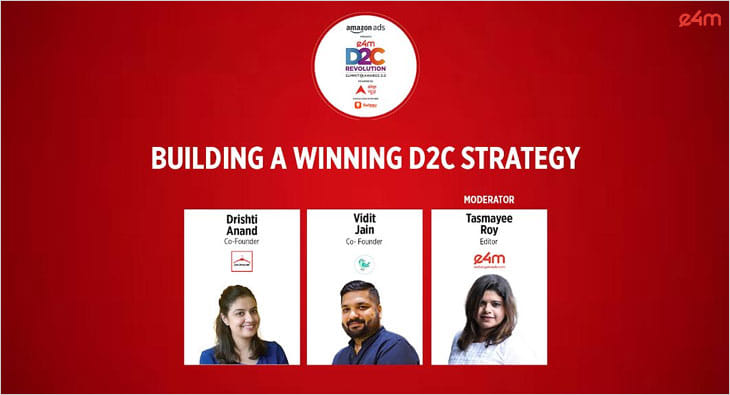

At the e4m D2C Revolution Summit 3.0, Drishti Anand, Co-Founder of Let’s Dress Up (LDU), and Vidit Jain, Co-Founder of Kindlife, shared key insights on building and scaling successful direct-to-consumer (D2C) brands. Moderated by Tasmayee Laha Roy, Editor of exchange4media, the session focused on the journey from brand conception to growth, strategies for differentiation in crowded markets, customer retention, and the future of D2C.
Roy started the discussion by asking Drishti Anand about the journey of LDU. Anand, a doctor-turned-entrepreneur, explained how Let’s Dress Up was born from her personal struggle to find the right fit and style. "At LDU, we believe in the power of dressing up and the confidence it instills in women. We are focused on inclusivity, offering sizes ranging from extra small to 8XL across styles without a ‘fat tax.’ Today, we served over 1 lakh consumers, covering more than 7,000 pin codes across India. Our core principle is inclusivity, empowering every woman to feel comfortable and confident."
Jain recounted Kindlife’s origin during the COVID-19 pandemic, as the importance of self-care became more prominent. "Kindlife is a well-being and healthy lifestyle platform focused on clean, toxin-free products. Our offerings span three categories: in the body (functional food, beverages, and nutritional supplements), on the body (skincare, cosmetics), and around the body (home essentials and baby care). We’ve built a thriving community because wellness is about more than just products; it’s about shared conversations and experiences. Our goal is to be the go-to platform for wellness and beauty in India."
When discussing strategies for standing out in highly competitive industries, Anand emphasized the importance of staying true to their mission and serving the needs of Gen Z consumers. "We’re building for a group that is both value-conscious and value-driven. They care deeply about what goes into and onto their bodies. Our inclusivity sets us apart, ensuring that women of all sizes and styles can find something that makes them feel confident."
Jain echoed the sentiment, underscoring the role of authenticity in their brand’s success. "We work closely with over 5,000 nano and micro-influencers, who have a more personal relationship with their audiences. This creates a deeper trust and higher conversion rates. We also focus on staying ahead of trends, especially in the fast-evolving beauty space, and curating products that fit into customers' wellness routines."
Both founders stressed the importance of customer retention as a key factor in long-term success. Anand highlighted how consistent quality and new product introductions help maintain customer loyalty. "We introduce new products every week to keep things fresh and exciting for our customers. Our focus on inclusivity means that every woman finds something for herself, and that keeps them coming back. We’ve also designed our system to ensure a very low return rate — less than 4%, which is something we’re very proud of in fashion."
Jain noted that for Kindlife, delivering an exceptional customer experience is at the heart of their retention strategy. "We focus on maintaining the authenticity of our products, ensuring that everything we sell is genuine. We continuously track feedback through Net Promoter Score (NPS) at multiple levels — from the website experience to product delivery — allowing us to constantly improve and provide a seamless experience for our customers."
Innovation, agility, and responsiveness to customer feedback were emphasized as crucial for staying relevant. Jain explained how Kindlife tracks key metrics such as retention rates, customer lifetime value (LTV), and customer acquisition cost (CAC) to gauge the success of new initiatives. "In a space like wellness and beauty, trends shift quickly, so being agile is crucial. You need to be able to introduce new products fast and fix what doesn’t work just as quickly."
Anand discussed how Let’s Dress Up has built an agile supply chain to introduce new products every week, ensuring customers always find something new when they visit the site. "We maintain a continuous feedback loop to ensure we’re not just guessing what consumers want — we know."
Both founders agreed that branding is not an afterthought but a continuous process that starts from day one. "Branding starts on day one," said Anand. "From the moment you choose your company’s name or design a logo, you’re building a brand. It’s not something you switch on later — it’s an ongoing process."
Jain added, "Branding is woven into everything from the start. Whether it’s the tone of your communication, your packaging, or the user experience, it’s all part of building your brand. Scaling from 1 to 10 requires a deeper focus on branding — that’s when you need to start investing more heavily in it."
What are your visions for the future of your brand?" asked Roy. Anand stated, "In the next two years, I want every woman to feel confident in Let’s Dress Up outfits. We aim to be the go-to destination for comfortable, inclusive fashion at affordable prices."
Jain shared his vision for Kindlife: "We aim to own the Korean and Japanese beauty space in India. In the next two years, if anyone thinks of Korean beauty or wellness, we want them to think of Kindlife."
Read more news about Marketing News, Advertising News, PR and Corporate Communication News, Digital News, People Movement News
For more updates, be socially connected with us onInstagram, LinkedIn, Twitter, Facebook, YouTube & Google News