‘You need to build D2C brands with purpose, not rush for the sake of growth’
At e4m D2C Revolution Summit 3.0, experts shared valuable insights on the challenges, strategies, and dynamics of growing a direct-to-consumer (D2C) brand in today’s fast-evolving market
 by
by
Published: Sep 21, 2024 9:48 AM | 5 min read
 Follow Us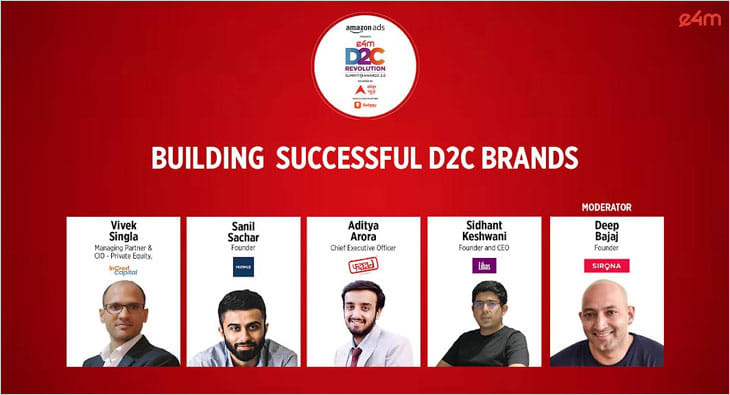

At the recently held D2C Revolution Summit 3.0 by the e4m group, the conversation on ‘Building a Successful D2C Brand’ brought together some of the brightest minds in the industry. Moderated by Deep Bajaj, Founder of Sirona, the panel featured industry leaders such as Sahil Sachar, Founder of Huddle; Vivek Singhla, Managing Partner and CIO of Private Equity at InCred Capital; Sidhant Keshwani, Founder and CEO of Libas; and Aditya Arora, CEO of Faad Network Pvt Ltd. Together, they shared valuable insights on the challenges, strategies, and dynamics of growing a direct-to-consumer (D2C) brand in today’s fast-evolving market.
Deep Bajaj kicked off the session by asking Sahil Sachar about the right time for a D2C brand to seek funding and how founders should approach it.
Sahil, emphasizing the importance of timing, said, “Founders often think of raising equity first, but equity is expensive. You need to be strategic about when and from whom you raise capital. The capital you bring in should serve to accelerate your learnings, not just fund your operations.” He stressed that founders need to assess not just the need for capital but its long-term impact on their company’s structure. “In the hierarchy of earnings, founders often find themselves at the bottom during liquidation if they’re not careful about how much equity they give away.”
He advised brands to demonstrate traction, even if it’s on a small scale, before entering a funding round. “Even if you’re driving 10 or 20 sales, that gives you enough data to show investors. Capital should come in to scale your efforts, not start them,” Sachar added.
Vivek Singhla of InCred Capital further elaborated on how investors evaluate founders. “I don’t believe in pitches alone. I prefer meeting founders in person to gauge their drive and clarity,” Singhla stated. He mentioned that investors look beyond financial projections, wanting to see how founders handle challenges and evaluate partnerships. “Capital is abundant today, but we want to understand why a founder wants *our* capital. It’s about more than just money; it’s about building a sustainable relationship and understanding whether we can help them grow their brand.”
Singhla also emphasized the importance of integrity and alignment of values, saying, “We measure things like IQ, EQ, RQ, and HQ—Integrity, Emotional Quotient, Restlessness, and Humility Quotient. The founder must have a clear understanding of what they don’t know and be willing to learn.”
Sidhant Keshwani, the founder of Libas, shared his perspective as a founder who raised capital while building a strong D2C brand. “For us, it was never about the money. We’ve been profitable from day one, so I was focused on finding investors who could help us scale our retail journey and support our IPO plans,” Keshwani explained.
He highlighted that differentiation in a cluttered market like fashion was critical. “In a competitive category, showing investors that you have a unique vision and approach is more important than just sales numbers. They want to see that you’re doing something different and sustainable in the long run.”
Keshwani’s strategic approach to fundraising, targeting specific investors who aligned with his brand’s goals, exemplifies how clear vision and patience can attract the right partners. “It took time, but I convinced the investors of my vision. It wasn’t just about the sales; it was about the roadmap for the brand’s future,” he noted.
Aditya Arora, CEO of Faad Network, weighed in with his own perspective on what founders often overlook when raising capital. “Many founders treat fundraising as a straightforward process—deck, financials, valuation, and done. But what’s often missing is context,” Arora pointed out. “Founders should have a detailed plan for how they will allocate the capital and how it will shape the next phase of growth. You need to know what milestones you want to hit by the time you raise the next round of capital.”
He stressed that financial projections are just one part of the equation. “Projections are estimations; they don’t hold much weight unless there’s a solid strategy behind them. I look for a founder who can not only explain their numbers but also the story behind them—what their long-term plan is and how they plan to avoid over-dilution or down rounds,” said Arora.
When asked about exit strategies, Vivek Singhla explained that every venture must be viewed on its own merits. “You can’t apply a blanket exit strategy across all companies in a fund. Each venture has its own pace and growth trajectory,” he said. Singhla also mentioned that the early phase should be focused on growth and learning, not on forcing premature exits. “Our job as investors is to enable, not pressure. However, at a certain stage, we do have a fiduciary duty to look at upstream investors who can take the brand to the next level.”
Read more news about Marketing News, Advertising News, PR and Corporate Communication News, Digital News, People Movement News
For more updates, be socially connected with us onInstagram, LinkedIn, Twitter, Facebook, YouTube & Google News