How brands are tuning into Bharat’s digital beat from tradition to transformation
From Bajaj’s region-rooted campaigns to Hoopr’s music-driven storytelling, brands are finding new ways to speak to Bharat; not in translation, but in true cultural resonance
 by
by
Published: Oct 17, 2025 11:13 AM | 9 min read
 Follow Us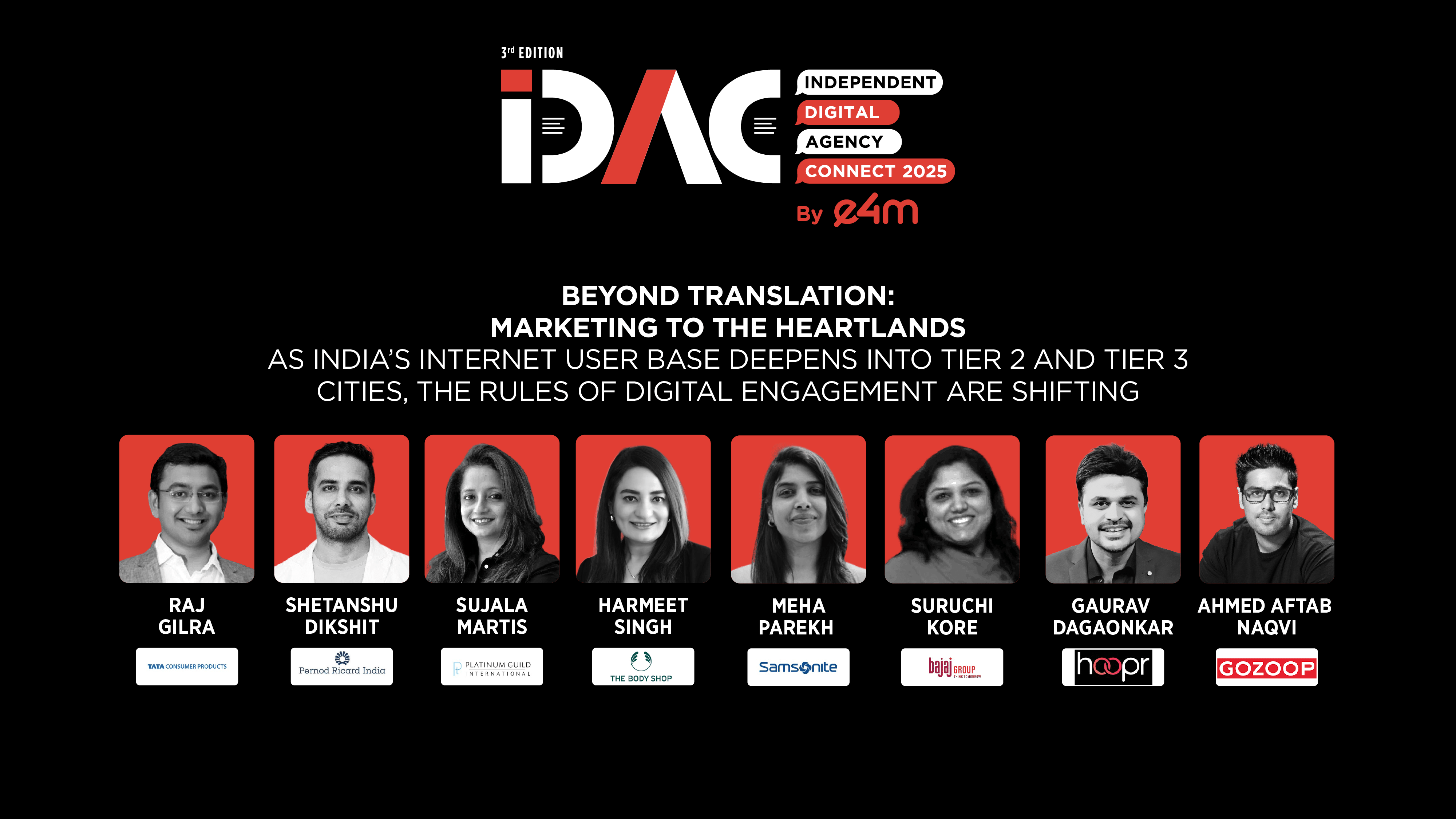

As Bharat and India converge into one consumer story, marketers are rethinking how they speak to the country’s diverse audiences. At e4m-iDAC 2025, the panel “Beyond Translation: Marketing to the Heartlands” unpacked what this shift means for brands today.
Moderated by Ahmed Aftab Naqvi, Global CEO & Co-founder, Gozoop, the session brought together Raj Gilra, VP & Business Head – Core Salt, Tata Consumer Products; Shetanshu Dikshit, Lead – Digital Communications, Pernod Ricard India; Sujala Martis, Director – Consumer Marketing, Platinum Guild International; Harmeet Singh, Chief Brand Officer, The Body Shop Asia South; Meha Parekh, Brand Head, Samsonite; Suruchi Kore, Head – Digital and Social Strategies, Bajaj Group; and Gaurav Dagaonkar, CEO & Co-founder, Hoopr.
Setting the context, Naqvi noted that marketers have long operated with two separate playbooks: one for India and one for Bharat. “But the story has changed,” he said. “The lines have blurred, and today Bharat isn’t just catching up. It is India.” He highlighted how trust is now being built at a micro level through regional discovery and community influence, especially as growth originates from smaller towns and villages.
Opening the discussion, Naqvi invited Gilra to share how a brand like Tata Salt, deeply embedded in everyday India, reaches audiences at scale.
Gilra explained that the brand’s strongest growth continues to come from rural and semi-urban regions. “What we realised is that, as Byron Sharp says, you need to reach the maximum number of people, the maximum number of times.” The challenge, he noted, was achieving this reach efficiently. “The cost per reach on television is about 30 to 40 paisa. We needed to bring that down to five. Voice allowed us to go very mass with around six to eight paisa per user.”
He elaborated that audio has become a powerful medium for the brand’s iconic “Namak ho Tata Kaka, Tata Namak” jingle. “We’ve taken that sound to high-footfall spaces like railway stations and bus stands; places with no brand clutter,” he said. “We even extend it to mandis and digital platforms like YouTube Shorts Rural. The idea is to deliver maximum reach at the lowest cost during the purchase cycle, and it’s given us results.”
Turning to Dikshit, Naqvi observed that localisation for a brand like Pernod Ricard carries greater responsibility due to regional sensitivities.
“For us, India is not one market; it’s many,” Dikshit said. “Every state has its own way of working, its own legal drinking age, and its own culture. What you say and how you say it really matters.” Unlike mass brands, Pernod Ricard’s approach focuses on cultural ownership rather than pure localisation. “You don’t just adapt to a culture; you hack it and own it completely,” he said.
He cited Royal Stag’s long-running ‘Live It Large’ platform as an example. “For over two decades, the brand has championed democratising success, from featuring sports stars like Mitchell Starc and Shane Warne to Rohit Sharma and Bumrah,” he said. “Owning and hacking culture is built on continuity and longevity.”
Dikshit admitted that in today’s dynamic marketing world, brands often change communication too quickly. “As marketers, we’re guilty of not staying true to one core insight,” he said. “You need to own one language and one message. If you keep shifting, you lose authenticity.”
Naqvi then turned to Martis to understand how emotionally and culturally rooted categories, such as jewellery, navigate India’s regional nuances.
“When it comes to jewellery, regional variations play a huge role,” Martis said. “Some centres are precious-stone forward, others are metal forward. For us, localisation starts with the product.” Given the personal and emotional nature of the category, Platinum Guild focuses on cultural integration. “We look at belief systems, symbols, and norms,” she explained. “Language naturally follows, but the ecosystem and the culture come first.”
She cited the example of Platinum Love Bands, which celebrates love that’s “truly rare.” “In metros, young women view relationships through a lens of individuality. They want to grow and flourish within it. But in the South, it’s more about partnership and equality,” she said. “In mini-metros, it becomes more romantic. These nuances shape how we communicate.”
Similarly, Men of Platinum focuses on success built on values. “In some regions, courage is aspirational; in others, humility is,” Martis said. “These differences define what resonates emotionally. We weave them into multiple touchpoints, not just one campaign.”
Martis added that authenticity in influencer partnerships is non-negotiable. “We look at local influencers through the lens of trust, not follower count,” she said. “If a brand stands for character, the person must embody that value. Otherwise, the backlash isn’t worth it.”
Singh highlighted how The Body Shop adapts its global ethos to the Indian cultural context. “Any international brand entering India has to connect with local nuances, rather than remain an outsider,” she said.
Citing examples, she pointed to The Body Shop’s recent festive campaign ‘Market Change’, which focused on intergenerational family bonds and inclusivity. “The product wasn’t the focus; rather, it was the emotion of love, connection, and togetherness. These values are integral to The Body Shop’s philosophy,” Singh noted.
She also spoke about a 2023 campaign celebrating the LGBTQIA+ community. “Inclusivity has always been central to our communication. The campaign reflected that, and it resonated deeply with consumers across regions,” she said.
On connecting with tier-2 and tier-3 markets, Singh emphasised that inclusivity and community-led initiatives have universal appeal. She referenced a recent Rakshabandhan collaboration with Terracore, a women-led artisan community from Panchkula. “We sourced handmade rakhis from them and included them in our gift boxes. It was a small gesture but one that tied cultural relevance with women’s empowerment,” she said.
Adding to the discussion, Parekh spoke about how Samsonite has extended its reach beyond metros. “For the longest time, most of our revenue came from metro cities. But today, tier-2 India is driving growth,” she said.
She identified two macro trends behind this shift: evolving travel habits and social media’s role in democratising access to premium brands. “Tier-2 consumers are taking multiple holidays a year. They want brands that make them feel connected to a global lifestyle,” Parekh explained.
Samsonite’s strategy, she said, focuses on localising emotions rather than simply translating content. “Our Diwali campaign, ‘Diwali Ka Safar’, thanked people who sacrifice their own celebrations, drivers, airline staff, and delivery partners, to make ours brighter. It was warm and empathetic, not performative,” she said.
Localisation, she added, extends to product assortments and search behaviour. “Designer collaborations under Samsonite Black Label work best in North India, while functional, work-led products perform better in Mumbai. Even in digital discovery, we adapt. Consumers may not search for ‘Samsonite cabin bag under 10,000’; they’ll write ‘strong trolley bag under 10,000’. We meet them where they are, without losing our voice,” Parekh concluded.
Kore shared how Bajaj Consumer Care, a brand rooted in India, has undergone a shift in its approach to communicating with consumers. “We’ve always been an Indian brand,” she said. “Earlier, our marketing was highly regional, from Durga Puja campaigns in Kolkata to festive drives in Maharashtra. But with the rise of digital platforms, the focus has evolved.”
She noted that today’s consumers seek authenticity and innovation, rather than repetition of traditional templates. “We are looking at how we can stay true to our brand language while offering what consumers want, like products with natural ingredients and communication that reflects that,” Kore explained.
Highlighting the two-way connection enabled by digital media, she added, “It’s a great time for brands because consumers are reaching out directly. Social media allows us to listen, engage and respond instantly.”
Kore also reflected on the rapid pace of content creation in the digital age. “It feels like a content factory, every brand is pushing festive campaigns, viral reels and new formats. Within that, staying true to brand voice is essential,” she said. “The digital shift is about dynamic storytelling, and the best part is the instant feedback loop with our audience.”
Adding a creative dimension to the discussion, Dagaonkar spoke about how music has become central to brand storytelling. “Music transcends barriers. Back in 2021, when we founded Hoopr, we realised that there was a gap in finding culturally rooted, regional music for brands,” he said.
Today, Hoopr works with over 170 brands and 400,000 influencers, offering licensed music across genres and languages. “Every brand has its own DNA, so the music they use and the artists they work with must align with that identity,” he explained.
He illustrated how music localisation goes beyond translation. “We helped ITC’s Bingo strengthen its presence in Uttar Pradesh and Bihar by creating songs in Bhojpuri with singer Khesari Lal Yadav. For Ultratech Cement, we composed a track that captures the aspirations of migrant workers who dream of building their own homes. It resonated deeply across the heartlands,” he said.
Hoopr also uses AI tools to help brands choose the right music. “If a brand wants to use a regional track, our platform analyses whether it fits their voice and even suggests the best video context to optimise impact,” Dagaonkar shared.
He closed by emphasising music’s universal power. “Every region, every audience connects through sound. If a brand today isn’t using music meaningfully and legally, they’re missing a huge emotional opportunity,” he said.
Read more news about Marketing News, Advertising News, PR and Corporate Communication News, Digital News, People Movement News
For more updates, be socially connected with us onInstagram, LinkedIn, Twitter, Facebook, YouTube & Google News