How communities are driving long-term brand value
At e4m-iDAC 2025, panellists highlighted that authentic engagement, not just campaigns, fosters loyalty, drives product innovation, and builds long-term value
 by
by
Published: Oct 17, 2025 10:11 AM | 9 min read
 Follow Us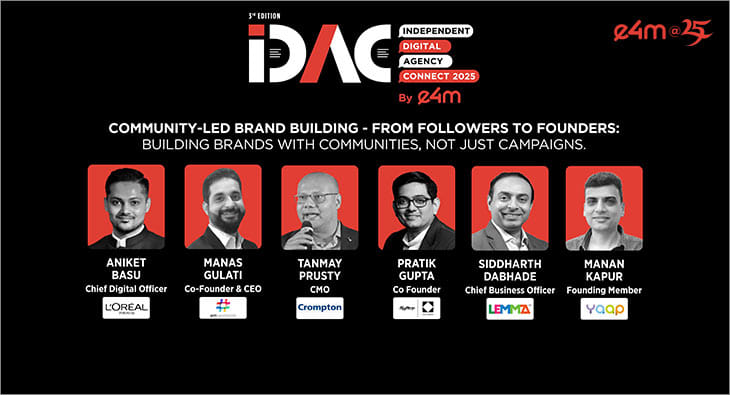

At the e4m-iDAC 2025 session titled “Community-Led Brand Building: From Followers to Founders,” industry leaders discussed how authentic engagement and value-led collaboration are redefining modern brand building.
The discussion brought together Harmeet Singh, Chief Brand Officer – South Asia, The Body Shop; Tanmay Prusty, CMO, Crompton; Manas Gulati, Co-founder and CEO, Arm Worldwide; Pratik Gupta, Co-founder, FoxyMoron and Zoo Media; and Siddharth Dabhade, Chief Business Officer, LEMMA, and was moderated by Manan Kapur, Senior Partner at Yaap.
Kapur began the session by reflecting on the challenge of standing out in a saturated digital landscape. “In today’s noisy digital era, everyone is fighting for the mind space of a consumer,” he said.
In a world ruled by virality and trends, he noted, “communities are fast becoming the next form of content building.” He then invited the panel to weigh in on whether brand building today is driven more by campaigns or communities.
Opening the discussion, Singh of The Body Shop said that community building had always been central to the brand’s philosophy. “Since inception, we’ve focused on supporting communities in the best possible way, and we brought that ethos to India when we launched here about two decades ago.”
Singh elaborated on the brand’s long-standing partnerships that drive social impact. “We’ve worked with various communities. One example is Plastics for Change in Bengaluru, where we’ve supported over 2,000 families of marginalised waste pickers through education, health insurance, and daily living,” she said. “We even provide e-tricycles to help improve their livelihoods.”
For The Body Shop, Singh emphasised, it is not just about marketing or content creation but about staying true to the brand’s values. “Marketing is important and we need content to showcase our products, but equally important is the true messaging of the brand and how it helps these communities grow bigger and better,” he said.
Reflecting on how the brand’s approach to marketing has evolved, she added, “It has really changed for us. Whether we launch a campaign or highlight a product, it’s always community-first. The product and its ingredients come after that.”
Turning to the consumer goods space, Kapur asked Crompton’s Prusty about balancing diverse product lines with intent-driven marketing. “With so many SKUs and different product categories,” he asked, “how do you tie everything together? Are these individual communities or one large ecosystem?”
Prusty explained that while Crompton operates as a single brand, it engages with distinct communities across its various businesses. “We are one brand, but we have many products and multiple business lines, each with a very different interplay and audience,” he said.
Using examples from Crompton’s product portfolio, Prusty broke down the company’s community-led approach. “We sell fans, and while that may sound purely technical, the community around it includes electricians who are integral to installation. So, we have a large engagement programme with them to gather insights for product development,” he said.
Similarly, he highlighted that Crompton’s water heaters involve a different influencer base. “Water heaters are electrical products, but are installed mostly by plumbers. They’re strong opinion leaders and have a major influence on consumers and our distribution channels,” he explained.
For Crompton, the focus lies in identifying and engaging meaningfully with these opinion leaders. “Our journey is to find the key opinion leaders for each of our products and build relationships with them,” Prusty said. “We take insights from these communities to refine our products and leverage these influencers to drive awareness and sales.”
Continuing the conversation, the panel explored how technology and integrated media are helping brands build and amplify communities beyond traditional campaign formats.
Siddharth Dabhade, Chief Business Officer at LEMMA, spoke about how the out-of-home (OOH) space is evolving into a connected, digital ecosystem. “We work in out-of-home media, but we’ve digitised this media,” he explained. “We’ve aggregated about 1.5 lakh screens across India, connecting all these screen owners on one platform and integrating them programmatically.”
This integration, he said, has created two distinct communities: the OOH media owners and the programmatic advertising ecosystem. “We’re making all these screens accessible through platforms like DV360 and The Trade Desk,” Dabhade noted. “Programmatic is expanding rapidly, and out-of-home media is now becoming part of that universe.”
He added that LEMMA not only builds its own media community but also helps advertisers amplify their social campaigns through digital OOH. “Whenever brands run social media or community campaigns, we help them extend those conversations offline,” he said. “For instance, when Amazon launched Modern Love Story, they invited users to share their take on modern love. We took those social media interactions and amplified them across digital outdoor screens nationwide. It created a massive buzz for the show.”
Dabhade emphasised that community amplification has become central to how LEMMA operates. “Community building is important for us, but also for the brands we work with,” he said. “Our role is to help them scale those efforts and amplify their messages across different touchpoints.”
Gupta, Co-founder of FoxyMoron and Zoo Media, addressed the constant tension between virality and community in digital marketing. “It’s our job, and has been for the last 18 years, to convince brands,” he said. “First, it was about moving them to digital, then to social, then to integrated media. Now, it’s about getting them to understand community.”
He explained that communities have always been intrinsic to digital platforms. “When Facebook started, people naturally formed communities based on shared interests. Today, those have evolved into micro-communities that live online but exist meaningfully in the real world,” Gupta said.
However, he acknowledged that many brands still prioritise short-term visibility over long-term engagement. “There are brands that want to build communities but are throwing short-term campaigns at a long-term problem,” he said. “A community needs consistent focus, a clear purpose, and genuine participation.”
Gupta drew a distinction between participation and integration. “Most brands still paste their logo on top of whatever is trending. That’s not integration,” he said. “Communities need integration with the brand’s ethos and purpose. The ‘why’ of a community matters more than the ‘what’. Unfortunately, in marketing, we’re often focused only on the ‘what’, the ‘why’ gets lost in the process.”
Adding to this, Gulati, Co-founder and CEO of Arm Worldwide, said that the essence of community-building lies in authenticity and empowerment. “Nobody likes a brand tom-tomming about itself,” he remarked. “That’s why communities exist.”
He explained that communities operate on two fronts: those directly associated with the brand, such as professional networks, and those built around consumer affinity. “When you nurture people from the ground up, they value your brand more. They become advocates who speak your language and extend your reach organically,” he said.
Gulati also highlighted examples from both B2C and B2B contexts. “In consumer brands, you see it with founders like Nish Hair’s. People associate with her personally, and that’s what builds community,” he said.
In the B2B space, Gulati noted, there’s immense untapped potential. Distributors, retailers, and financiers often form their own local ecosystems, he said. Citing examples from brands like Bajaj and Niva Bupa, he explained that conducting training sessions for distributors builds stronger advocacy. When empowered, these partners promote the brand organically, eliminating the need for inorganic reach through Meta ads.
He concluded that genuine advocacy can’t be forced; it must be earned. “You don’t need to convince people to do it when they truly believe in the brand,” Gulati said. “Communities grow when people feel seen, empowered, and part of your story.”
When asked whether intent marketing will be driven more through passion communities or whether these communities will themselves drive larger engagement, Prusty emphasised the power of shared enthusiasm. “Passion is a very strong rallying cry. It gives you a unifying purpose,” he said.
Drawing on his own experience as a quiz enthusiast, he explained, “The quiz community has paid for itself in many ways. It’s auto-organising: the Karnataka Quiz Association, the Bombay Quiz Club, the Delhi Quiz Association, and even international associations. During COVID, this community kept life entertaining; in fact, I met my wife through quizzing.”
Prusty highlighted that such communities create tremendous loyalty and commercial potential, noting that if a sneaker brand meaningfully interacts with a passionate community, it could even create a new product range, customising and living vicariously through the community. He added that these rallying points hold significant value for brands.
Singh shared The Body Shop’s approach to passion-led engagement. “Building communities through passion isn’t difficult because people understand what they care about. In beauty, we also connect through sports and marathons, such as the Delhi Marathon. SPF, for example, is relevant for anyone participating in sports,” she said.
She also stressed that connecting with consumers must go beyond clichés. “It’s not about telling them directly; it’s about showing through our actions. Consumers are smart and understand marketing and absorb messaging. Clear, simple communication in both content and community building is key,” he added.
Gupta elaborated on the importance of authenticity in community engagement. “To be part of a community, a brand must genuinely belong. Participating or nurturing a community is not the same as sponsoring it. Your brand personality, tone, and ethos must align with the community’s purpose,” he said. He warned against superficial involvement: It’s not about a logo or a flashy reel. It has to extend beyond the event, into everyday life.
Gupta also emphasised the global nature of passion groups today. “These communities are dispersed worldwide, yet accessible daily. Brands that fail to align their character with the community’s values will stand out as a sore thumb. Authenticity is the only step brands must take to truly integrate,” he concluded.
The future of intent marketing lies not in temporary campaigns but in embedding brands meaningfully into the communities that reflect shared values and passions.
Read more news about Marketing News, Advertising News, PR and Corporate Communication News, Digital News, People Movement News
For more updates, be socially connected with us onInstagram, LinkedIn, Twitter, Facebook, YouTube & Google News