Culture is becoming business lens: ShareChat & Moj on what that changes for marketers
That shift was a central theme at the Gurugram edition of ShareChat and Moj’s Culture Intelligence Summit 2026
 by
by
Published: Aug 26, 2026 11:20 AM | 7 min read
 Follow Us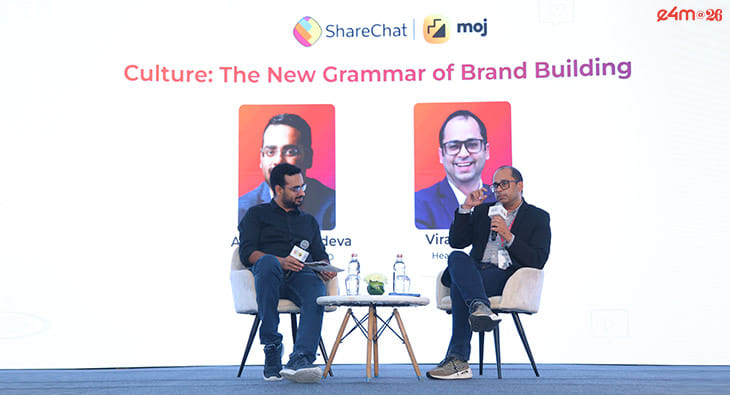

- The ShareChat and Moj Culture Intelligence Summit 2026 emphasized the growing importance of cultural understanding for brands in India, highlighting the need for deeper localization beyond mere translation of campaigns.
- Marketers discussed the shift from broad national campaigns to targeting smaller communities and sub-cultures, recognizing that consumer trust is built through culturally relevant messaging that resonates with diverse audiences.
- Successful brand strategies were illustrated through examples like Maggi's intergenerational campaign and KFC's adaptation of local street food culture, demonstrating the effectiveness of aligning brand identity with cultural truths.
- The summit underscored the necessity for brands to evaluate their participation in cultural moments based on relevance and consumer connection, as India's cultural landscape continues to diversify and evolve.
Culture is becoming increasingly important to how brands build relevance in India. As consumers move across languages, regions, communities and sub-cultures, localisation is no longer simply about adapting a national campaign or translating its message. It requires a deeper understanding of the cultural cues that shape how different audiences watch, share, trust and buy.
That shift was a central theme at the Gurugram edition of ShareChat and Moj’s Culture Intelligence Summit 2026, where marketers discussed how brands can navigate India’s cultural complexity while remaining relevant to increasingly diverse audiences.
Opening the summit, Ankush Sachdeva, Co-founder & CEO, ShareChat and Moj, pointed to the opportunity beyond large national moments, as smaller communities, occasions and behaviours increasingly shape consumer attention.
From localisation to cultural understanding
Virat Khullar, Head - Marketing, Hyundai Motor India, defined the landscape simply. “India is a very diverse land,” he said, drawing on Hyundai’s three decades in the country. Global brands that enter markets with “pre-baked products” without sufficiently nuancing them to local culture, values and ethnicity can struggle to find relevance. “We cannot expect one national expression to capture the complexity of every market and consumer,” added Khullar.
That shift from broad reach to cultural proximity ran through several conversations at the summit, from large festivals to sub-festivals, states to neighbourhoods, and demographic segments to communities connected by shared interests and behaviours.
Mayank Prabhakar, Chief Media Officer, vivo India, said the starting point has to be making consumers feel recognised. “We have to ensure that the consumer feels empowered by speaking to them in their language or else an ad is just a blocker for them.”
Neha Khullar, Head of Marketing, Kenstar, pointed to another change: consumers themselves are becoming far more informed. “Gone are the days when you can just have a national ambassador for your campaign,” she said. A national celebrity may have enormous visibility, but a regional creator can sometimes be far more relevant to a particular market.
Why familiarity matters in building trust
The need for cultural relevance becomes even more pronounced in categories where the consumer is not making a frequent purchase. Samir Sethi, VP & Head of Brand Marketing, PolicyBazaar, said “Building trust in a culturally diverse country like India is a challenge so you have to ensure you remain relevant to the consumers,” he said.
Sethi offered the contrast of a corporate executive in Gurugram and a first-generation entrepreneur in Jamshedpur. The product may be the same, but the emotional context around it is not.
In a fragmented market, trust may not necessarily come from saying something louder or reaching more people. It can come from saying something in a way that feels like it belongs to them.
Sajit Gopal, Head of Media, Jubilant FoodWorks, brought that principle to food and occasions. India, he said, is a country that loves to eat, and the opportunity for brands is not only to participate in existing celebrations but also to create new occasions around food. Yet there are limits to how far a brand can insert itself.
“During Onam, for instance, a pizza cannot replace a traditional Sadya. The opportunity is elsewhere. People may be busy shopping or preparing for the festival, and during those days they may choose a pizza because they do not have the time to go home and cook,” said Gopal.
Niti Kumar, CEO, Spark Foundry, said marketers can no longer simply make a list of festivals at the beginning of the year and plan campaigns around them. The shift, therefore, is from festivals to moments.
Anand Saluja, Head - Media, Oppo India, described this widening cultural canvas as a move beyond culture itself to the sub-cultures within it. “We are no longer talking about culture but are also aware about the sub-cultures, not only festivals but also sub-festivals,” he said.
“The meaning of Diwali for the younger audience is very different from the meaning of Diwali I had,” Saluja said. In fact, he argued, new occasions are taking on the weight traditionally associated with festivals. “Friendship is a festival now,” he said, pointing to the growing relevance of occasions such as Friendship Day for younger audiences.
Brands finding cultural truths
Some of the strongest examples discussed at the summit came from brands that began not with a festival or trend, but with a cultural truth and then found the right expression for it.
Kanika Juneja, Category Marketing Head - Maggi Noodles, Nestlé, spoke about the brand’s 50 years in India and its continued focus on staying relevant by understanding cultural truths. The brand’s “Rishte Mange Do Minute” campaign, for instance, brought together three generations of the household, the child, mother and grandmother. Juneja’s approach was to keep three things aligned: brand truth, consumer truth and cultural truth. The brand does not have to change its identity every time it moves into a different market. What changes is the way that identity is expressed.
KFC offered a different example. Tamisha Sajnani, Director, Integrated Brand Marketing, KFC India, spoke about the brand’s KFC thela (roadside stall) in Connaught Place.
The idea came from seeing people selling KFC-style chicken on the streets. Rather than treating these sellers simply as imitators, the brand brought the format into its own marketing.
“We put up a thela in Connaught Place right outside our own store and within hours the idea was picked up digitally,” Sajnani said.
The KFC thela was therefore not just a campaign execution. It acknowledged that a global brand could enter an unmistakably Indian cultural format without losing its identity.
Knowing when a brand should participate
As brands move into smaller and more specific cultural spaces, another question becomes important: when should a brand participate at all?
Prashant Desai, Head of Media, Data & Partnerships, South Asia, Haleon, offered a simple filter. “If you put in a filter of whether the cultural moment is relevant, is there a real consumer tension and can a brand credibly add value, the answer lies there,” he said.
Iodex provides an example of what that can look like when the connection between brand and cultural moment is genuine. The brand has long been associated with “Iodex maliye, kaam pe chaliye” and has increasingly taken that proposition into cultural spaces where physical activity and walking are central to the experience.
For Nitin Malhotra, CMO, Livpure India, that is particularly relevant for categories that need to combine national scale with local relevance. “For our category national outreach may build aspiration, but the how and why of it you will have to build a cultural nuance,” he said. That nuance is also expanding beyond traditional festivals such as Diwali. Harvest seasons and marriage seasons, he noted, are becoming important cultural drivers in their own right.
India is becoming more connected, but that connectivity is not making the country culturally uniform. If anything, it is giving more communities the ability to express their identities, preferences and interests at scale.
For brands, the old hierarchy of national versus regional is beginning to break down. Cultural intelligence is increasingly about understanding the many smaller audiences within the larger market ,what they celebrate, what they watch, what they eat, who they listen to, how they speak and, ultimately, what makes a brand feel like it belongs.
Read more news about Marketing News, Advertising News, PR and Corporate Communication News, Digital News, People Movement News
For more updates, be socially connected with us onInstagram, LinkedIn, Twitter, Facebook, YouTube & Google News