Bharat’s quirks become a marketing playbook in new ‘It Happens in Bharat Only’ report
A new report brought out by Bharat Lab and Rediffusion explores how everyday Indian behaviours can shape consumer understanding and brand strategy
 by
by
Published: Sep 17, 2026 5:57 PM | 3 min read
 Follow Us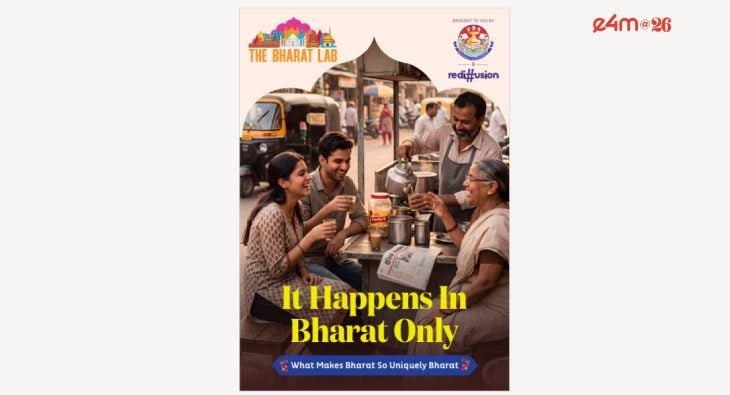

- A new report titled "It Happens in Bharat Only" from Bharat Lab and Rediffusion explores distinct Indian consumer behaviors, emphasizing relational decision-making influenced by family and community rather than individualistic tendencies.
- The report identifies cultural practices such as bargaining, product longevity, and festive buying as key insights for marketers, linking these behaviors to historical scarcity and resourcefulness.
- Concepts like "Jamai Premium" and "Shagun Pricing" illustrate how cultural nuances affect consumer treatment and purchasing decisions, while the "Kitty Party Economy" highlights informal networks as modern influencers.
- The report aims to document everyday Indian practices and behaviors, advocating for a deeper understanding of these cultural dynamics in marketing strategies, rather than attempting to change them.
Everyday behaviours such as bargaining, family-led decision-making, festive buying, neighbourhood recommendations and even the way consumers judge a product through a home-cooked meal are being positioned as potential marketing insights in a new report, “It Happens in Bharat Only”, from Bharat Lab.
The report, brought out by Bharat Lab and Rediffusion, takes an observational look at what it describes as distinctly Indian behaviours and examines what businesses and marketers can learn from them. It draws on conversations with people across India and focuses on behavioural patterns rather than conventional demographic or economic classifications.
Among the report’s central themes is the idea that Indian consumer behaviour is often relational rather than individualistic. Family, social circles and community can influence decisions, with the report arguing that brands need to understand consumers within these relationships rather than treating them simply as individual buyers.
The report also identifies jugaad and the legacy of scarcity as another behavioural influence. It links practices such as bargaining, extending the life of products and finding workarounds to an earlier period of limited resources, suggesting that these habits continue to shape consumer behaviour even as incomes and consumption patterns change.
Several sections translate these cultural behaviours into marketing concepts. The “Jamai Premium”, for instance, looks at the tendency to over-serve a son-in-law and contrasts it with how long-standing family members may be treated differently. The report uses this as a lens for examining how businesses treat new versus existing customers.
The report also examines “Shagun Pricing”, pointing to the cultural preference for amounts such as ₹101 or ₹501, where the additional rupee is seen as carrying symbolic value rather than simply representing a monetary difference.
Another section, titled “The Kitty Party Economy – India’s Original Influencer Network”, argues that informal women’s groups have historically functioned as networks for recommendations, social proof and even peer-to-peer financial activity. The report draws a parallel between these networks and today's WhatsApp-led recommendations and influencer ecosystems.
The “Tiffin Box Test” similarly looks at how products can be judged within the family and workplace, suggesting that consumer acceptance can extend beyond the person who actually purchases the product.
Other themes include the “Badaam Effect”, which examines how visible acts of care can communicate value, and the “Sharma Ji Ka Beta Effect”, which frames social comparison and family networks as an Indian form of FOMO.
The report also explores buying around auspicious occasions, describing this as the “Muhurat Tax” and arguing that brands need to account for culturally driven purchase windows rather than relying solely on conventional seasonality.
Beyond these marketing-oriented observations, the report catalogues a range of everyday Indian practices — from preserving plastic covers and reusing household containers to food rituals, gestures, superstitions and social forms of address.
The report describes itself as an attempt to capture these behaviours before they are increasingly standardised by SOPs and apps, and says its objective is not to “fix” Bharat but to frame and understand it.
One caveat for the news copy: the report is explicitly described as largely observational and based on conversations, so claims such as the specific consumer percentages and sales figures in it should be treated as report findings/claims rather than independently established market data unless separately sourced.
Read more news about Marketing News, Advertising News, PR and Corporate Communication News, Digital News, People Movement News
For more updates, be socially connected with us onInstagram, LinkedIn, Twitter, Facebook, YouTube & Google News