Influencer Earnings Gap: Why top creators earn big while others chase brand deals
According to industry experts, a few top influencers earn lakhs monthly, while thousands of smaller creators chase brand deals and wait for payments, questioning career sustainability
 by
by
Published: Nov 28, 2025 9:30 AM | 9 min read
 Follow Us

“The influencer marketing industry is booming,” they say. But for whom?
According to industry experts, a handful of mega creators are minting lakhs every month, while thousands of small and mid-tier influencers are left refreshing their Gmail inbox, chasing payments, revising briefs, and wondering whether this career is actually worth it.
It is one of the biggest questions on everyone’s mind: how much do influencers really earn?
Read On: Follower count loses shine as brands shift focus to ‘influence density’: Report
Take Sarthak Sachdeva, for instance. He is one of the biggest names in the space, known for his fake cheese videos, 24-hour vlogs, and even filming dustbins outside celebrity homes. According to him, someone with 100K followers can earn between Rs 2 to 2.5 lakh per month “easily in hand.” Easy, yes, but only if you sit at the top of the content food chain.
Meanwhile, Farah Khan said on a podcast that she has never earned as much in her entire film career as she is earning now from YouTube. Even her chef Dilip is on his way to making his own house and paying off debts because of brand collaborations and YouTube vlogs. She repeatedly described content creation as giving the “easiest ROI so far”.
However, these are the outliers, the faces that command massive loyalty. For the rest of the creator universe, the fee structure looks a lot more complicated. As follower count rises, creator fees scale up, but not in a clean, linear way. It depends on category, content quality, the city they live in, and the demand they attract.
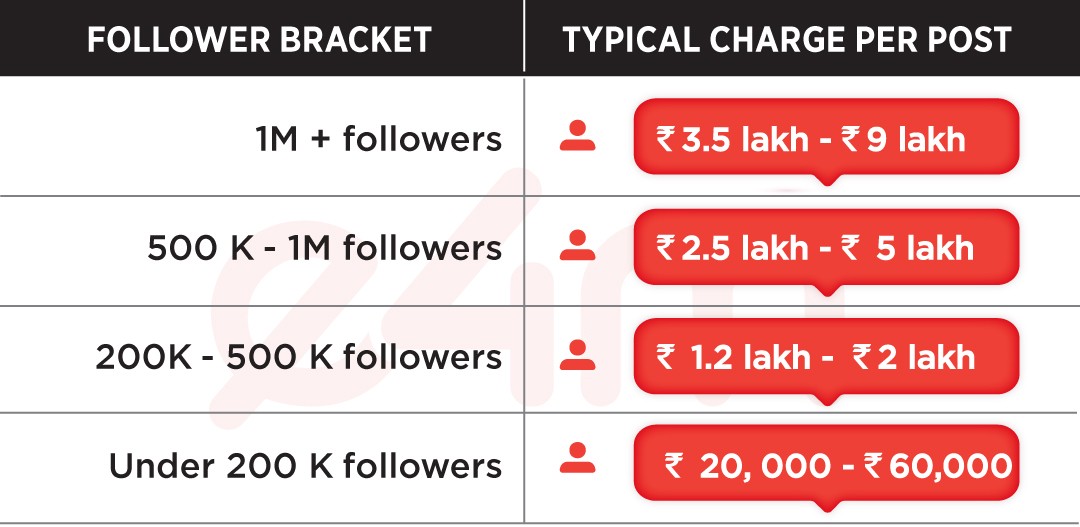
Mega-creators with over a million followers typically charge anywhere between Rs 3.5 lakh to Rs 9 lakh per collaboration, while those in the 500K to 1M bracket fall in the Rs 2.5 lakh to Rs 5 lakh range. Mid-tier creators holding 200K to 500K followers usually charge Rs 1.2 lakh to Rs 2 lakh, whereas nano and emerging creators – those under 200K followers – earn around Rs 20,000 to Rs 60,000 per branded post.
Sounds decent, but in reality, not everyone earns even this much. Lifestyle creator Bhavna Jaiswal, who has about 70K followers, explained how the system becomes diluted once intermediaries enter the scene. She says agencies and managers often take significant cuts.
She shared, “There are many agencies ready to pay creators directly. A brand approves 25k or 30k for a post. But PR agencies and managers take out their own commission. Let’s say a club is launching and inviting 200 creators. Even then everyone won’t show up. Now what happens is there is a friend of mine with 500k followers and great reach.. can she attend, so the influencer invites the influencer and money gets further divided. What is the solution? Brands and PR should have firm ad rates. Even creators should speak up for their rights.”
According to her, the abuse creators face is constant. “Brands feel like creators are their slaves. They will pay Rs 2000 or Rs 3000 and still want N number of changes, last minute additions, everything.”
Payment delays are another nightmare. “Policies are always against creators. Like you cannot delete the post for 90 days or your payment won’t be issued. We wait a minimum of 90 days to get paid. We made the content, you got the visibility and reach. But sometimes we keep chasing brands.”
Read On: Will ad-free social media send creator fees soaring?
Across categories, reels cost 3x to 10x more than regular videos. This is simply because brands want the highest reach and engagement. Fashion and beauty creators charge the highest. Comedy creators sit in the middle. Sports creators like Akash Chopra charge less per follower but higher absolute fees due to strong credibility.
So here’s the million-dollar question: who really qualifies as an influencer? Simply having a social media presence doesn’t automatically make you one.
Kunal Sawant, Business Head – Content & Influencer Marketing, GroupM, WPP (Goat Agency India), defined it clearly. According to him, “An influencer today is someone who, through their content on digital platforms, can shape opinions, decisions, or purchasing behaviour of an audience.”
At MRSI webinar, he explained how influencer marketing has now become a strategic priority for nearly every major brand surveyed. Around 71 percent plan to adopt an always-on approach instead of campaign-specific bursts. The study covered Group M on FMCG, BFSI, manufacturing, utilities and included senior marketers from legacy companies like P&G and Tata to fast-growing D2C brands.
Using a massive data set of 60,000 influencers and posts from 52 brands across 8 categories, Kunal claimed that companies are leaning towards niche micro-influencers for authenticity. Moreover, long-term partnerships are now the norm with 72 percent of brands and a whopping 95 percent of manufacturing companies preferring ongoing relationships.
While discovery tools exist, brands still struggle to identify the right influencers, especially in regulated sectors like BFSI. Engagement rate is becoming the primary currency while impressions and views are losing importance. Conversion metrics, currently at 23 percent, are expected to rise.
Lavani Agarwal, VP & Head of Marketing, South Asia, Mastercard told e4m, "Today, brands simply don’t have a brand strategy if they’re not working with influencers. We’re in the business of a network of influence. The days of making one TV ad and expecting it to move consumers are long gone. People see between 3,000 and 5,000 pieces of content in a single day — it’s pure information overload. In that environment, no matter how much communication we build, influencers help campaigns cut through the noise and take them to the finish line.”
On who she considers an influencer, “Influencers are people you trust. The ones I follow are different from the ones you follow — that’s where hyper-customisation comes in. Their voices bring a level of authenticity an ad can try but never fully achieve. So you must layer influencers and content creators onto your main communication; they take the message home in a way a single ad campaign never can.”
Read On: Reach no longer guarantees influencer collaborations—Here’s why
“We work across the entire spectrum, A-list, B-list, micro-influencers, everybody. I’m sure you follow people with 500 followers as much as you might follow someone with 5 million. Each creator type plays a very different role in the media plan. You can’t adopt a one-size-fits-all approach. It’s not ‘this or that’. And I don’t go only by follower count...engagement and content quality matter just as much.”
The BFSI company is planning to launch a campaign next week, Agarwal said, “The core proposition will be established by the main films. But safety is a lived experience, and for us to talk about safety, we need trusted voices. That’s why we call it ‘edutainment’. To drive education, you have to work with influencers. They have a very special place in my heart and in all our media campaigns. They’re doing a phenomenal job and they are here to stay as part of every media strategy.”
Sawant also highlighted that influencers drive trust across the consumer funnel. Micro and nano influencers build stronger trust for newer brands, while established brands focus on creators with brand safety and high-quality content. He said audience dynamics, objectives and brand fit are crucial.
Kunal Ghosh, DGM Strategy, Cheil SWA Group India, said not all brands are chasing big influencers. “I know brands who invest a lot in nano and micro influencers because that gives regional relevance. If you want to make a story big in Tamil Nadu, you need local influencers who get the dialect and cultural nuances right. Not just big names.”
Swiss Beauty’s CMO, Vidushi Goyal, shared how they balance macro, micro and nano influencers. She said brands are now diverting more spends to mid-tier, micro and nano creators. “Bigger influencers give reach but not high engagement. Mid and smaller creators give more comments, more conversation. That is very important for us as a brand.”
She added that strategy depends on the category and stage of the brand. If reach is the objective, macros work. But for deeper engagement and talking to the right buyers, mid and small creators matter.
Read On: Long-term partnerships over quick campaigns: Is creator economy undergoing a big shift?
Kalyan Kumar, Co-Founder and CEO of KlugKlug, shared beauty categories show 2x to 5x Earned Media Value (EMV) multipliers and home and kitchen show 5x to 7x. Influencers boost purchase intent through increased search volumes. But operational challenges remain. Brands often reach only 50 to 60 percent of the audience they assume. Surprisingly, only 14 percent of female beauty influencers actually have more than 50 percent female followers, causing misalignment.
When multiple intermediaries enter the chain, only 30 to 50 percent of budgets reach the creators, so many D2C brands now work directly with influencers.
Kalyan noted that swipe ups and link in bio capture only 8 to 12 percent of real influence. Agile brands are now using smarter influencer deployments to outperform bigger competitors on Amazon. With 43 percent of India’s internet users being Gen Z and 67 percent being Gen Z plus millennials, traditional media barely matters for them. They show 7x higher recall for social first content.
He concluded that influencer led content to commerce is a massive 10000 crore opportunity. The next wave lies in helping brands unlock that potential. Whether in B2C, B2B or regional markets, influencers are shaping discovery and purchase decisions at scale.
Read On: Creator Economy vs Traditional Agencies: Coexistence, collaboration or competition?
On the other hand, an industry insider revealed a lesser–spoken truth: several emerging creators, who started late on social media, quietly inflate their presence before approaching brands.
“For many unknown faces, the playbook is simple...buy 20,000 followers, secure the blue tick, and start posting every day in a niche. If you look consistent and verified, brands assume credibility,” he said.
They added that the practice isn’t limited to creators; even some young brands have followed a similar path, faking early traction by making the first few purchases themselves and flooding platforms with positive reviews.
Even though brands often claim they’re equally invested in mid-level and niche creators, the reality on the ground is different. Many smaller creators still struggle to secure even a single brand deal in a month, making it difficult to consider content creation a reliable or standalone source of income.
Read more news about Influence Zone, Marketing, PR and Corporate Communication, Internet Advertising, People Movement
For more updates, be socially connected with us onInstagram, LinkedIn, Twitter, Facebook, YouTube & Google News
