How street agitation is powering India’s creator growth
Here is a lowdown of how key digital commentators and on-ground voices fared during the recent Delhi protests
 by
by
Published: Oct 14, 2026 11:11 AM | 5 min read
 Follow Us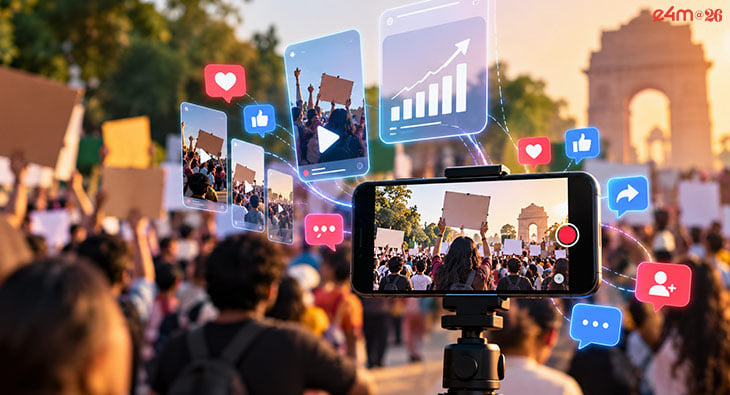

- Protests in Delhi have led to a shift in media consumption, with crowds favoring independent digital creators over traditional TV news for coverage of events like the NEET-UG paper leaks and student agitations.
- Independent journalists, such as Dhruv Rathee and Samdish Bhatia, have seen significant subscriber growth and viewer engagement by providing direct, relatable coverage of protests, often achieving millions of views within days.
- Creators like Kavya Karnatac and Neha Bora have utilized social media platforms to document protests, capturing real-time reactions and fostering community engagement, contributing to their rapid follower growth.
- The trend indicates a permanent change in audience behavior, with independent creators gaining influence and trust during crises, challenging the traditional media's monopoly on news coverage.
When protests break out on the streets of Delhi, people do not just tune in to television news anymore. During recent flashpoints, such as the massive outrage over the NEET-UG paper leaks and the student-led agitations outside central offices demanding accountability from Chief Election Commissioner (CEC) Gyanesh Kumar, a clear pattern emerged: crowds actively shut out big TV channels, while opening barricades for creators with phones and collar mics.
For independent journalists and digital creators, these moments of public anger are not just social causes; they act as huge engines for organic reach, subscriber spikes, and community trust.
Independent journalists reporting directly from the protest tarmac saw their subscriber bases multiply and direct viewer donations jump within days.
Here is how key digital commentators and on-ground voices started, how they cover agitations, and what it has done for their numbers.
Dhruv Rathee: The Explainer Engine
https://youtu.be/sba7qX3Xug0?si=KSLJjxnUpXLJQJdB
Dhruv Rathee began over a decade ago in 2014, putting out simple travel videos and basic political explainers from Germany using a basic webcam setup. Rathee rarely visits protest spots himself. Instead, he waits for the chaos to peak, collects official data, court filings, and news clips, and packages them into a single, clean Hindi explainer that common viewers can easily follow. During the NEET-UG examination leaks, his comprehensive video breakdowns pulled tens of millions of views within 48 hours, acting as the default primer for confused parents and students. Operating as India's biggest independent political creator, Rathee's core YouTube channel has crossed 33 million subscribers, generating more than 200 million views monthly. Each time a national controversy or street agitation peaks, his channel records daily subscriber spikes of over 100,000, bringing in massive advertising revenue and solidifying his position as the digital counterweight to legacy TV.
Samdish Bhatia (UNFILTERED by Samdish)
https://www.instagram.com/reel/DaQAGuZJ3NH/?psln=aXVsa2ZtZWhmNGJz
Bhatia started his digital run hosting satirical political segments and street interviews for ScoopWhoop Unscripted, before breaking away to launch his independent venture, UNFILTERED by Samdish, in late 2021. While traditional reporters run after netas and spokespersons, Bhatia walks straight into the crowd. During youth and student agitations, he sits with demonstrators, cracks dry jokes, and lets them speak in an unedited, conversational way. His coverage humanises the agitation, showing the anger of ordinary aspirants rather than reducing them to a political clash. Since setting up his independent channel, Bhatia has built a loyal base of over 1.3 million subscribers. His long-form protest conversations and deep-dive political interviews routinely generate 2 to 5 million views organically, proving that long, unhurried conversations can hold modern digital audiences.
Kavya Karnatac (KK Create)
https://www.instagram.com/p/Deb0eLOk32x/?rpxt=YnIyZjBnNXV0ZWFr
A graduate from TISS Mumbai, Kavya Karnatac initially built her reputation by making educational, culture, and geography content using engaging, visual storytelling across Instagram and YouTube. Over the past year, Karnatac expanded her scope, bringing her camera directly to Delhi's streets. During demonstrations surrounding the CEC and electoral transparency, she reported directly from the frontlines, capturing the ground atmosphere in vertical short-form reels. Her video clips documenting police crackdowns and ground detentions went viral within hours, reaching a younger audience that rarely watches traditional news formats. Her cross-platform community has surged past 7.8 million followers, including over 4.6 million on Instagram alone. By adapting serious civil ground realities into tight, 60-second mobile-first edits, she has become one of the quickest-growing independent creators covering ground issues in the country.
Neha Bora: The Activist
https://www.instagram.com/reel/DeWUFeRvLjM/?exln=c2dkdDR5Yjl2aXQz
A JNU research scholar and national president of the All India Students’ Association (AISA), Bora emerged from grassroots student politics rather than commercial content creation. Bora represents a new category where activist leadership directly merges with digital broadcasting. During the NEET row, where she led a 23-day hunger strike, and the CEC agitation, she bypassed press briefings entirely. Speaking directly to mobile cameras from atop police barricades or detention buses, her unvarnished, high-energy speeches were cut into Instagram reels and shared across student networks within minutes. Her personal and organisational handles saw an exponential rise in followers, with individual video clips crossing multi-million views across Instagram and X. This direct-to-phone approach transformed her into a widely recognised face among student youth, demonstrating that political agitations now build public personal brands faster than traditional party press releases ever did.
Other Creators on the Tarmac
Beyond individual commentators, a crop of digital-first outlets and creators were seen holding microphones where mainstream TV crews were not permitted. The Mooknayak: Documenting Dalit, student, and rural voices directly from ground zero. Article 19 India (led by Naveen Kumar): Delivering fast-paced ground reports focused on government policies and youth unemployment. Hyperlocal Creators & Stringers: Dozens of regional YouTubers armed simply with low-cost wireless mics and smartphones, streaming raw, uncut footage directly to social media audiences.
What This Means for the Business
The massive viewer migration towards these creators during protests underlines a permanent change in audience behaviour. Mainstream news networks no longer hold the monopoly on public attention during a crisis.
For the broader digital economy, it shows that street friction is one of the biggest drivers of real community growth. While commercial brands generally avoid placing paid promotions directly next to sensitive political protests, the sheer follower growth and deep audience trust gained during these agitations give independent creators enormous long-term leverage across the creator market.
Read more news about Influence Zone, Marketing, PR and Corporate Communication, Internet Advertising, People Movement
For more updates, be socially connected with us onInstagram, LinkedIn, Twitter, Facebook, YouTube & Google News
