From Data to Discourse: What most thought leadership gets wrong
Author, speaker, storyteller Priyanka S Kaintura writes research is not simply the material to be disseminated, but something to be probed, dissected and understood
 by
by
Published: Apr 23, 2026 3:10 PM | 6 min read
 Follow Us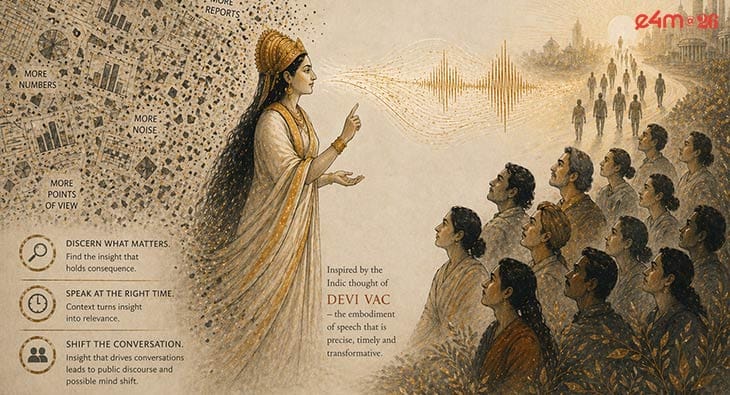

- Many organizations invest in thought leadership through reports and content, but often find that it fails to sustain relevance or influence conversations beyond its initial release.
- Successful thought leadership, as demonstrated by the Monster Employment Index and Monster Salary Index, relies on presenting data in a way that reveals significant insights and resonates with broader societal issues.
- Effective communication requires a focus on specific, consequential insights rather than overwhelming audiences with extensive data, as well as strategic timing to amplify the message's impact.
- Ultimately, enduring thought leadership is characterized by its ability to provoke reflection and dialogue, rather than mere visibility, aligning with the idea that meaningful narratives are shaped by depth of understanding rather than volume.
Over the years, I have watched organisations invest heavily in what they call thought leadership - reports, whitepapers, content pipelines - only to find that very little of it truly shapes conversations. It gets published, amplified, and then rarely sustains relevance beyond its moment. And then there are rare instances where something travels far beyond its intended audience - picked up by media, referenced in boardrooms, and echoed by public voices and opinion-makers beyond corporate circles, at times even entering policy discourse. Having led platforms like the Monster Employment Index and the Monster Salary Index across markets, I have seen both outcomes closely. The difference is rarely about scale or visibility. It is about whether the work merely presents data, or whether it reveals something people cannot ignore.
What worked for the Monster Employment Index (MEI) was not just that it tracked employment - it was how it did so. It measured month-on-month shifts across sectors, roles, and locations, creating a directional view of hiring activity across India, Southeast Asia, and the Middle East. Built on live online job postings, it offered something most reports couldn’t - a near real-time sense of where the market was moving. Over time, it came to be seen as an early indicator of employment trends, and that gave it both credibility and attention. We were also conscious of another layer – Monster.com, at the time, was an American-origin platform operating across markets. Without overstating it, we used that perception of neutrality to strengthen our share of voice in conversations where data is often questioned as much as it is consumed.
The Monster Salary Index (MSI) on the other hand taught us something more nuanced. In its first year, we approached it the way most brands do - by putting out the report in its entirety, supported by press interactions and coverage that reflected the breadth of the data. It performed well. It travelled across regions, languages, and formats over a couple of months. But it largely remained within the expected cycle of visibility.
What changed the following year was not the scale of the data, but the way we chose to look at it. Early in my career at TNS (Now Kantar), I had learned that research is not simply the material to be disseminated, but something to be probed, dissected and understood before anything else.
Instead of running with the full set of findings, we asked a harder question - what within this data has the power to shift a conversation? That meant going back in, examining patterns more closely, and identifying an insight that was not just relevant, but consequential. As a team, we began to approach the report differently and that is how the spotlight on the gender pay gap emerged.
From that point on, the method became more deliberate. The report continued to carry its full set of findings, but the communication was anchored around a sharper narrative. The first release of the year established the broader context. Another, timed with intent, brought the gender pay gap into focus -anchoring it in the month of March, around International Women’s Day, when its significance would naturally amplify. The response was qualitatively different. It moved beyond coverage into conversations across media, organisations, and wider public discourse, finding resonance well beyond corporate circles. Over time, it began to create anticipation. At its peak, the data was no longer just expected; the insight was awaited.
If there is one pattern that has held consistently across these experiences, it is this - information, no matter how well produced, rarely sustains attention on its own. It may generate visibility, even credibility - but it does not necessarily create movement. What shifts discourse is something more precise.
It begins with data, but it does not end there. It requires the ability to recognise what within that data holds consequence - not just for the brand, but for the larger environment it operates in. It also requires restraint - the discipline to not say everything at once, but to say the one thing that needs to be heard. And it requires timing - the awareness that when something is said can be as important as what is said.
Both the Monster Employment Index and the Monster Salary Index, in different ways, began to find a place in larger conversations. The former, over time, became part of broader economic conversations. It even found mention in the inaugural address of Prime Minister Narendra Modi during the Make in India launch - not as a campaign, but as a reference point within a national narrative on employment. That is not something communication can manufacture. It is something it can enable - when the underlying work is credible, and the insight is relevant enough to travel beyond its original context.
In many ways, thought leadership today is still approached as an exercise in visibility - how widely it can be distributed, how frequently it can appear, how consistently it can be sustained. But visibility, by itself, is a short cycle. What endures is what people return to, reference, and build upon.
In a world where information is abundant and increasingly mediated by systems that can generate, amplify, and circulate it at scale, the distinction becomes sharper. Narratives today can form quickly, travel widely, and shape perception far beyond their point of origin - sometimes constructively, and at other times through partial, misinterpreted, or deliberately framed information. Which is why the responsibility of interpretation and of what is chosen to be put out - becomes critical. The advantage no longer lies in access to data, but in the ability to discern what matters, to frame it with intent, and to place it in a context that holds.
In Indic knowledge traditions, a कथा is not defined by how widely it is told, but by how deeply it is understood and how far it travels through interpretation. It carries something that stays with the listener, something that invites reflection, and in some cases, demands a response, a dialogue or an action.
This is how larger narratives take shape - not through volume, but through meaning that travels.
Thought leadership works in much the same way. Data informs but insight endures. However, only that which unsettles what people think they know has the power to move discourse.
Inspired by the Indic thought of Devi Vac - the embodiment of speech that is precise, timely and transformative.
Disclaimer: The views expressed here are solely those of the author and do not in any way represent the views of exchange4media.com.
Read more news about Industry Briefing, Internet Advertising, Marketing, PR & Corporate Communication, Television Media
For more updates, be socially connected with us onInstagram, LinkedIn, Twitter, Facebook YouTube & Google News