ShareChat & Moj’s Microdrama Report by Kantar Signals New Opportunity for Brands
ShareChat and Moj, in partnership with Kantar, launched the ‘State of Microdrama in India’ Report at the Culture Intelligence Summit 2026
 by
by
Published: Aug 27, 2026 10:49 AM | 5 min read
 Follow Us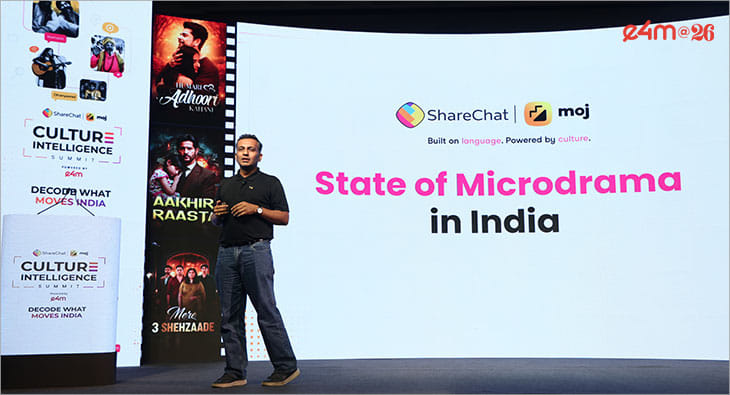

- ShareChat and Moj, in collaboration with Kantar, released the 'State of Microdrama in India' report, highlighting the growing popularity of microdramas, which attract around 100 million viewers monthly and generate 1.2 billion daily episode views.
- The study reveals that 86% of viewers spend at least 15 minutes daily on microdramas, with 54% returning to the same story within the same day, indicating a developing habit and emotional investment in the format.
- Industry experts emphasize the importance of recommendation algorithms in enhancing viewer engagement, noting that successful matchmaking can lead to high episode continuation rates.
- The report suggests that microdramas present unique marketing opportunities, allowing brands to integrate into ongoing narratives rather than relying solely on traditional advertising methods, thus fostering deeper audience connections.
India's rapidly growing Microdrama habit now has its first industry-wide study.
ShareChat and Moj, in partnership with Kantar, launched the ‘State of Microdrama in India’ Report at the Culture Intelligence Summit 2026, offering a closer look at how audiences discover, watch and return to the mobile-first episodic format, and what that behaviour could mean for brands.
Microdrama is already reaching a significant scale in India. Speaking at the summit, Manohar Charan, Co-founder & CFO, ShareChat & Moj, said around 100 million Indians consume Microdramas every month, accounting for nearly 1.2 billion episodes viewed daily.
But the more interesting story is how quickly the format is becoming a habit. The report found that 86% of viewers spend at least 15 minutes a day watching Microdramas, while 54% return to the same story within the same day.
The intensity of consumption is equally striking. On average, users spend about 55 minutes a day watching microdramas and consume more than 80 episodes on the platform.
The numbers suggest that microdrama is not simply another variation of short-form video. It is developing into a distinct viewing routine, built around the pull of continuing stories, familiar characters and episode-by-episode cliffhangers.
The question, therefore, is no longer whether microdramas will become a meaningful part of India's entertainment ecosystem. It is what this new format means for the people creating it, the platforms distributing it and, increasingly, the brands trying to find a place inside these stories.
At the launch of the report, Charan described the scale of the opportunity and the role of technology in determining what audiences eventually watch.
“Moj has over four lakh hours' worth of content and is adding about 15,000 hours' worth of content every single week,” Charan said. “This large pool allows the algorithm to find a viewer for each story and a story for each viewer.”
That matchmaking is becoming increasingly important as the volume of content grows. Charan pointed to the experience of short-form video to explain why discovery can be as important as content itself.
“As content volume increases, as we saw in the case of short form videos, the ability to surface the right content in front of the right audience at the right time enables the magic,” he said.
The numbers suggest just how powerful that recommendation loop can become. According to Charan, when one episode is shown to 100 users, around 75 continue to the second episode. Once they make that transition, many continue watching the subsequent episodes in the story.
“That is the power of recommendation algorithms doing the right matchmaking,” he said.
Soumya Mohanty, MD and Chief Client Officer, Kantar Insights South Asia, described it as a “third order disruption” following the country's mobile internet revolution.
“E-commerce is now quick commerce, from web series to short-form videos to now microdramas,” she said.
The appeal, she argued, lies in the basic strength of storytelling. Microdramas offer audiences a narrative in small, easily consumed portions while retaining the emotional pull of a continuing story.
“Microdrama is nothing but a story and stories hold attention, they engage people,” Mohanty said.
Kantar's study, conducted with more than 1,000 consumers, offers some indication of how audiences are responding to the format:
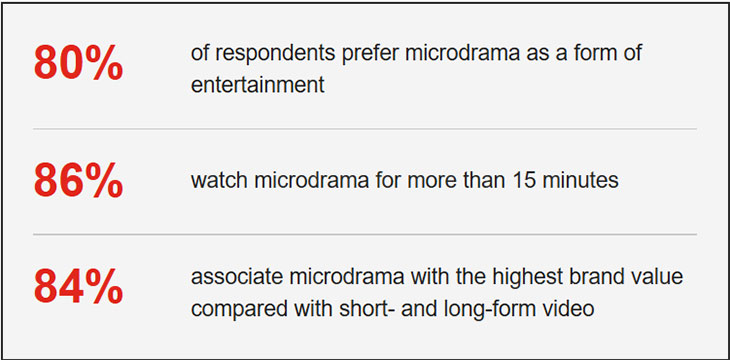
Perhaps more significant for marketers is the frequency with which audiences return.
“54 percent of the people who are watching microdrama return back on the same day which means they are emotionally invested in the characters and the narrative making it a big opportunity for brands to associate with them,” Mohanty said.
That repeat behaviour matters because it points to something beyond passive consumption. If audiences return to the same story and characters, there is an opportunity for brands to build associations over time rather than attempting to make an impression within a single 10-or 20-second advertisement.
This is perhaps the most interesting shift for marketers. Microdrama does not necessarily require brands to simply place another advertisement around content. Its episodic structure creates the possibility of making the brand part of the narrative.
Opportunity is particularly relevant in a market where audiences have become increasingly comfortable scrolling away from anything that does not capture their attention immediately.
For actor Arham Abbasi, who was also part of the panel, the first few seconds remain critical.
“The starting three seconds are key to engage a viewer who is sitting with his phone and can scroll away any second,” he said.
For brands, however, holding attention may require thinking beyond the conventional question of how long an advertisement should be. Industry leaders from different panels too agreed that brands must explore the microdrama format.
Sajit Gopal, Head of Media, Jubilant FoodWorks Ltd, argued that brands need to recognise short-form content as an essential part of the media landscape.
“Short-form content is a space that every brand needs to be,” he said. “The content has to be right.”
That distinction could become important as brands experiment with microdrama. The format may be short, but its strength lies in continuity. A brand that enters a story at the right moment can potentially benefit from the same repeat behaviour that keeps viewers returning to the next episode.
Sudip Sanyal, Vice President, Content, Partnerships & Experiences, Zenith Media, said the early numbers around the format were already promising. “It draws you in with storytelling, the connection can be longer and much deeper,” he said.
That is perhaps where microdrama's biggest opportunity lies. Its episodic format gives audiences a reason to return, while giving brands the possibility of building an association over multiple episodes rather than relying on a single advertising moment.
As the volume of content grows, the competitive advantage may not simply belong to those who can produce more stories. It could belong to those who can find the right story, put it in front of the right audience and give brands a role within it without breaking the connection.
For deeper insights, the full report can be accessed on:
https://ads.sharechat.com/research-and-insights/report-on-state-of-microdrama-in-india
Read more news about Digital Media, Internet Advertising, Marketing News, Television Media, Radio Media
For more updates, be socially connected with us onInstagram, LinkedIn, Twitter, Facebook, YouTube & Google News