OpenAI’s TOI & IE deals spark wider interest among news publishers
With the BCCL deal pegged at around $5 million a year and the Indian Express Group at about $3 million, several Indian publishers are exploring similar arrangements with Sam Altman’s firm
 by
by
Published: Sep 23, 2026 9:56 AM | 6 min read
 Follow Us

- OpenAI has formed partnerships with two major Indian newspaper groups, Bennett, Coleman & Co Ltd (BCCL) and the Indian Express Group, valued at approximately $5 million and $3 million annually, respectively, prompting interest from other publishers in similar arrangements.
- The partnerships aim to address concerns over copyright and monetization, as publishers seek compensation for their content used by AI platforms, while also ensuring transparency and attribution.
- The growing interest in AI licensing deals among Indian publishers reflects a broader trend, as global media companies have entered into similar agreements, with tech giants committing nearly $2.92 billion for news content as of January 2025.
- The ongoing debate between publishers and AI companies highlights the potential impact on journalism's business model, with concerns that AI-generated content could diminish traffic to original sources and lead to a "no-click era" in news discovery.
OpenAI’s recent partnerships with two of India’s largest newspaper groups have sparked fresh interest among other news publishers, with several now reaching out to the AI company to explore potential commercial arrangements around their content, sources privy to the development told e4m.
Sources familiar with the discussions estimate that the California-based AI firm’s partnership with Bennett, Coleman & Co Ltd (BCCL), publisher of The Times of India and The Economic Times, could be worth around $5 million annually, while the Indian Express Group deal is estimated at about $3 million a year. E4M reached out to BCCL, the Indian Express Group and OpenAI for details on the commercial terms, but none disclosed the value of the agreements.
“The twin deals have prompted other Indian publishers to step up their efforts to engage with the Sam Altman-led firm. A few leading publishers have approached Sam Altman-led company to explore potential partnerships, although they are yet to receive a commercial arrangement”, industry sources privy to the development told e4m.
There is a recognition that publishers invest in curating and producing original content, while news agencies also play a role in the wider content supply chain. If AI platforms are willing to pay for access to content from some publishers, there is growing interest in understanding whether similar conversations could extend to others as well.
“Such efforts, however, are likely to take time. Globally, publishers such as the Financial Times, News Corp, Washington Post, TIME, Le Monde and Condé Nast entered into similar partnerships with the firm at different points between 2023 and 2025,” industry executives told e4m.
Notably, OpenAI has signed content partnerships with over 25 news publishers covering 160+ outlets in over 20 languages, from the Associated Press in July 2023 to India’s TOI in September 2026.
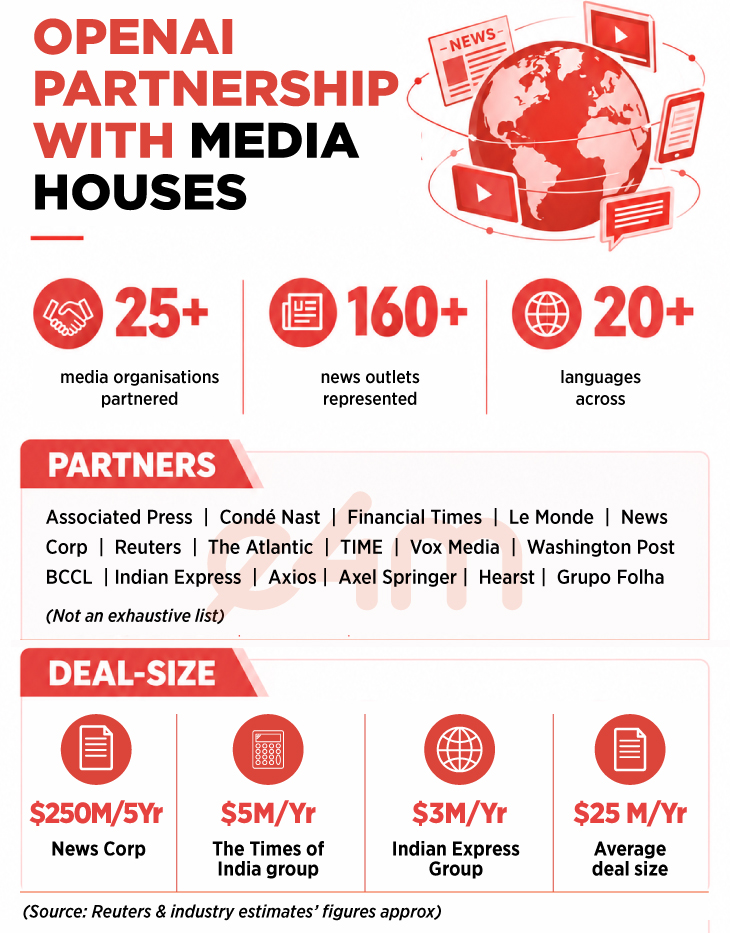
The largest reported deal is News Corp at over $250 million across five years. The average deal size is estimated at $25 million a year.
The experience of these global partnerships suggests that the conversations are not limited to compensation for copyright violation. At the time of the News Corp agreement in May 2024, CEO Sam Altman said the partnership would help create a future where AI “deeply respects, enhances, and upholds” the standards of world-class journalism. However, publishers had highlighted transparency, attribution and compensation as important elements of the relationship.
According to global media reports, Microsoft, Amazon, Google, Meta, Perplexity and Mistral have also signed publisher licensing deals covering the same content and uses. According to an estimate, these tech giants have made a $2.92 billion commitment for news content, as of January 2025.
For Indian publishers, the value of these deals therefore provide an early reference point for how the value of journalism could be assessed in an AI-driven discovery environment.
At the same time, more than a dozen publishers chose lawsuits over licenses, including The New York Times. They fear that tech giants are using their journalism as free fuel for AI products that could ultimately erode the very business model sustaining publishers. They also accuse OpenAI and Microsoft of even circumventing paywalls.
Also Read: Over ⅓ leading Indian news publishers block OpenAI as fair-share battle deepens
Cloudflare blocks AI crawlers: Digital publishers hail the move
Blocking Crawlers to Getting Commercial Deals
The latest development marks another stage in a debate that has been playing out between publishers and AI companies over the past few years.
Several leading publishers globally, including in India, had restricted or blocked ChatGPT and other AI crawlers two years ago over concerns around copyright, unauthorised use of content and monetisation. The underlying concern extended beyond content ownership: publishers were also worried that AI-generated answers could reduce the need for users to click through to the original source.
“OpenAI subsequently moved towards formal content partnerships with publishers in several markets, combining access to publisher content with attribution and links to original stories,” publishers noted.
For publishers, the commercial question is therefore becoming increasingly important: if AI interfaces become another major gateway to news discovery, how should the value of the underlying journalism be shared?
Could AI Deals Reshape Publisher Monetisation?
e4M has earlier reported that digital ad revenue and other non-print ventures now account for 25–30% of the total revenue of India’s news publishers, as print advertising faces pressure from declining circulation and broader economic constraints. Potential AI licensing deals could provide publishers with an additional revenue stream to help navigate these pressures.
The economics of the two Indian deals could provide an early reference point, although the reported figures remain unconfirmed. If the industry estimates of approximately $5 million for BCCL and $3 million for the Indian Express Group are accurate, they would put a tangible value on access to large archives, ongoing reporting and established news brands.
The scale and scope of the agreements will also matter. BCCL’s partnership covers participating English and Indian-language publications, while the Indian Express Group’s arrangement spans seven languages and includes both live reporting and archives.
For other publishers, however, the bigger question is whether such arrangements can develop into a broader commercial model rather than remain limited to a small number of large publishing groups. That question assumes greater significance as publishers contend with what could become a no-click era in digital discovery. If consumers increasingly use AI interfaces to find, summarise and understand news without necessarily visiting the source website, publishers could lose some of the page views that underpin digital advertising.
Many publishers believe that while content partnerships with tech giants may appear lucrative, they could still fall short of what would constitute fair compensation for the use of their content.
In India, The Digital News Publishers Association (DNPA) and ANI had sued OpenAI for allegedly infringing the rights of media organizations by training its Large Language Model (LLM) ChatGPT on the basis of online news reports. The DNPA, said in its argument at Delhi HC last year that circulation of physical newspapers had already come down drastically and ChatGPT would make even online news vanish. The case is still pending.
“If The New York Times and DNPA win the case, the outcome could push tech giants towards a more formal, paid market for news content. Both publishers and AI companies would have greater incentive to engage collectively, with licensing potentially offered at scale and payments structured around usage and the certainty of the legal framework,” said an executive.
Read more news about Digital Media, Internet Advertising, Marketing News, Television Media, Radio Media
For more updates, be socially connected with us onInstagram, LinkedIn, Twitter, Facebook, YouTube & Google News