Human safety and dignity must remain central in artificial intelligence: Ashwini Vaishnaw
At India AI Impact Summit, Ashwini Vaishnaw emphasized that while we harness the benefits of AI, we must also find collective solutions for mitigating the risks
 by
by
Published: Feb 19, 2026 10:54 AM | 4 min read
 Follow Us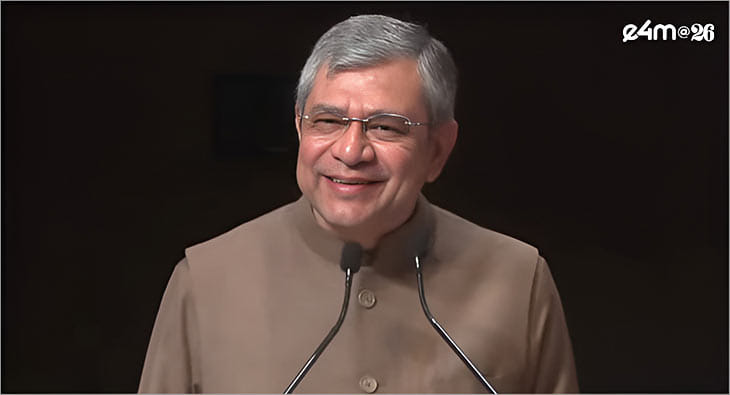

“While we harness the benefits of AI, we must also find collective solutions for mitigating the risks,” Union Minister of Information & Broadcasting, Ashwini Vaishnaw, said on the fourth day of the India AI Impact Summit, underlining that “human safety and dignity” must remain central as countries accelerate adoption of artificial intelligence.
“By placing human safety and dignity at the heart of AI, we can move forward with conviction,” Vaishnaw added, framing India’s AI strategy as one that combines scale, access, sovereignty and responsibility. Calling AI a “foundational technology,” Vaishnaw said it is already “transforming how we work, learn, and make decisions,” and positioned India’s approach around Prime Minister Narendra Modi’s vision of ensuring technology benefits reach the masses.
“Our Honorable Prime Minister, Shri Narendra Modiji, believes that the true value of technology lies in ensuring that its benefits reach the masses,” he said. “Our Prime Minister’s vision is to democratize technology, deploy it at scale, make it accessible to all.”
Vaishnaw said India is working across “all the five layers of the AI stack,” starting with applications. “The first layer is the application layer. We sincerely believe that ROI will come from this layer,” he said, adding that this is where the “real benefit will flow to the masses.”
He said the government is building real-world AI solutions across sectors including “healthcare, agriculture, education, logistics, design, financial services,” and “every sector, wherever the benefits can reach the masses.”
The minister then moved to the model layer, linking it directly to sovereignty. “The second layer is the model layer, and that’s where the sovereignty comes in,” he said.
While acknowledging that very large frontier models will continue to push innovation, Vaishnaw argued that India’s needs will largely be met through smaller, specialised models.
“We also understand and believe that more than 90% of the use cases can be addressed with smaller focused models,” he said, adding that these models will deliver value at “much lower cost, cost per token as well as overall cost of access.”
Vaishnaw said India’s “bouquet of sovereign models,” several of which were launched during the summit, are focused on “multimodal and multilingual capabilities” to match India’s diverse linguistic environment.
On the compute layer, Vaishnaw said India is treating access to GPUs as a democratised public infrastructure priority. “The third layer is the compute layer, and here, once again, our Prime Minister’s vision of democratizing technology is clearly visible,” he said.
“We treat compute as a public good,” Vaishnaw said, announcing that India has created a common compute platform through a public-private partnership.
He said the platform is providing access to “38,000 GPUs at a very affordable rate” for “startups, academia, researchers, and students,” and added that India will be “adding another 20,000 GPUs” to the platform.
Vaishnaw said the fourth layer, AI infrastructure, will be supported by India’s talent pool and policy direction, pointing to what he described as a major shift announced in the Union Budget.
He said the Prime Minister has pushed for “getting the world’s data to India, to reside in India, to be processed here, and to deliver high-value services to the entire world.”
“We expect large investments in data centers in the coming months,” Vaishnaw added.
Vaishnaw also cited Stanford University’s AI Index, saying it places India among leading countries in “AI adoption, AI talent, and AI diffusion.” At the same time, he acknowledged workforce challenges as AI reshapes the economy.
To address this, he said the government is working with industry and academia “to upskill, reskill, and to build a new talent pipeline for this new intelligence age.”
Closing the address, Vaishnaw urged collective action through the summit and beyond, framing the next phase of AI as a human-centred project.
Read more news about Digital Media, Internet Advertising, Marketing News, Television Media, Radio Media
For more updates, be socially connected with us onInstagram, LinkedIn, Twitter, Facebook, YouTube & Google News
