Brands train AI guns against fakes, frauds and farms
Indians lost over ₹11,000 crore to cyber crimes in the first half of the year. Here's how brands and their tech allies are now employing AI against AI-driven frauds
 by
by
Published: May 2, 2025 8:46 AM | 7 min read
 Follow Us

Ad fraud is no longer just a cost of doing digital business—it’s a full-blown war. In 2024, Indians lost over ₹11,000 crore to cyber fraud in just the first half of the year. That’s ₹60 crore being siphoned daily from people’s accounts; thanks to anything from a faked email from a boss or colleague, a text message from a bank you trust or a brand you frequently buy, or even an old school flashing neon banner ad, which ends up being more risky than risqué.
And as fraudsters become increasingly sophisticated—wielding deepfakes, AI-generated bots, and click farms like digital swords—Indian brands and their tech allies are bringing out the big guns: AI.
“The irony is that AI has become the best defense against AI-driven ad fraud,” says Prasun Kumar, Chief Marketing Officer at Magicbricks. “Brands now use machine learning for real-time anomaly detection, pattern recognition, and predictive analytics to combat click fraud and deepfakes.”
And it’s not just a trend—it’s an arms race.
India has already seen a 36% reduction in ad fraud rates this year, thanks to increased adoption of AI-powered ad verification tools, according to DoubleVerify’s 2024 Global Insights Report. Global giants like Google suspended a jaw-dropping 39.2 million advertiser accounts in the same period, using AI tools to detect policy breaches and suspicious activity—three times more than the previous year, as revealed in the recently released Ads Safety Report by Google.
Closer home, Bharti Airtel took things a notch further by launching India’s first network-based, AI-powered spam detection system. It processes a trillion data points in real time and flags over 100 million spam calls and three million spam SMSes every day. It’s not just telco hygiene; it’s battlefield-level defense.
But in a fragmented, fast-moving ad ecosystem, generic solutions don’t always cut it. “Indian brands are fighting back against AI-powered fraud with hyper-local tools,” says Bala Kumaran, Founder and Director of BrandStory. “We once caught a deepfake ad featuring a fake Virat Kohli mid-campaign—by analyzing unnatural facial tics. In another case, 8,000 users came from a single IP in Nagpur. Classic click farm stuff.”
His agency doesn’t just rely on flashy tech. They’re also experimenting with blockchain to publicly log ad interactions—cutting out shady middlemen—and implementing reward-based models for clean engagement. “Instead of invasive tracking, we offer quizzes that give discounts in exchange for honest preferences,” he explains. “Privacy isn’t a hurdle; it’s a design principle.”
What unites all these efforts is one clear trend: the AI is getting smarter, but so are the fraudsters. That means staying still is not an option.
“Machine learning models are now used to detect irregularities in traffic patterns by flagging behaviors that suggest fraudulent activity,” says Pulkit Narayan, Founder and CEO of DangleAds. “These models continuously learn from real-time data to improve accuracy. It’s not just about bots anymore—it’s about bots pretending to be humans.”
He adds that behavioral analytics and biometrics are coming into their own. “Tracking mouse movements, click speeds, and user interaction patterns helps differentiate between real users and bots. For deepfakes, we use AI-powered image and video forensics to spot manipulated media before it tarnishes brand credibility.”
Another critical piece of the puzzle is predictive analytics. Instead of reacting after a scam has eaten up your media budget, these tools score incoming traffic and weed out suspicious inventory before the ad even serves.
This kind of preemptive strike mentality is what’s helping brands hold their ground—and even go on the offensive.
Chetan Barapatre, Senior Manager, Growth Advisory, Aranca, says to counter these new sophisticated frauds, AI is being used for defence, relying on behavioral analytics, pattern recognition, and visual forensics to stop fraud in real-time and at scale. “Techniques such as ML based real-time anomaly detection, Pre-Bid Fraud Filtering, Deepfake Detection Tools, AI-Enhanced Graph and Relationship Mapping, Botnet fingerprinting, AI based Viewability scoring and LLM models for advertiser vetting are now increasing being adopted in India.”
Solutions from mFilterIt, AppFlyer, Adjust, IAS, TrafficGuard, MOAT, Double Verify, Comscore, Fraud0, etc. are being used by brands such as HUL, Zee Entertainment, Tata Neu, Madison World, Hotstar, Flipkart and many more. Barapatre adds that while the impact and effectiveness of these tools varies, proven use cases display that using these tools will help counter ad fraud.
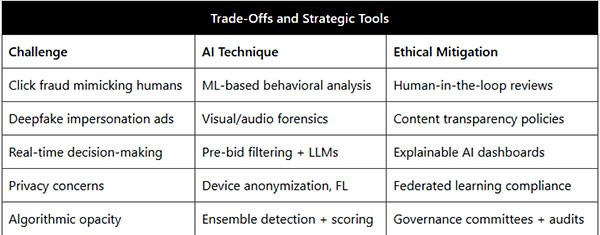
“Working examples of these initiatives is common with brands such as HUL and Jio that demand visibility reports with traffic-level breakdowns, have third-party audit provisions in vendor contracts and have internal policy to have periodic human oversight with any AI tool,” adds Barapatre.
“At Magicbricks, we’ve built in-house AI/ML models that verify listings, flag fakes, and ensure that asking prices are relevant,” says Kumar, noting, “It’s not just about user safety—it’s about market integrity.”
Similarly, AI tools like Consuma filter out bot responses and AI-generated content using purpose-built models they have in-house. “When it comes to measurement, however, ad platforms and brands are both left struggling with this issue. Incentives are also not aligned - brands want genuine clicks only, with aggressive bot filtering - which results in lower numbers that threatens ad-platforms’ topline - who, to be fair, argue that aggressive filtering leads to loss of some number of genuine interactions,” says Abhilash Madabhushi, Founder, Consuma AI.
According to him this tension is where today’s landscape lies. “With LLMs becoming cheaper and better - we foresee this only becoming a bigger issue in the future.”
But even as brands lean harder on AI, many are also wary of turning their tools into black boxes that alienate users or breach privacy.
“Real-time fraud detection is important in the fast-moving programmatic ecosystem,” Narayan points out, “but it can’t come at the cost of user trust. That’s why more brands are adopting privacy-first AI tools that analyze behavioral patterns without collecting personally identifiable information.”
There’s also a slow but steady move toward transparency. “To address the ‘black box’ concern, many brands are adopting explainable AI frameworks. These offer visibility into how fraud is detected and blocked. They’re also working closely with third-party auditors to ensure ethical data practices,” adds Narayan.
Kumaran’s team has taken the transparency mandate quite literally—with click dashboards that give real-time, human-readable reasons for fraud flags. “User aged 122? Nice try, bot,” he quips.
Despite the snark, the message is serious: Indian marketers are building ad fraud prevention models that are not just effective, but accountable.
And collaboration is becoming just as important as innovation. “Competing brands are now sharing fraud data in real time,” Kumaran says, adding, “It’s creating a united front against bots.”
The underlying truth is that ad fraud isn’t going anywhere. As long as there’s money to be made, fraudsters will keep innovating. But so will the defenders. By combining cutting-edge AI, local intelligence, privacy-aware design, and shared industry learnings, Indian marketers are proving that it’s possible to fight fraud and build trust.
Read more news about Digital Media, Internet Advertising, Marketing News, Television Media, Radio Media
For more updates, be socially connected with us onInstagram, LinkedIn, Twitter, Facebook, YouTube & Google News