Are Indian brands moving back to walled gardens from the open internet?
Since on the open web, attribution is fragmented and less reliable, experts say brands are reallocating to walled gardens as it helps with data control, measurability, and brand safety concerns
 by
by
Published: Apr 25, 2025 9:35 AM | 6 min read
 Follow Us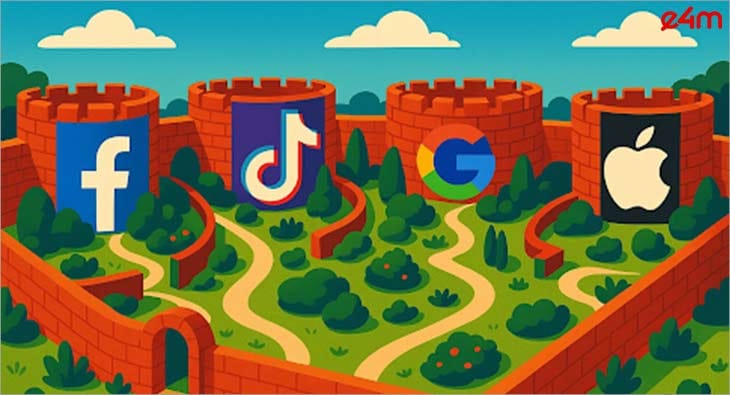

There was a time—not that long ago—when the open internet seemed poised to become the ultimate playground for advertisers. A freewheeling bazaar of endless choice, contextual targeting, and democratic reach. But if recent ad spend patterns are anything to go by, Indian brands are quietly packing up their tents and heading back inside the safe, shiny compounds of walled gardens.
In 2024, Google and Meta alone accounted for a staggering 65% of India’s digital advertising pie, collectively raking in ₹50,000 crore in the year. Add Amazon and Flipkart’s booming retail media networks—together pulling in ₹11,621 crore, or 22.93% of total spends—and you’re looking at an ecosystem where the vast majority of ad budgets are flowing into just a handful of tightly controlled platforms. The open internet? Despite accounting for 52% of user attention, it receives under 15% of ad spends. That’s not a trickle—it’s a drought.
So what’s drawing Indian marketers back inside the gates? For one, performance and accountability.
“Indian brands are increasingly shifting their advertising budgets away from the open web and toward walled gardens such as Google, Meta, Amazon, Flipkart, and Jio,” says Yaron Tomchin, CEO of Mobupps. “Performance expectations, data control, measurability, and brand safety concerns are driving this reallocation.”
In other words, marketers are tired of guesswork. Walled gardens offer closed-loop attribution and real-time optimization—something the open internet struggles to provide, especially in a post-cookie landscape. “Walled gardens offer closed-loop tracking, enabling brands to see the full user journey and optimize in real-time,” adds Tomchin. “On the open web, attribution is fragmented and less reliable.”
Jacob Joseph, VP - Data Science at CleverTap, highlights the advantage of precision targeting. “Walled gardens provide robust targeting capabilities by leveraging rich user data, enabling brands to reach specific demographics and behavioral segments with a high degree of precision. This enhances message relevance and campaign performance.”
It’s not just the tech that’s changed—it’s the cost calculus. The government’s quiet rollback of the 6% Equalisation Levy on foreign digital platforms has made advertising on global giants like Meta and Google cheaper. “By reducing the overall cost of advertising on foreign digital platforms, it adds another layer of financial incentive for marketers to prioritize walled gardens,” Joseph points out.
The platforms themselves have made it increasingly easy for advertisers to get on board. Tools like Google’s Performance Max and Meta’s Advantage+ offer AI-assisted campaign automation, optimization, and performance tracking with minimal human input. “Automated tools like Meta Advantage+ and Google Performance Max simplify campaign setup and scaling,” notes Tomchin. “In contrast, open web campaigns often involve multiple vendors and longer lead times.”
And then there’s the big looming compliance cloud—India’s new DPDP Act. In a digital economy where data is the new oil, who controls the pipelines matters. Walled gardens do. “As data privacy laws evolve, reliance on third-party cookies makes the open web less effective,” says Tomchin. “With India tightening data protection laws, walled gardens are better equipped to handle user consent and compliance.”
Retail media is the latest star in the walled garden constellation. Amazon and Flipkart don’t just offer ad space—they let brands advertise and attribute within the same purchase journey, closing the loop in a way the open web simply can’t match without complicated tech stacks. And those numbers are surging: ₹11,293 crore in ad spends on retail media networks in India alone last year.
That’s not to say the open internet is down for the count. But it’s on the ropes.
“Primarily, it comes down to performance, scale, and measurability,” says Nishant Gopalia, Senior VP - Media and MarTech at Tonic Worldwide. “Walled gardens like Google, Meta, and Amazon offer end-to-end solutions—with reliable targeting, attribution, and optimization tools—all within a single platform.”
Still, Gopalia believes the open web has a role to play—if it evolves. “To stay competitive, publishers need to embrace programmatic more strategically—especially by partnering with larger DSPs and plugging into high-quality supply paths,” he says. “The open web still has a vital role in upper-funnel storytelling and contextual advertising—areas where it often outperforms closed platforms.”
But staying competitive is becoming harder. As budgets consolidate, smaller players are feeling the squeeze. CPMs on the open web are dropping, and premium campaigns are getting rerouted into big-tech pipelines.
“Independent publishers and programmatic platforms… struggle to compete with the first-party data and closed-loop measurement offered by dominant tech players,” says Tejas Maha, Group Head – Media at White Rivers Media. “Over time, this could stifle innovation and content diversity.”
There’s also a transparency problem. As Maha notes, “Transparency wanes, limiting external partners' access to campaign performance and audience insights.” Brands may love the convenience, but they lose visibility into how their money is actually being spent.
There’s no doubt that walled gardens offer performance, predictability, and now, regulatory comfort. But they also lock out innovation, limit competition, and—ironically—create a dependency that brands may come to regret.
Vedavyas Badri, DVP – Programmatic at LS Digital, puts it bluntly: “As investments concentrate within a few dominant platforms, brands lose bargaining power, becoming exceptionally dependent on these few platforms that control decision-making and data access for the brands.”
He warns this growing dependency could create long-term damage: “This could make India’s digital advertising landscape less dynamic in nature, less diverse in its characteristics, and increasingly centralised—taking away its virtue of being vibrant and innovative.”
Badri also reminds us of the sheer global scale of this shift. “With the share of the world's largest walled gardens in global digital advertising revenue estimated at 78%, marketers often find themselves picking accountability in the high-stakes landscapes.”
So where does that leave the open web? Still alive. Still vital. But in need of investment—not just in inventory or reach, but in infrastructure, identity, transparency, and value measurement.
As Joseph suggests, the answer might lie in balance, “To maximize return on investment, brands should consider adopting a more balanced approach by leveraging the targeting strengths of walled gardens while continuing to invest in the open internet for discovery, contextual relevance, and broader brand building.”
In the end, Indian brands aren’t just moving to walled gardens. They’re moving to control, clarity, and convenience. Whether they stay there permanently—or eventually come up for some open air—will depend on how well the rest of the ecosystem catches up.
Read more news about Marketing News, Advertising News, PR and Corporate Communication News, Digital News, People Movement News
For more updates, be socially connected with us onInstagram, LinkedIn, Twitter, Facebook, YouTube & Google News