Cannes Voices: Dheeraj Sinha on what the jury room must reward
As a member of this year's Creative Strategy jury, Dheeraj Sinha makes the case for strategic courage and warns the industry against mistaking cultural aesthetics for genuine human insight
 by
by
Published: May 29, 2026 9:10 AM | 10 min read
 Follow Us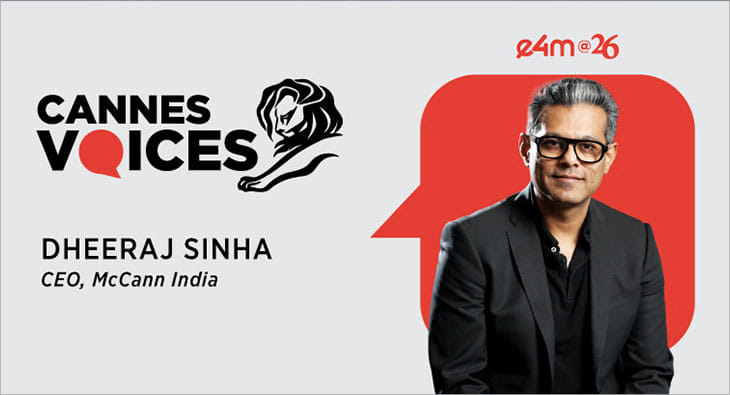

- Dheeraj Sinha, CEO of McCann India and President of the Advertising Club of India, is recognized for his strategic expertise in advertising, having transformed brands like PepsiCo and Amazon over his 30-year career.
- He will serve on the Creative Strategy jury at the Cannes Lions International Festival of Creativity 2026, where he emphasizes the importance of strategic clarity and the ability to reframe problems in advertising.
- Sinha distinguishes between culturally reactive campaigns, which often lack depth, and insight-driven work that resonates on a deeper emotional level, arguing that the latter tends to endure beyond fleeting trends.
- He advocates for rewarding strategic courage in advertising, encouraging work that challenges conventions and embraces originality in dynamic markets like India, where traditional frameworks may not apply.
Strategy, in advertising, has always been the discipline that does most of its work in the shadows. The brief, the insight, the reframing of the category, none of it shows up in the reel. What shows up is the film, the platform, the campaign. And yet, every creative director worth the title will tell you that the difference between work that merely looks good and work that changes the commercial conversation for a brand almost always traces back to the quality of a strategic idea. It is the invisible architecture that holds everything else up.
Dheeraj Sinha has spent the better part of three decades building that architecture, and thinking rigorously about what separates the kind that endures from the kind that collapses at the first sign of cultural pressure. As CEO of McCann India (a role he assumed in late 2025 following the landmark Omnicom-IPG merger, one of the most consequential holding-company realignments in the industry's recent history), Sinha carries a reputation as one of the sharpest strategic minds in Indian advertising.
Over his career, Sinha has built and transformed brands including PepsiCo, Uber, Spotify, Amazon, Tata AIG, and ITC Aashirwad, working across networks. From his early years at McCann Erickson, Euro RSCG, and Bates, through leadership roles at Grey, Leo Burnett South Asia, BBH India, and FCB, each transition was accompanied by the kind of creative and commercial turnaround that agencies announce and clients remember. He is also the current President of the Advertising Club of India, a role that places him squarely at the centre of every important conversation the industry is having about its own future.
This June, that conversation moves to the Croisette. Sinha is one of fourteen Indian jurors at the Cannes Lions International Festival of Creativity 2026, scheduled from 22 to 26 June, and sits on the Creative Strategy jury. It’s a category that, perhaps more than any other, asks the industry to defend not just what it made, but why. Joining a panel that includes the Global Chief Strategy Officers of Wieden+Kennedy, TBWA Worldwide, and VML, he will be one of the few jury members whose mandate extends to the entire Indian market, where legacy systems are rarer, and the consumer landscape shifts at a pace that demands a different kind of strategic instinct.
When we spoke to Sinha ahead of the festival, it became clear that his framework for evaluating strategy (whether in the jury room or in the briefing room) rests on a set of distinctions that sound simple and are genuinely hard to apply.
The strategic leap
The Creative Strategy category at Cannes has, over the years, produced a particular kind of submission: the case study that explains, with forensic precision, how insight led to platform led to work led to result, with each step flowing inevitably from the last. It is a format that rewards logical coherence. What it does not always reward is the moment of genuine strategic surprise.
"At the final stage, what separates the truly exceptional work is usually the clarity of the strategic leap," he says. "You suddenly see a problem differently. Or a category differently. Or the role of the brand differently. The best work has that rare quality of feeling both surprising and completely obvious in hindsight. You can trace a very clear line from human understanding to strategic thinking to creative expression to business impact."
The phrase 'surprising and completely obvious in hindsight' is worth pausing on. It describes something specific: not novelty for its own sake, but a reframing so well-grounded in human or cultural truth that, once you've seen it, you cannot imagine the category without it. The brands that have produced this kind of work did not just execute well. They saw their problem differently before a single frame was shot.
The challenge for strategists in India is that this kind of reframing often requires resisting the gravitational pull of category convention. Markets where legacy brands have spent decades building specific associations tend to calcify around a received set of truths about what the category is for, who it speaks to, and what it is allowed to say. The strategic leap, in this context, is frequently the act of refusing that received wisdom and having the credibility and the evidence to back the refusal.
Insight versus reaction
If the strategic leap is the highest expression of the discipline, cultural reactivity is its most seductive counterfeit. The speed of the current media environment (combined with the sophistication of social listening tools and the perpetual incentive to be seen as relevant) has created a generation of campaigns that are, in Sinha's formulation, borrowing the aesthetics of culture without actually understanding it.
"A lot of culturally reactive work is really just borrowing the aesthetics or language of culture," he says. "It may feel current, but it doesn't always reveal anything meaningful about people. It has topical relevance, but not necessarily emotional depth. Real insight comes from recognising a deeper human connect — something people instinctively relate to, even if they've never articulated it themselves. That's the difference."
The distinction between topical relevance and emotional depth maps closely onto a structural problem in how campaigns are commissioned and evaluated. A campaign tied to a cultural moment can produce impressive short-term metrics. It will be shared, discussed, and attributed. Then the moment passes, and so does the campaign. Insight-led work, Sinha argues, operates on a different timescale.
"Reactive work often disappears as quickly as the moment that inspired it," he says. "Insight-led work tends to endure because it is rooted in behaviour, identity, aspiration, contradiction — the things that don't vanish with the news cycle."
This is not a new observation, but it bears repeating with increasing urgency in an era when the infrastructure for cultural reactivity has never been more capable. The tools for producing reactive work are faster and cheaper than they have ever been. The result is a market flooded with work that is competent, current, and forgettable. The jury room, for Sinha, is one of the few places where the industry formally bets on the alternative.
What data can and cannot do
The rise of data-led planning has produced its own version of this tension. The argument, made with increasing confidence by the industry's tech and measurement vendors, is that behavioural data has made intuitive insight redundant: that you can now derive strategy from signals rather than from the messier, slower process of understanding what people actually feel. Sinha is unconvinced and precise about why.
"Data can explain behaviour," he says. "Insight explains motivation. And the most effective creative strategies are still built on a deep understanding of what people value, fear, desire, resist, or aspire to. In fact, as AI becomes more democratised, originality increasingly comes from interpretation, empathy, and the ability to connect commercial ambition with human truth."
The data/insight distinction is important because the two are often conflated in planning conversations. Data can tell you that a segment of users abandons a checkout page at a particular step, or that engagement on a content format peaks at a specific length. What it cannot tell you is why those users distrust the brand enough to hesitate, or what they are actually looking for when they engage. The motivational layer requires a different kind of attention. As AI tools become more adept at processing and synthesising behavioural data at scale, the competitive edge in strategy shifts toward the human capacity to interpret what the data means rather than to describe what it says. Sinha's framing names this directly, and it has implications for how agencies build their planning functions.
From shortlist to awarded
The Creative Strategy category, like most Lions categories, produces a genuinely impressive shortlist. A collection of campaigns that have been rigorously evaluated and found to have met a high threshold of craft and effectiveness. The gap between the shortlist and the winners is not always about quality. It is about a particular kind of intentionality.
"Usually, it's the difference between solving a communication problem and solving a business or human problem," Sinha says. "Awarded work tends to have sharper intentionality. There's often a strong strategic leap, which could be a reframing of the category, audience, behaviour, or role of the brand. The idea feels necessary rather than decorative."
The word 'necessary' is the tell here. Decorative work has a function, as it fills media space, it maintains presence, and it signals investment, but it does not change anything. Necessary work intervenes in a category, a cultural conversation, or a commercial relationship in a way that shifts the terms of the engagement. It is the kind of work that brands look back on as a turning point, not as a campaign. Sinha's second marker is equally significant.
"The strongest campaigns have strategic thinking embedded into every decision," he adds, "from the creative platform to execution to participation to outcomes." This is coherence of a particular kind: not visual consistency, not brand guidelines, but the presence of the same strategic logic at every level of the work. The brief and the billboard should be solving the same problem. The media plan and the insight should be in the same conversation. When they are, the work holds together under pressure. When they are not, the cracks appear the moment the campaign leaves the agency.
The markets the industry isn't watching closely enough
The final question Sinha addresses is also the most pointed, and it is worth reading as something approaching a manifesto for what the Creative Strategy jury should be looking for this year. He is not interested in work that has succeeded by working within established systems. He is interested in work that has succeeded despite their absence.
"Some of the most interesting strategic thinking today is coming from places where marketers cannot rely on legacy systems or predictable consumer behaviour," he says. "They have to build relevance in incredibly dynamic environments."
India is the obvious reference point: a market of over a billion active consumers, several dozen languages, radical income stratification, and a media landscape that has been transformed multiple times in a decade by Jio, by the explosion of short-form video, and most recently by the aggressive entry of generative AI into the creative workflow. There is no playbook for this environment. The strategic thinking that emerges from it is, by necessity, more original than work that has the luxury of following one.
Sinha's second prescription is starker. "I also think the industry should reward strategic courage more strongly," he says. "Work that challenges category conventions, resists algorithmic sameness, and takes a clear stance instead of trying to appeal to everyone."
The phrase 'algorithmic sameness' is the most contemporary thing in this interview, and possibly the most important. As media platforms optimise for engagement and as AI tools train on the creative corpus of the past, the gravitational pull toward a certain kind of content intensifies. The result is a creative ecosystem in which the work that performs best in the short term looks increasingly like the work that already exists. Strategic courage, in this context, is the act of making a different bet: the bet that audiences will respond to something they haven't seen before, that a clear stance is more valuable than broad appeal, that distinctiveness is worth the risk of alienation. It is, Sinha would argue, the only bet worth making.
As he takes his seat on the Creative Strategy jury in Cannes this June, alongside some of the most influential strategic voices working globally today, the question he will be asking of every entry is the same one he has spent a career asking in briefing rooms across India and Asia: not whether the work was well-made, but whether the strategy was genuinely necessary. Whether it saw the problem differently. Whether the leap was real.
Read more news about Cannes Lions Festival, Advertising, Marketing, Digital Media, PR & Corporate Communication News
For more updates, be socially connected with us onInstagram, LinkedIn, Twitter, Facebook YouTube , WhatsApp & Google News