Surrogate Ads: Can brands use minors as proxies?
As the debate around minors in advertising heats up, industry heads say that the terrain around minors is murky and the grey zone begins when minors are used less as real consumers and more as shields
 by
by
Published: May 8, 2026 9:16 AM | 8 min read
 Follow Us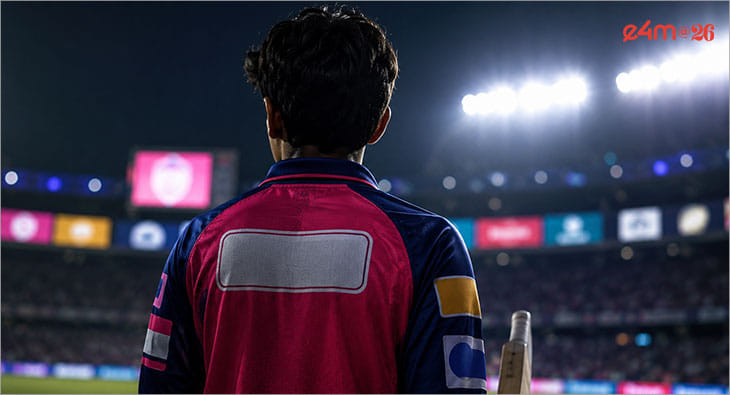

- Vaibhav Sooryavanshi, a 15-year-old cricket prodigy, plays for Rajasthan Royals in the Indian Premier League and sports the logo of Oaksmith Style Studio, a brand extension of a whisky company, raising concerns about surrogate advertising in India.
- The legal framework in India allows alcohol brands to promote lifestyle ventures, but the use of minors in such advertising is controversial, with industry experts highlighting the ethical implications despite the lack of explicit prohibitions.
- Critics argue that the surrogate advertising system in India is ineffective and hypocritical, as it aims to protect minors from alcohol marketing while still allowing alcohol brands to influence young audiences through sports sponsorships.
- The conversation emphasizes the need for transparency and responsible marketing practices, suggesting that the focus should be on the intent and context of advertising rather than outright bans on child participation in marketing.
There is a 15-year-old boy who can bat wonderfully. He plays for Rajasthan Royals in the Indian Premier League. His name is Vaibhav Sooryavanshi, and he is, by any measure, a prodigy. But somewhere on his jersey sits the logo of Oaksmith Style Studio, a whisky brand extension from Beam Santory. And that, right there, is the question nobody in the industry wants to answer out loud.
Oaksmith Style Studio is not a whisky brand in the eyes of the law. It is a fashion and lifestyle venture. A brand extension that’s perfectly legal, carefully constructed, and firmly within the framework that allows alcohol companies to advertise in India, provided they pitch something else entirely. A soda. A mineral water. A music CD. A style studio. The product sold is a lifestyle. The product being built is brand recall for a liquor label, inside the minds of a country that watches cricket like a religion, including, and especially, its children.
The old trick in new clothes
India's advertising regulatory architecture has long grappled with the surrogate ad problem. The Cable Television Networks (Regulation) Act, the ASCI Code, and guidelines from the Ministry of Information and Broadcasting all restrict the direct advertising of tobacco and alcohol. What emerged in the vacuum was a parallel universe of proxies (brands that sell music CDs nobody buys, soda nobody remembers, and now, lifestyle studios nobody visits) just so the parent brand can stay in the national conversation.
Manisha Kapoor, CEO and Secretary General of the Advertising Standards Council of India, is careful to draw the line where the law draws it. "Surrogate advertising refers to a banned practice in India under various statutes. However, what is permissible and allowed by law is brand extensions of alcohol brands into genuine categories with genuine business models. So long as the creatives of the brand extension do not violate any law, and do not cue the prohibited category, there are no other restrictions as such on their creative representation," she says.
The phrase 'genuine business model' is doing a lot of heavy lifting in that sentence. And Kapoor herself acknowledges that the terrain around minors is murkier than the law lets on. "While the use of minors in ads of brand extension is not expressly prohibited, it may not be good practice. The National Commission for Protection of Child Rights has detailed guidelines on the use of child talent in media. Those need to be abided by for all commercial media production," she adds.
Not expressly prohibited. May not be good practice. In advertising, that gap between what is legal and what is right has historically been where the most creative (and the most cynical) decisions are made.
The child as cultural currency
The deeper issue is not merely regulatory. It is strategic. Brands (particularly those that are age-restricted or perception-burdened) have increasingly recognised that young talent carries a specific kind of cultural power. They signal aspiration. They attract young audiences. They generate social media traction with an authenticity that no thirty-second ad can manufacture. A fifteen-year-old cricketing sensation on a jersey is not just a sponsorship placement. He is a cultural statement.
Prathap Suthan, Managing Partner and Chief Creative Officer of Bang In The Middle, frames this tension with unusual clarity. He begins from first principles: children belong in advertising when the context is honest. "Using minors in advertising is not wrong in itself, especially when the products are genuinely for them: toys, biscuits, cereals, chocolates, juices, jams, butter, cakes, health supplements, dental care and so on. In these categories, showing children enjoying what they actually use is an honest reflection of reality," he says.
The argument extends naturally. Children are not outside the economy; they are part of household decision-making, they influence purchases, and they consume media voraciously. Excluding them from brand storytelling would produce campaigns that feel sanitised to the point of unreality. "Families are a truthful frame," Suthan notes, and he is not wrong.
But then he pivots to the exact nerve that the Oaksmith-Sooryavanshi case touches. "The grey zone begins when minors are used less as real consumers and more as emotional shields, or as vehicles to soften a brand, bypass adult scrutiny, or manufacture cultural coolness for products that are not meant for them. In such cases, the child becomes a kind of cover rather than a genuine user. That is where the echo of surrogate advertising can be heard," Suthan says.
Problem in the framework?
India's surrogate advertising ecosystem, built on the twin pillars of legal technicality and regulatory complicity, has never fully convinced anyone. The pretence that Royal Stag really wants to sell you a music CD, or that Kingfisher's soda business is a genuine commercial enterprise, is one of Indian advertising's most elaborate open secrets. The industry knows. Regulators know. Consumers know. And yet the system persists.
Lakshmipathy Bhat, a self-employed brand communications advisor and former Vice President at FCB Ulka, pulls no punches. "Surrogate advertising framework in India is a joke. If the intent is to shield minors and those below legal drinking age from alcohol ads and 'influence', it is only lip service. Pubs serve alcohol to school kids. Even kids are aware of alcohol brand names through sports teams, 'drinking water,' or 'music CDs'," he says.
The hypocrisy, as Bhat sees it, is structural. "Liquor brands have to advertise some other 'line of business' than the alcohol brand in India. The hypocrisy of such a government policy is apparent. I guess the intent was to shield youngsters from age-inappropriate categories and their brands. Meanwhile, we see liquor being served to minors in so many establishments in our towns," he observes.
He goes further by identifying what the industry never says in polite company. "The industry's future depends on bringing in younger audiences to the fold, and hence the targeting and messaging are understandable," Bhat says. That sentence deserves to be read twice. The future of alcohol marketing depends on young people. And young people are watching cricket. And cricket jerseys have brand logos. And some of those brand logos belong to whisky labels that are technically advertising lifestyle studios.
The Pitch Madison Advertising Report 2025 flagged the IPL as commanding over ₹5,000 crore in ad revenues annually, making it the single largest advertising event in the Indian calendar and a natural battleground for brands that want mass visibility at any cost.
Peer influence, not prime time
One of the more uncomfortable truths that emerges from this conversation is that advertising, for all its cultural power, may not actually be the primary vector through which young people encounter harmful products. Suthan makes this point with characteristic directness. "Advertising is not the main driver of harmful behaviour such as smoking or substance use. Most minors pick up such habits from peers, family members, or the wider environment, not from advertisements. You rarely see children smoking on screen, yet the habit spreads through real life, through social cues and imitation," he says.
If that is true, then the regulatory energy spent policing jersey logos and brand extension creatives may be addressing the symptom rather than the disease. The question is not whether the jersey triggers a desire for whisky in thirteen-year-olds watching the match. The question is what it normalises. What it places inside the frame of aspiration and success. Oaksmith Style Studio is a name that now lives in the visual grammar of the IPL, and IPL is the grammar of modern Indian sporting culture.
Bhat sees a path through the fog, and it points toward transparency rather than restriction. "It feels that being upfront about the category advertised and measures to encourage more responsible consumption seem to make business sense," he says, nodding to how markets like Western Europe have approached alcohol marketing with age-gating, consumption messaging, and honest category identification.
Intent, not innocence
The advertising industry in India is not short of self-regulation mechanisms. ASCI has the tools. The NCPCR has the guidelines. The MIB has the notifications. What is missing is not the framework, but the will to apply it to situations that are technically legal but functionally manipulative.
Suthan's closing argument is, perhaps, the most useful one for regulators, brand managers, and creative directors to sit with. "The focus should be on clarity of intent and honesty of context, not on banning children from advertising altogether," he says. The test is not the age of the talent. The test is what the talent is being used to do.
Is Vaibhav Sooryavanshi being used to sell a genuine style studio? Or is he being used to attach a whisky brand to the emotional voltage of a teenage cricketing prodigy in the world's most watched cricket tournament, building familiarity, warmth, and aspiration for a product that, by law, cannot speak its own name?
The answer is not hard to find. The industry just has to be willing to say it out loud.
Read more news about Internet Advertising India, Marketing News, PR and Corporate Communication News, Digital Media News, Television Media News
For more updates, be socially connected with us onInstagram, LinkedIn, Twitter, Facebook YouTube & Google News