Piyush Pandey: The man who taught India to speak human
Niranjan Kaushik, the Chief Content Officer at Fingerprint Films, India, an advertising creative director and filmmaker, has paid tribute to adman Piyush Pandey
 by
by
Published: Oct 24, 2025 1:44 PM | 7 min read
 Follow Us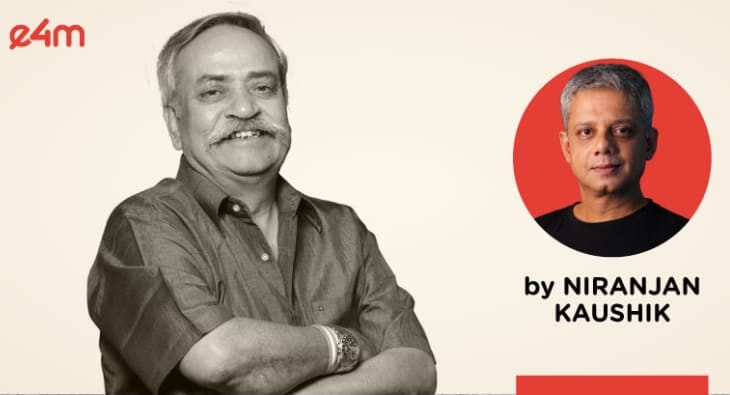

Niranjan Kaushik, Chief Content Officer at Fingerprint Films, India, paid tribute to advertising legend Piyush Pandey, fondly recalling their first meeting. He also reflected on Pandey’s iconic campaigns that not only transformed Indian advertising but also inspired generations of creatives.
The first time I met Piyush Pandey, I was late. Thirty minutes late to be exact. And in that version of Ogilvy, inside Apeejay House, South Bombay, that was sometimes a little dangerous. Piyush did his rounds at 9:30 sharp, walking through the creative department to see who arrives on time. And he was on time. Every single day. Those who weren’t in got a yellow post-it from his secretary, Ophelia. Three words, written in thick marker. Go see Piyush.
I remember walking into his cabin, heart thudding like a bad jingle. He didn’t even look up from his newspaper. “Why the (expletive) are you late,” he asked, calm, flat, terrifying. I began mumbling something about my motorcycle having a flat tyre, and no puncture shop being open. Before I could finish the sentence, he said, “Be on time from tomorrow, (expletive).” (Those who’ve worked with him know these expletives.)
That was it. No lecture, no wisdom. Just an expletive and a lesson that stayed longer than most philosophies in advertising ever have.
That was Piyush. Direct, impatient with nonsense, but full of warmth and wit when the work deserved it. In those years between 1996 and 2000, when I was a cub writer learning to string words and lines that might one day make it to print or film, Piyush was both god and volcano. You never quite knew which version you would get.
The best and worst time to share a script with him was always the same, when India was playing cricket. If India was winning, Piyush was in a dangerously good mood. He’d read your script, chuckle, and either approve it or throw it out with the same booming laugh. If India was losing, none of us even tried. We stayed far away from that cabin. Nobody really knew what happened to anyone who walked in during those overs. We weren’t brave enough to find out.
But cricket aside, what we all learnt from him was simple and pure. Piyush stripped advertising of all its pretence. He made it human again. He taught us that brands don’t speak in demographics or psychographics. People do. And people respond to one thing, stories. Simple, emotional, funny, beautiful stories that stay.
He showed us that ideas don’t come from PowerPoint decks or market research, they come from life. A carpenter, a fisherman, a truck driver. He saw magic in the ordinary. A hen eats from a used Fevicol can, her egg doesn’t break. A fisherman catches four fish in one go because chutki mein chipkaye, Fevikwik. We sat there watching the man build folklore out of glue, and we realised we were learning something no advertising school could ever teach, how to make India laugh at itself with affection.
What set Piyush apart wasn’t just his work, it was the way he made everyone around him want to be creative. Under his leadership, creativity wasn’t a department, it was a contagion. You could feel it in the air of Apeejay House. Client servicing people started pitching ideas in corridor chats. Strategic planners began writing lines. The office boy who brought you chai had an opinion on the new Fevicol TVC. The accounts executive, who otherwise spent his day staring at numbers, would suddenly say, “Sir, what if the kid says this instead?”
And Piyush would listen. He didn’t care where the idea came from as long as it made sense, as long as it had soul. That was his true genius, he turned the agency into one big creative organism. Every single person, from the peon to the president, felt like they had a stake in the storytelling.
When I finally decided to leave Ogilvy at the end of 2000, it was because I had been offered a job in Singapore. Back then, a job in Singapore advertising was coveted beyond imagination. The opportunity, of course, came because of the work Ogilvy Bombay had taught, encouraged, and allowed me to do. Piyush wished me well, but he also smiled and said, “You’ll get bored of the clinically sanitised advertising there, and you’ll come back.” And boom, he was right. I came back to Bombay in 2004 and quite literally never left again.
In those days, Ogilvy wasn’t just an agency, it was an ecosystem of madness and imagination. You didn’t just go to work there, you lived there. You inhaled the smell of cigarette smoke and Camlin markers, and exhaled scripts that tried to make India smile. And at the centre of that world stood Piyush, the man with the big laugh, the bigger heart, and an even bigger love for a well-told story.
When Piyush narrated a script, it was a performance. He would build it up like a joke, his voice rising, his eyes twinkling, and then he’d deliver the punchline with the timing of a stand-up comic who didn’t know he was one. He’d laugh the loudest at his own line, not because it was his, but because it was honest. And when the campaign came out, the whole country laughed too.
Over time, we learnt that for him, storytelling wasn’t about cleverness. It was about clarity. He would often tell us, “When you are telling a story, tell a story. Don’t use camera angles and lighting in your narration.” I carried that line with me long after I left Ogilvy. And when I began writing for long-form fiction, 9 Hours for Disney Hotstar, Karenjit Kaur and Mersheed for ZEE5, Candy for Jio, that principle became my compass. The format changed, the medium evolved, but the soul stayed the same. Keep it simple. Keep it human. Keep it unforgettable.
Looking back, I realise Piyush never built a company, he built a culture. One that valued instinct over intellect, humanity over jargon, and stories over slogans. A place where laughter was strategy and emotion was data. Where the only focus group that mattered was the one in your gut.
Yesterday, when I heard that Piyush had passed away, I felt something crack quietly inside me. It wasn’t just grief. It was the sound of an era taking a bow. Because if you’ve ever worked in Indian advertising, you’ve worked in a world that Piyush built.
But maybe it’s wrong to say he will be missed. Because how do you miss someone who never really leaves. His laughter, his words, his lessons, they stay with you. In the way you write a line. In the way you tell a story. In the way you look for the human in every brief.
Piyush Pandey didn’t just make ads. He made a generation of storytellers. And for that, we’ll never stop hearing his voice in our heads, saying, “Be on time, (expletive). And tell a damn good story while you’re at it.”
Read more news about Internet Advertising India, Marketing News, PR and Corporate Communication News, Digital Media News, Television Media News
For more updates, be socially connected with us onInstagram, LinkedIn, Twitter, Facebook YouTube & Google News
