How BFSI brands are navigating the finfluencer boom
At the e4m BFSI summit, brand leaders spoke about how they are harnessing influencers and key opinion leaders to drive awareness, trust, and engagement
 by
by
Published: Sep 29, 2025 12:48 PM | 8 min read
 Follow Us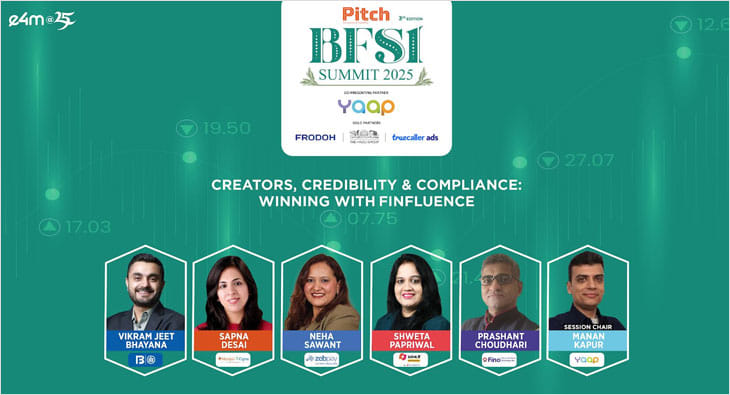

In a world where every swipe and scroll shapes financial decisions, leaders at the BFSI summit discussed how they are turning to influencers and key opinion leaders to connect, educate, and build trust; all the while ensuring compliance and credibility remain uncompromised.
Moderated by Manan Kapur, Senior Partner, Yaap, the session titled: “Creators, Credibility & Compliance: Winning with Finfluence” featured insights from Somesh Surana, Joint President – Digital Business Group & Marketing, HDFC ERGO General Insurance; Vikram Jeet Bhayana, Head of Marketing, Bajaj Allianz General Insurance; Sapna Desai, CMO, ManipalCigna Health Insurance; Neha Sawant, VP and Head of Marketing, ZebPay; Shweta Papriwal, Senior Vice President – Marketing & Communication, BlinkX by JM Financial; and Prashant Choudhari, Head of Marketing, Fino Payments Bank.
Setting the context, Kapur observed how financial content has seen a dramatic rise in recent years. “We’ve witnessed close to a 60% jump in influence in the financial category in just the last two years,” he said.
While this content has helped consumers improve their financial literacy, he raised concerns around authenticity and potential fraud. “Is the content authenticated, or could it mislead people? That’s the challenge brands need to address when working with creators,” he noted.
Bhayana acknowledged the growing role of creators in the sector. “A lot of us are using influencers in our day-to-day marketing campaigns,” he said, pointing to the importance of tier 2 and tier 3 markets for Bajaj Allianz.
He explained that the brand works with two kinds of influencers: external and internal. “For external influencers, it’s very important that we first identify educators and not just influencers. Categories that require product understanding, like insurance, can only be influenced once they know what it entails,” he stressed.
He added that the focus was on educating both audiences and influencers. Referring to Surana’s initiatives, he remarked, “Hats off to what Somesh is doing at HDFC ERGO with the whole quiz they’ve built over 10 years and 3,000 schools. That’s what most of us are doing; trying to build education deeper into the ecosystem.”
Surana then spoke about how HDFC ERGO defines success metrics while engaging with influencers. “Depending on the objective of the campaign, you need to decide the metrics or the KPI,” he explained. If the aim is awareness, the focus is on reach, impressions, and whether the brand is connecting with the right audience.
He cited the example of Insurance Quiz Junior, an IP HDFC ERGO has built over the past decade. “We started with one city and 18 schools. Today we are in 565 cities with 3,600 schools participating. This initiative is purely about category awareness, not business. When we use influencers here, the KPI is about how many schools we can register and how many students we reach,” he said.
Surana added that in digital campaigns focused on lead generation, the priorities shift. “The KPI there has to be the number of leads generated and whether the influencer’s audience is aligned with our brand values. Since influencer associations are typically not long term, we need to be very careful about who we partner with,” he explained.
Choudhari spoke about the realities of creating content for tier 4 and tier 5 towns. “Ground realities today are very different. About 10 years ago, yes, there would have been a need for heavy customisation. But thanks to Jio and internet penetration, things have changed,” he said.
He illustrated how even in remote hamlets, consumers are digitally active. “A housewife in a village of 20 homes may not be literate, but she knows WhatsApp and consumes Instagram or YouTube Shorts. Even if she doesn’t understand English fully, she grasps the crux of the content and is entertained as well as informed,” he explained.
He said language came with its own challenges, noting that while many assumed local language was essential, pure Hindi often failed to connect. For instance, people easily understood the word “table,” but not “mage.” This was why his team adopted Hinglish content in the HSM belt, which worked far better than using Hindi alone.
He added that in the South, the mix was different. “In some parts of Tamil Nadu, a Tamil and English combination works better than just one language.”
When asked how health insurance, a deeply personal and complex category, could be communicated through content creators, Sapna Desai outlined three key points. “Advertising has always been about storytelling. With influencers, it’s moved from storytelling to story-living, and that’s the stage we are in today,” she said.
She explained that creators help simplify complexity and build trust. The category comes with jargon and is not simple, but content creators make it more relatable. According to her, the first objective was to build brand love, credibility, and trust, while the second was to ensure the message was delivered effectively.
Sharing an example, she spoke about ManipalCigna’s product launch. “When we launched Sarva last year, we sent a box to influencers for unboxing. It had a kit with product features, and they explained it in their own style. It looked like a beauty bundle unboxing and worked very well,” she said.
Desai also highlighted how influencers enable hyper-local reach. Unlike a national campaign with one celebrity, regional creators can drive authenticity. “We’ve done content in Bengali, Punjabi, Tamil, Malayalam. Once these assets are created, our sales teams also use them as organic push. It works well from a trust and believability point of view,” she said.
Measurement, she added, goes beyond audience size. “For us, it’s not just about reach. Quality of content, engagement rates, and relevance matter as much. Eventually, influencers are creating a brand asset for you, and that’s how we measure their value,” she concluded.
Taking the discussion forward, Papriwal reflected on the rise of financial influencers during the pandemic. “In the broking industry, we are highly regulated. During the pandemic, stock markets were booming, and parallelly came the boom of finfluencers (finance influencers). Anybody who was good on camera, had presentation skills, and could read about markets started talking about it. Reels went viral because content consumption was at its peak,” she said.
She explained that financial advice could not be equated with casual consumption. She said that while people might Google simple medicines like Crocin or Dolo, they would research and consult certified, knowledgeable experts for surgery. Similarly, in finance, since they were dealing with people’s money, SEBI imposed caps on influencers. She added that an influencer’s follower count, qualifications, licenses, and certifications all mattered before they could make any recommendations.
According to her, money is both an aspiration and an emotion. “Someone may say if you bought a stock in 1980, you’d be worth crores today. It looks good on paper, but were you told in 1980 to do that? And during COVID, did you even have surplus cash to invest?” she asked, stressing that credibility comes only from facts and data-backed storytelling.
Compliance shapes every marketing decision, she elaborated. “Yes, we engage with influencers at times, but only within SEBI’s purview. We also focus on creating our employees as influencers. Our research teams and analysts automatically become credible voices. They may not be great on camera, but their information is authentic, validated, and backed with trust.”
Moment marketing, she added, is not viable in her sector. “By the time something gets compliance and exchange approval, the moment has passed. So, we’ve consciously avoided it. Our approach is mindful, aligned with the brand’s vision, and ensures we don’t compromise on trust or legacy.”
Turning to crypto, Sawant spoke about the challenge of building awareness. “My job is to make Bitcoin or crypto investments simple for Indians. To enter is easy, but to exit is difficult; and that’s a challenge,” she said.
She explained why selective partnerships with creators are critical. “Crypto is a very new industry, only 15–17 years old. At Zebpay, we’ve been around for 10 years, but still most people only know Bitcoin or Ethereum. Beyond that, awareness drops. People may know meme coins but not credible protocols,” she noted.
For that reason, the company prioritises key opinion leaders (KOLs) over mass influencers. “Trust is the cornerstone. We look for creators who’ve spent time in the industry, who understand the basics, and can explain concepts beyond just platform features. Even if they come from traditional finance, if they can break down how crypto parallels or contrasts with existing assets in simple terms for their communities, that’s valuable,” Sawant concluded.
Read more news about Internet Advertising India, Marketing News, PR and Corporate Communication News, Digital Media News, Television Media News
For more updates, be socially connected with us onInstagram, LinkedIn, Twitter, Facebook YouTube & Google News