Successful content must work on shareability, scalability, relatability: Manan Kapur, Yaap
At Pitch BFSI Summit 2025, Manan Kapur, Senior Partner at Yaap, outlined how brands must fundamentally reimagine their approach to digital content creation in order to succeed
 by
by
Published: Sep 25, 2025 7:08 PM | 4 min read
 Follow Us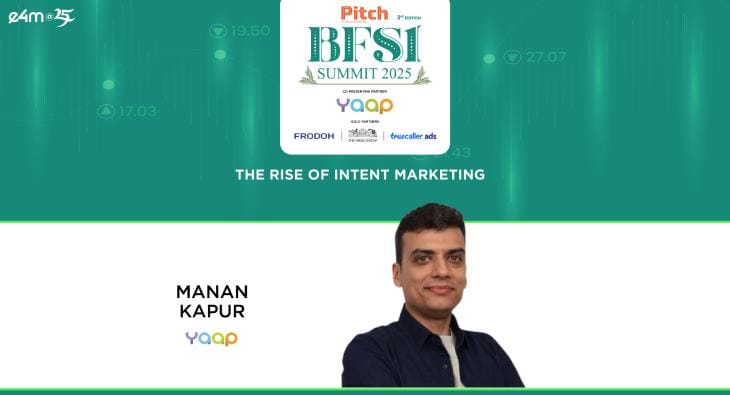

Manan Kapur, Senior Partner at Yaap, delivered a compelling spotlight session at the Pitch BFSI Summit 2025, outlining how brands must fundamentally reimagine their approach to digital content creation in order to succeed in today's crowded digital ecosystem.
Speaking at the summit, where Yaap served as co-presenting partner, Kapur emphasized that traditional content strategies are no longer sufficient in an era where consumers are constantly bombarded with content from influencers & celebrities and memes.
"When a bank creates a content piece on digital, we are fighting against the space of content creators themselves," Kapur explained during his presentation. He pointed out that brands are competing for the attention of consumers who are often engaged in doomscrolling, saying that "30% of us must be doing doomscrolling right now and not looking at branded content but looking at influencer-based content."
Kapur highlighted the fundamental shift occurring in digital content consumption. "We believe that we are not here against our own competitors," he said, explaining that the real battle is for mindspace in an attention economy dominated by entertainment content.
Kapur stressed the importance of moving away from traditional advertising approaches. "It's all about exchange of values rather than having exchange of force-feeding content to consumers like us," he said, emphasizing that successful content must work on "shareability, scalability, and relatability, which is purely to do with creating content and scale, owning content, and making sure that content lives a life beyond the screen that we make for."
Central to Kapur's presentation was the concept of Intellectual Properties (IPs) as a solution to scaling content beyond individual campaigns. "It's basically something which is not rented media; it's the own media," he explained, describing IPs as owned assets that brands can control and scale across multiple platforms and timeframes.
The distinction between campaigns and community building was a key theme throughout his talk. "It also gives you more than a campaign; it's actually a community that is being built," Kapur noted. He identified a critical challenge facing brands today: "The most difficult aspect of content today is that it doesn't go beyond one scale and cannot scale to a community."
Kapur positioned IPs as the solution to this scalability problem. "When IPs are built, they create communities which help content to go beyond one space or confined space of the brand page itself," he explained, adding that "these are assets which are built for advertisements, for your large-scale campaigns where brand plugins become easier than a force-fit plugin."
Kapur showcased several successful IP examples, including a sneaker festival targeting Gen Z audiences and the GCC Spotlight Award. The latter project demonstrates Yaap's community-building approach, bringing together "more than 150 content creators who are ready to partner with them" in what Kapur described as "one of the largest awards being hosted in a region."
Kapur also highlighted a long-running partnership with fintech brand Rupe, featuring the "Rupe Foodie Files and Travel Tales" IP that has evolved over three years, demonstrating the longevity potential of well-crafted intellectual properties.
He outlined four essential checkpoints for successful IP creation, emphasizing purpose-driven content creation. "Let's not do IPs just for the sake of it," he warned, stressing that "Content needs to be built for staying there. If you cannot do it, don't enter into it."
Kapur distinguished between trend-chasing and culture-building, stating: "It's not about going after a trend. It's about building a culture and planning on the culture of how you scale up in the largest segment." He also emphasized community focus: "You need to get an IP for the community and not for the consumers."
Platform-specific content adaptation was another crucial point. "We build content across YouTube, Instagram, and other platforms, but each of the IPs are presented differently on that particular platform," he explained, citing how long-form YouTube content transforms into bite-sized Instagram posts targeting specific interests.
Read more news about Marketing News, Advertising News, PR and Corporate Communication News, Digital News, People Movement News
For more updates, be socially connected with us onInstagram, LinkedIn, Twitter, Facebook, YouTube & Google News