Ad Review: Astrotalk's latest campaign finds the human truth hidden inside every horoscope
Three films, three everyday anxieties, and one quiet argument for why millions of Indians reach for the Astrotalk app
 by
by
Published: Mar 30, 2026 9:55 AM | 4 min read
 Follow Us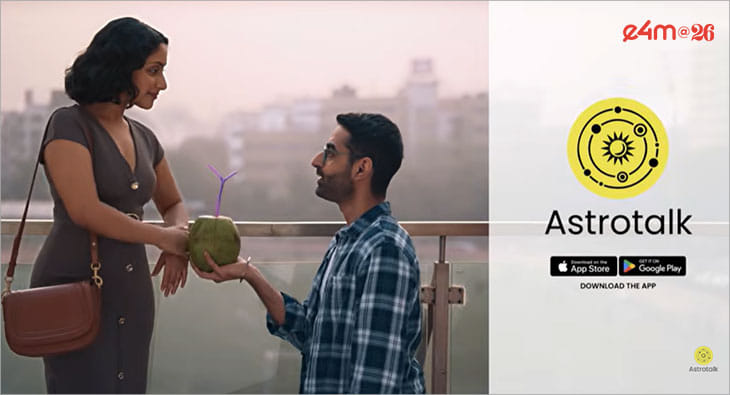

Astrology has long occupied an uneasy space in Indian advertising, either leaning too hard into mysticism or reducing itself to generic reassurance. Astrotalk's new three-film campaign, directed by Nitesh Tiwari, does neither. Instead, it makes a quietly ambitious creative bet: the most compelling argument for an astrology platform is not the stars themselves, but the very human knot of doubt that drives people toward them.
Tiwari, whose filmography from Dangal to Chhichhore is defined by an instinct for emotional precision, brings that same sensibility to the brief. Each of the three films is compact but unhurried, built around a protagonist sitting with a discomfort they cannot quite name, and that restraint earns the campaign its credibility.
The first film is perhaps the most relatable to a domestic audience. It captures the particular silence of a marriage beginning to fray, not from crisis but from routine, where work quietly displaces emotional presence, and both partners sense it but neither says it. There is no villain here, no dramatic argument. Just the slow erosion that modern couples know well, rendered with the kind of observational detail that feels lived-in rather than scripted. The pivot to Astrotalk does not arrive as a solution so much as a pause button, a moment of seeking clarity before the distance becomes permanent.
The second film moves to younger, more ambiguous emotional territory: a relationship where the question of commitment keeps getting deferred. This is the anxious grammar of millennial and Gen-Z romance, where feelings are real but labels are avoided, and conversations keep getting postponed. Tiwari and the brand resist the urge to resolve the ambiguity neatly. The film simply sits inside that uncomfortable in-between, which is precisely what makes it land. Astrotalk here is not a matchmaker or a counselor; it is closer to the friend you call when you cannot decide what you actually want.
The third film is the most tonally distinct of the trio. Its protagonist is a small business owner, navigating livelihood rather than love. A quiet crisis of confidence facing financial setbacks despite operating in a sector with legitimate growth potential. This film is important for what it signals about Astrotalk's brand ambition: the platform is not just for the romantically uncertain. It is positioning itself as a companion for professional anxiety and economic self-doubt, categories that are vast and largely untapped in the astrology-adjacent category.
What ties all three narratives together is a single, well-chosen insight: uncertainty today is not always about the absence of opportunity, but about the absence of clarity. That is a sharp line, and the campaign has been built faithfully around it. None of the films dramatise failure. None of them promise transformation. They simply locate the precise moment before a decision and place Astrotalk there.
The IPL timing is strategically sound. The campaign will be amplified during the IPL season, leveraging high user attention and cultural relevance during the period. With hundreds of millions of viewers tuned in and emotional investment running high across households, a campaign built on domestic and professional anxieties travels well in that environment; it meets audiences at a moment when they are already emotionally engaged.
As Puneet Gupta, Founder and CEO of Astrotalk, put it, “The questions people ask us are rarely abstract, they come from very real situations. Whether it’s a relationship that feels uncertain or a career path that isn’t going as planned, people are looking for clarity and reassurance. With this campaign, we wanted to reflect those moments honestly and show how astrology can help individuals navigate them with more confidence.”
That is a meaningful repositioning. Whether audiences receive it as such will depend on execution at scale, but as a creative statement, this campaign is among the more grounded and emotionally honest works the category has produced in some time.
Read more news about Internet Advertising India, Marketing News, PR and Corporate Communication News, Digital Media News, Television Media News
For more updates, be socially connected with us onInstagram, LinkedIn, Twitter, Facebook YouTube & Google News