The new communications dilemma: to speak, stay silent, or somewhere in between?
Has strategic silence become a reputational risk? Industry leaders weigh in on its impact, future challenges, common misconceptions and where communicators should draw the line
 by
by
Published: Jul 2, 2026 10:00 AM | 16 min read
 Follow Us

- The traditional approach of strategic silence in crisis communications is under pressure due to the rapid spread of information on social media, which can lead to misinformation before organizations can respond.
- Many communications leaders now argue that silence is often interpreted negatively, and prolonged inaction can damage reputations, prompting a shift towards structured, staged communication that acknowledges issues early and provides updates as facts emerge.
- The evolving landscape requires organizations to balance the need for timely communication with the accuracy of information, as stakeholders expect engagement even in uncertain situations.
- Crisis communication is increasingly viewed as a leadership responsibility, emphasizing the importance of preparedness and coordinated decision-making across departments to effectively manage crises.
By the time an organisation drafts its first holding statement today, social media has often written three versions of the story. This is the major challenge unfolding in the crisis communications world!
For decades, strategic silence was one of the most trusted tools in a communicator's crisis playbook. When facts were unclear, legal implications uncertain or investigations underway, organisations often chose restraint over reaction and wait before speaking publicly.
That playbook is now under unprecedented pressure.
Today, news breaks within seconds. Speculation spreads faster than verified information. Employees, customers, influencers and even AI-generated content can shape public opinion long before an organisation issues its first official statement.
The old communications principle was simple: fill the information vacuum before someone else fills it with misinformation. But today, many corporate legal teams and PR advisors are arguing the exact opposite: “If you say nothing, the 24-hour internet news cycle will get bored and move on to a new villain tomorrow.”
The question is no longer whether organisations should communicate during a crisis. It is whether silence itself has become the bigger reputational risk.
According to Ipsos, nearly one-third (32%) of global Chief Communications Officers intentionally use strategic silence instead of taking public positions on certain issues.
To understand how India's communications industry is rethinking one of its oldest crisis management strategies, exchange4media spoke with senior communications leaders across sectors to explore how they view strategic silence today, its impact on trust, and whether its role is changing in a world that expects immediate answers.
Why this debate matters
Crisis management in 2016 is far different from 2026. A decade ago, organisations often had hours, sometimes even days, to assess a developing situation before making a public statement. Traditional media cycles provided breathing room. Information travelled slower, and organisations largely controlled the first official version of events.
Today, that advantage has disappeared.
A single employee post, leaked email, customer video or viral tweet can trigger a reputational crisis within minutes. Artificial intelligence has added another layer of complexity, making manipulated videos, synthetic content and misinformation increasingly difficult to distinguish from reality. By the time an organisation verifies what has happened, millions may already have formed an opinion.
This changing information ecosystem has fundamentally altered stakeholder expectations. Audiences no longer expect organisations to have every answer immediately but they do expect them to acknowledge that something has happened.
Abhijit Borah, Head of Global Communications & Public Affairs at RHI Magnesita, believes organisations are still operating with assumptions built for a slower information ecosystem. "Historically, silence was sometimes used to control information flow. Today, that is increasingly unrealistic. Information will move regardless of whether an organisation participates in the conversation." He says that many organisations delay communication because they are waiting for certainty. The challenge, however, is that information now travels much faster than certainty.
Gaurav Bansal, Senior Director & Head – Marketing & Communications at SHRM India, MENA & APAC, believes the operating conditions for strategic silence have changed fundamentally. "Strategic silence has not disappeared, but its operating conditions have changed fundamentally. In a media environment where a narrative can fully form within hours of an incident, silence is no longer a neutral position. It is interpreted, and rarely charitably."
For Chhavi Leekha, Corporate Affairs & Communications, CSR and Brand Reputation Specialist, the shift is driven by changing stakeholder behaviour. "One of the defining realities of today's communications environment is that information moves faster than organisations do. The challenge is that when an organisation chooses not to communicate, others often step in to fill the void, whether that is social media, employees, customers, influencers, or the media."
.jpeg)
Silence is no longer neutral
Perhaps the strongest consensus emerging from the conversations is that prolonged silence has become significantly riskier than it once was.
Communications leaders repeatedly pointed to one common consequence: the information vacuum. When organisations choose not to communicate, they rarely control who fills that vacuum or what version of events eventually becomes accepted as truth.
Bhavna Singh, Vice President – Corporate Communications at BSV, expresses confidently, "Allowing the 'information vacuum' to grow and spread is a strict NO-NO during a crisis. Organisations must acknowledge, validate and communicate within set timelines to ensure that false and untrue narratives do not damage reputation."
Borah puts it succinctly. "The real risk is not silence itself. It is unexplained silence." He explains that by the time organisations establish every fact, stakeholders, media outlets and online communities may already have constructed their own narratives, creating what he describes as a false choice between saying nothing and having all the answers.
Bansal echoes this concern."The information vacuum created by organisational silence will always be filled by someone else, and organisations rarely control who that someone is or what they say."
Leekha believes stakeholders today are more willing to accept uncertainty than perceived inaction. Rather than expecting organisations to have every answer immediately, audiences increasingly want evidence that the organisation is present, engaged and actively managing the situation.
Strategic silence isn't dead. It's evolving
Not long ago, communicators worried primarily about saying the wrong thing during a crisis. Today, many skip the risky route and choose to say ‘nothing at all.’ However, the strongest consensus among communications leaders is that silence today is no longer interpreted as neutrality.
As information spreads across social media, messaging platforms and digital news channels within minutes, organisations are increasingly losing the luxury of time. Narratives often begin forming before official investigations have even started. What once meant withholding communication altogether is increasingly evolving into something more deliberate: an intentional, time-bound pause supported by acknowledgement, transparency and a commitment to update stakeholders.
Bhavna Singh, Vice President – Corporate Communications at BSV, perhaps sums up this evolution most succinctly. "Silence is a dead strategy, intentional pause is acceptable." For her, strategic silence only works when it exists within clearly defined timelines and is accompanied by visible action.
"Strategic silence works as a tactic, only when it is used within a set timeline. It cannot be used as a permanent solution. If the organization wants time, a holding statement to the effect that the organization is gathering facts, is still an acceptable and effective PR."
She believes organisations have a responsibility to use that pause productively—to investigate, formulate an action plan and communicate it before speculation overtakes facts.
Gaurav Bansal shares a similar perspective, arguing that silence still has legitimate applications in situations involving legal proceedings, regulatory investigations or genuinely unverified facts. The difference today, he says, is that organisations can no longer disappear while they wait.
"Unacknowledged silence reads as indifference or concealment. Acknowledged silence, handled with transparency about the reason for the pause, can still protect an organisation without surrendering credibility."
Chhavi Leekha defines thar the evolution is even more nuanced. "Strategic silence still has a role, but its application has become far more nuanced." She believes organisations may choose not to disclose every detail immediately, particularly during investigations or regulatory matters, but stakeholders still expect visible engagement. "The question is no longer whether to speak, but what to say, when to say it, and how much to say."
Abhijit Borah takes the argument a step further, suggesting that silence today is less about withholding information and more about exercising discipline.
"Silence should not be confused with absence. An organisation can acknowledge an issue, communicate its awareness, explain that facts are still being established and commit to further updates without rushing into premature conclusions." For him, the role of strategic silence has shifted from controlling information to protecting credibility.
The biggest shift: From silence to staged communication
If there is one idea that emerges repeatedly across conversations, it is that communicators are increasingly rejecting the binary choice between saying nothing and saying everything. Instead, a new model is taking shape.
Rather than waiting until every fact has been verified before issuing a statement, organisations are increasingly adopting what several leaders describe as structured or staged communication. It is acknowledging a situation early, communicating what is known, being transparent about what remains uncertain, and continuing to update stakeholders as more information becomes available. It represents perhaps the biggest evolution in modern crisis communications. The objective is no longer to have every answer before speaking. It is to ensure stakeholders are never left wondering whether the organisation is paying attention.
Chhavi Leekha believes this approach better reflects today's communication environment. "Organisations increasingly need to communicate in stages—acknowledging first, updating as facts emerge, and providing greater detail as clarity improves."
She points out that during major cybersecurity incidents, airline disruptions and operational crises, the organisations that retained public trust were not necessarily those with the fastest solutions, but those that maintained the most consistent communication throughout the crisis.
Gaurav Bansal sees staged communication as replacing one of the oldest assumptions in crisis management. "The communicators adapting most effectively are replacing the binary choice between silence and full disclosure with a more sophisticated third option: structured, staged communication that is honest about what is known, transparent about what is still being determined, and consistent in its commitment to update stakeholders as clarity develops."
For Borah, this evolution requires organisations to separate acknowledging an issue from resolving it. "In the early stages of a crisis, stakeholders rarely expect complete information. They do expect awareness, accountability and engagement." That distinction, he argues, allows organisations to remain credible without speculating or rushing into incomplete conclusions.
Bhavna Singh believes one of the most powerful tools in this approach is the holding statement. "The most immediate way to communicate is the holding statement. This not only signals that the organisation has acknowledged the challenge, it displays empathy and signals a direction that the organisation is taking to ascertain the facts around the crisis."
Are brands overcommunicating?
Yet even as the industry moves towards greater transparency, not everyone believes organisations should communicate more. Some leaders argue the profession risks swinging too far in the opposite direction.
As companies respond to every controversy, trending hashtag and online allegation, a new question is beginning to surface - Has communications started rewarding visibility over judgement?
Talari Anand Mahesh, Co-Founder & Managing Director of Mavcomm Group, offers another compelling counterpoint. For him, silence remains not just relevant but increasingly valuable.
"Silence is also a communication, so it absolutely does."
Mahesh believes organisations have become conditioned to respond to almost everything, even when doing so may unintentionally legitimise rumours or amplify misinformation. "In some instances, organisations can refrain from commenting as commenting may add credence to the speculation and misinformation."
Instead of treating every online conversation as a reputational emergency, he argues organisations should carefully evaluate whether engagement is necessary in the first place.
"I would like to recommend organisations to practice more strategic silence in the age of over communication. You need to create a certain bit of anticipation in the stakeholders and communicate what's absolutely necessary and when it's necessary."
Mahesh argues that responding too quickly may itself become a reputational risk. "Sometimes, an early unplanned communication may end up creating a larger crisis."
Piyali Reddy, Group Head of Corporate Communications at Axis Bank, believes the industry risks undervaluing accuracy in its pursuit of speed. “Strategic silence is often interpreted in different ways, but for me, it means not speculating before the facts are clear. Communicating incomplete or inaccurate information can create even greater problems and potentially damage credibility further.”
She warns that premature communication can undermine trust rather than strengthen it. “During a crisis, stakeholders need a single, consistent source of truth. If multiple spokespersons are communicating different messages across different channels, it can create confusion and amplify concerns rather than resolve them,” she adds.
Leekha highlights the importance of trust during crises, mentioning, “Trust is rarely built through silence. It is built through informed engagement, sustained transparency, and the confidence stakeholders develop when they believe an organisation is willing to communicate openly, even under pressure.” She candidly speaks that stakeholders may forgive uncertainty but are less likely to forgive perceived inaction.
Crisis communication is no longer a communications function
Behind every statement, or decision not to issue one, is often a complex internal debate involving communications teams, legal advisors and business leaders. Another striking theme emerging from the conversations is that crisis communication is increasingly being viewed as a leadership responsibility rather than a communications function alone.
Several leaders believe organisations that respond well have one thing in common: they prepare long before the crisis arrives.
Abhijit Borah believes the responsibility ultimately rests with leadership, with communications acting as a strategic advisor rather than merely a messaging function. "Most organisations today treat crisis communication not as a communications exercise but as an enterprise leadership responsibility."
He shares that RHI Magnesita operates a 24x7 virtual crisis war room, independent of the company's IT environment, bringing together leadership, communications, legal and technology teams to ensure coordinated decision-making—even during cyberattacks. "The strongest responses emerge when communication strategy, business judgment, legal considerations and operational realities are integrated into a single decision-making process."
Bhavna Singh agrees that accountability cannot be fragmented. "The buck stops at the top."
While communications and legal teams provide guidance, she believes a leadership-led command structure is critical to making timely decisions, taking ownership and maintaining stakeholder confidence.
Chhavi Leekha echoes that sentiment. "Crisis communication works best as a collective decision-making process, but accountability ultimately rests with leadership."
For Gaurav Bansal, alignment, not hierarchy, is the defining factor. "Crisis communications works best when three functions that typically operate separately are genuinely aligned before a crisis occurs, not scrambling to find consensus during one."
Talari Anand Mahesh also points to the importance of preparation. He believes organisations should have predefined crisis management teams, clear chains of command and scenario-based response plans that determine ownership depending on the nature of the crisis—whether operational, financial, technological or reputational.
Where organisations are still getting it wrong
Despite broad agreement that crisis communications has evolved significantly, the leaders believe many organisations continue to misunderstand what strategic silence actually means. One of the most common misconceptions, according to communications leaders, is treating silence as a substitute for communication rather than a communication strategy in itself.
Abhijit defines the biggest misconception that organisations delay communication because they do not want to speak. More often, they delay because they are seeking certainty.
Gaurav Bansal believes organisations frequently underestimate how quickly silence itself can be interpreted. "Silence is no longer a neutral position. It is interpreted, and rarely charitably," he structures. As a result, many organisations unintentionally allow stakeholders to perceive silence as indifference, evasiveness or an attempt to conceal information, even when the intention may simply be caution.
Another challenge lies in balancing speed with accuracy.
Piyali Reddy warns that the pressure to respond instantly can sometimes push organisations into communicating before they fully understand the situation. This tension between responsiveness and accuracy remains one of the most difficult challenges facing communications leaders today.
Responding to every conversation
Talari Anand Mahesh believes another misconception has emerged from the belief that every issue requires an immediate public response. “In some instances, organisations can refrain from commenting as commenting may add credence to the speculation and misinformation.” According to him, the challenge is knowing which conversations deserve engagement and which are better left unamplified.
Chhavi Leekha points to another persistent issue, called confusing communication with complete disclosure. Organisations may not always have all the answers during the early stages of a crisis, but stakeholders still expect acknowledgement, visibility and accountability.
The challenge, she suggests, is not having every fact immediately, but demonstrating that the organisation is actively managing the situation.
Next is interpreting that silence means doing nothing
Bhavna Singh believes organisations often misunderstand the purpose of silence during a crisis. “At times organizations take to strategic silence but it should never be used as a refusal to take accountability,” she explains, For her, silence is only effective when it serves a strategic purpose and is accompanied by visible ownership of the issue.
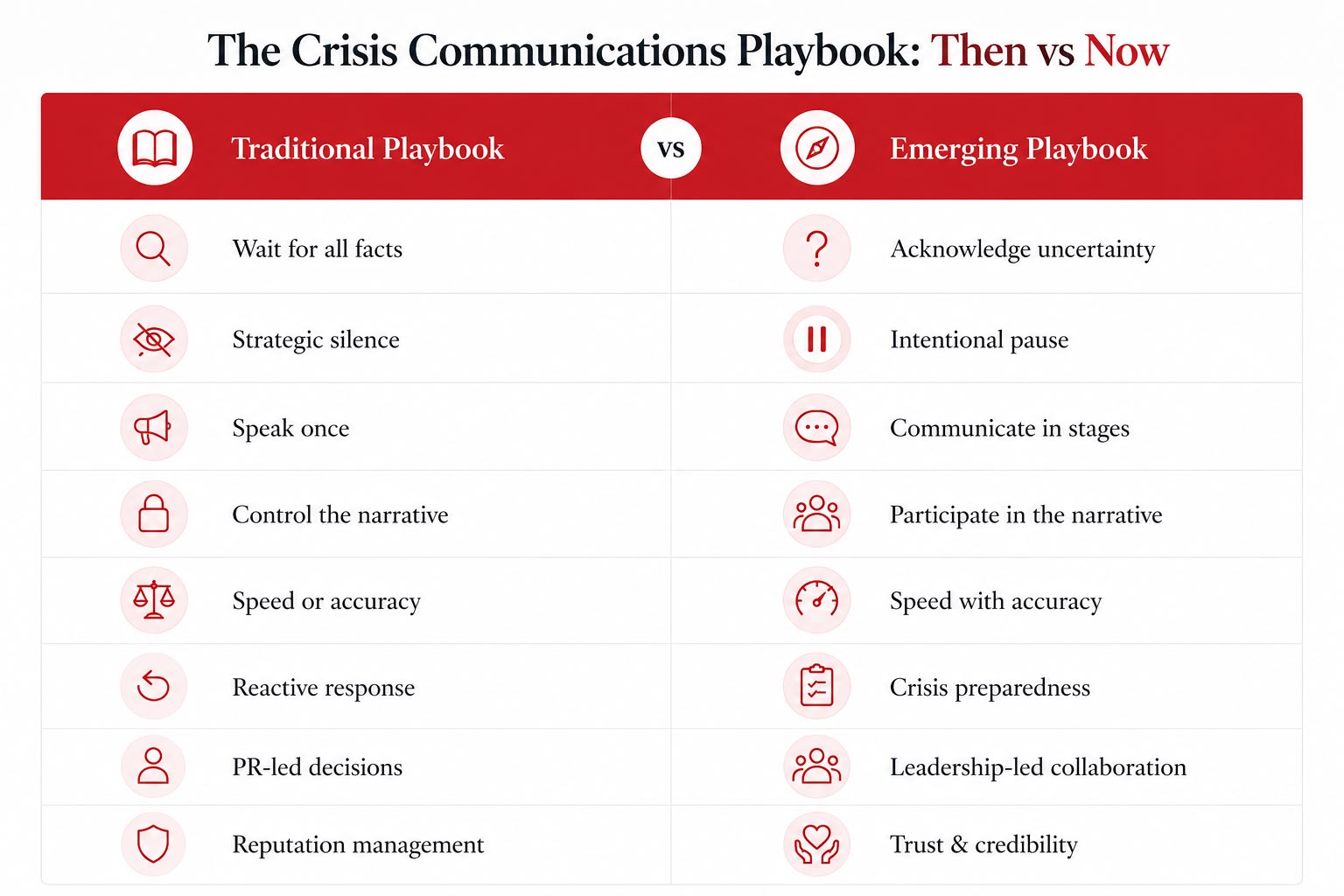
Has the Crisis Communications Playbook Been Rewritten?
If there is one thing the industry appears to agree on, it is that the old crisis communications rulebook is being rewritten.
The emerging framework looks something like this:
Looking Ahead
If the past decade was defined by organisations deciding whether to communicate during a crisis, the next decade is likely to be defined by how they communicate under conditions of uncertainty.
The communications leaders agree that strategic silence is unlikely to disappear. Instead, it is evolving from a standalone crisis response into one element of a broader trust-building strategy.
Bhavna Singh believes the future belongs to organisations that acknowledge situations early rather than waiting until every answer is available. "A key communication tool for the future is 'acknowledging' rather than 'answering'."
She argues that crisis preparedness can no longer begin after an incident occurs. Organisations need to invest in crisis simulations, pre-approved holding statements, leadership-led command structures and crisis hubs that enable timely, coordinated responses even when facts are still emerging.
Abhijit Borah believes the industry's next challenge extends beyond the debate around silence itself. "The future debate is not really about silence versus communication. It is about how organisations communicate responsibly in conditions of uncertainty."
He believes organisations that earn trust in the years ahead will not necessarily be those that communicate first, or the most, but those that communicate with "the right balance of speed, transparency and judgment."
Talari Anand Mahesh, however, offers an important counterpoint. While much of the industry is moving towards greater transparency and more frequent communication, he believes emerging technologies may actually make strategic restraint even more valuable.
"I believe it will remain a key communications tool and may actually gain more relevance in the future with deep fakes and other technological interventions potentially harming the reputations of a company by imitating them."
As misinformation becomes increasingly sophisticated, he argues, organisations will need to become equally disciplined about when not to communicate.
For Gaurav Bansal, the future lies somewhere between these perspectives. Rather than choosing between silence and transparency, he sees communicators embracing structured, staged communication—one that is honest about what is known, transparent about what is still being determined and consistent in updating stakeholders as clarity emerges.
Similarly, Chhavi Leekha believes organisations should follow 3C’s strategy: communicating early, communicating honestly and communicating progressively as situations evolve.
This shows that the biggest shift is that strategic silence is no longer about saying nothing. It is about ensuring that every word and every moment of silence has purpose. Ultimately, the organisations that will survive won't be those that speak first or stay silent the longest, they'll be the ones that know what to say, when to say it, and when an intentional pause is the smarter strategy.
Read more news about PR and Corporate Communication News, Internet Advertising, Marketing News, Digital Media News, People Movement News
For more updates, be socially connected with us onInstagram, LinkedIn, Twitter, Facebook YouTube & Google News