From PR to strategic advisor: A 40-year view of the communications industry
This ‘In the Spotlight’ features Subramaniam M’s four-decade journey, his views on the evolving role of communications, the impact of technology, and what professionals must do to stay relevant
 by
by
Published: Feb 23, 2026 4:24 PM | 13 min read
 Follow Us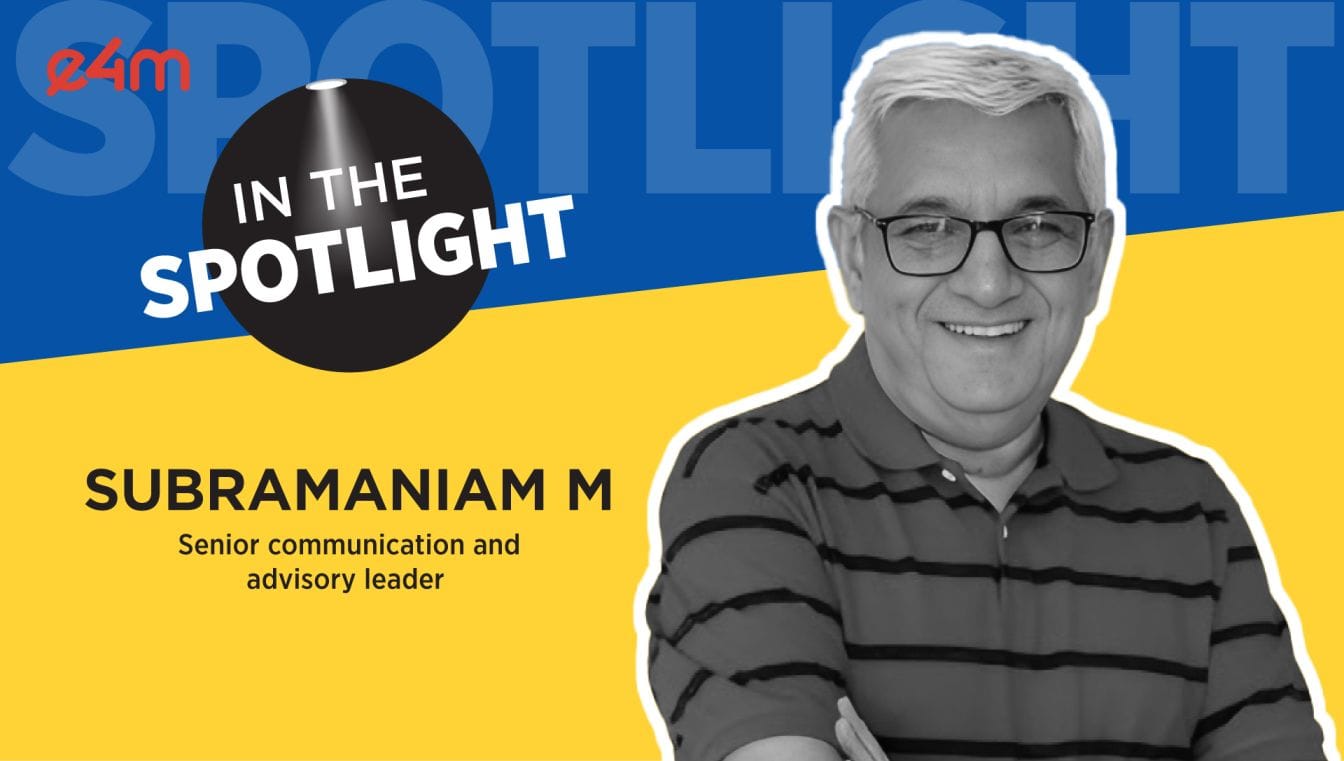

At a time when Public Relations was not even considered a glamorous career, many professionals entered the field simply because they believed in the work and its purpose.
Subramaniam M is one such leader. A senior communications and advisory professional with nearly four decades of experience, and a career was full of growth, constant learning, and meaningful impact. He started as an Executive Trainee at Lintas and went on to lead major communication mandates for companies such as Wipro, IBM, Apple, Toyota, Airtel, Morgan Stanley, and more.
Few professionals claim to have experienced a wide arc of industry transformation and even fewer have actively contributed to shaping it. From a back-office support role to a key advisory function that influences boardroom decisions, he has witnessed it all. Moreover, he has navigated economic shifts, regulatory changes, media disruption, and now the rapid integration of technology and artificial intelligence into the communications landscape.
In today’s ‘In the Spotlight’ feature, we explore Subramaniam M’s four-decade journey. We look back at what the industry looked like when he first entered it, the turning points that helped him transition into leadership roles, and the lessons he learned while managing complex communication mandates for global corporations. We also discuss his entrepreneurial journey and how building advisory capabilities. Moreover, we examine his views on the true role of communications in organisations, what it genuinely contributes today versus what it should contribute in the future. As technology reshapes industries and artificial intelligence begins to redefine workflows, we ask how communications professionals must prepare themselves, and more.
.jpg)
Excerpts:
How did you start your professional journey? What first drew you to the world of public relations and communications, especially at a time when the industry was still finding its professional footing in India?
Naïve is what comes to mind when I began my career, which was initially in advertising and then transitioned to public relations. My late brother-in-law, a filmmaker and journalist, prodded me to enter advertising in early 1987. He put me in touch with a couple of CEOs who literally laughed in my face when I was questioned about my knowledge of the industry. I then did a course at the Xavier Institute of Communications (XIC), a then-fledgling setup run out of a couple of small classrooms in St. Xavier’s College, Mumbai. The curriculum in advertising and marketing opened up a whole new world to me. Compared to most, I’m no great academic and my grades were pathetic. But I absorbed everything and joined Lintas as an Executive Trainee, an extremely coveted job at the time, at one of the largest advertising agencies in the country. And so began my journey in communications.
The experience at Lintas and subsequently Ogilvy took me to the Middle East, where I managed advertising for JVC, a very popular Japanese electronics brand. Organising a press conference in Dubai introduced me to public relations (PR). Little did I know that it would become a career choice.
On my return to India, a very close friend, a banker and journalist, introduced me to corporate communications, a term I had not heard before. It was a homecoming of sorts when I rejoined Ogilvy PR in Chennai, managing the Ford account. Those were early days when few people had heard of PR, and if they had, it was with not-so-positive connotations. More of that later.
I went on to work with brands like Pond’s, the UB Group, Herbalife, Microland, Tanishq, Scania, and Philips, among others.
I have now been in communications for almost 38 years, primarily with agencies, with a couple of stints at IBM and Wipro. It’s been a wonderful journey, full of pressure, enjoyment, and, of course, learning.
You’ve witnessed the PR and communications industry across multiple phases, how would you describe its evolution from when you began to now?
When I began my journey, there was a “PRO (Public Relations Officer)”, typically a hospitality expert, who arranged accommodation and transportation for senior management and other employees. She/he would also arrange corporate events, which sometimes included press conferences. They would also issue “PRs” or press releases. Modern, professional PR service offerings were far and few, as were the personnel. Most came from an advertising or hospitality background and journalists had not yet warmed up to the profession.
In India, PR was a poor cousin to advertising, the big daddy of the communications industry. Mainly, because PR was least understood and campaign measurement, was, at best, vague. There were few institutes that offered courses in PR and even fewer books that gave enlightenment on the profession. Philip Kotler, the father of modern marketing devoted very few pages to PR in his iconic text book, “Marketing Management”. Al Ries and Jack Trout had just released their book, “Positioning, The Battle for Your Mind”, an ode to the marketing and advertising industry. It would be much later, when Al Ries, along with his daughter Laura Ries, wrote a book, “The Fall of Advertising and the Rise of PR”, that suddenly people took notice.
Today, while it is still a poor cousin to advertising, PR in India has evolved, and how. Many multinational companies have entered India and along with them a certain level of professionalism. The “PROs” are long gone, and while youngsters are still not quite able explain the profession to their parents, there is a pride in being part of the industry. War stories of successes (and disasters) are discussed in boardrooms. Case studies have been written and published and furiously debated. And PR is definitely not a term to be frowned upon. It can make (or break) companies, brands and people.
.jpg)
You’ve led communication mandates for global giants like Wipro, IBM, Apple, Toyota, Airtel, and Morgan Stanley, how was your experience and what differences did you observe in how global organisations versus Indian enterprises view communications role?
Communication has evolved over the last several decades and, as I mentioned earlier, the level of professionalism has improved significantly. Collaboration and shared experiences have led to processes being refined to adapt to local requirements. If a company’s management believes that PR is an important tool in the overall communication process, then there is very little to differentiate between global and Indian organisations.
In boardroom conversations today, what role does communications genuinely play versus what it should play?
Most conversations on communications in boardrooms happen during a crisis. It is then that its true value is understood and appreciated.
However, communications can and must play a larger role, and the key to this is CEO buy-in. More often than not, CEOs are focused on developing the company’s business, acquiring clients, and servicing them. The perception is that communications (read PR) is not an essential tool. There is often a belief that if business numbers are strong, shareholders will be satisfied and, consequently, the media will be positive, resulting in second-level spokespersons fronting the communications function. Advertising is considered more important, and PR comes into play only when a crisis occurs.
After decades in leadership roles, what sparked the decision to start Grey Owl Public Relations? What were the biggest surprises, good or bad, once you stepped into entrepreneurship?
I did attempt an entrepreneurial foray in 2019, but the pandemic disrupted those plans.
Post my stint with Wipro, I received a couple of media training assignments, which sparked the desire to restart the journey. Since then, I have focused primarily on media training, which has been progressing well so far. I have consciously chosen not to pitch for large or even medium-sized accounts, though opportunities have been limited.
There have also been a few recent surprises in PR account realignments in India. Google has chosen The Mavericks as its PR agency, and rumour has it that Samsung has appointed Kaizzen for corporate communications and Value360 for product PR. If the latter is true, it bodes well for smaller, independent agencies and gives me encouragement to continue my entrepreneurial journey.
From your vantage point, are Indian PR firms and professionals keeping pace with global standards, or are we still catching up?
Just to clarify, traditionally, the scope of work for Indian PR firms was largely restricted to media relations, press conferences, press releases, interviews, online/digital PR, and related activities, along with extensions such as securing speaker opportunities and managing event participation. Functions like event management, social media management, video production, podcasts, and influencer management have only been added more recently. In contrast, international PR firms have been offering the entire gamut of services for quite some time.
Indian PR professionals often describe themselves as integrated communicators. However, I believe this would be fallacious without the inclusion of advertising management in their offerings. It is not merely about creating one-off creatives; it is about developing sustained campaigns, like advertising agencies do, that run consistently for years. Edelman was probably the only PR firm ranked among the top 20 advertising agencies in India in 2024. Ogilvy was the only agency I worked with that truly understood integrated communications and followed a structured process that delivered results and ensured client satisfaction.
So yes, we are still catching up. Advertising professionals need to understand PR, and professionals need to understand advertising, for truly integrated communication campaigns to succeed.
.jpg)
How do you see technology transforming the PR & Communications industry? Have technologies like AI, data analytics, real-time reputation tracking, and other tools made PR more powerful or more fragile?
Technology has already transformed the PR and communications industry through tools we now take for granted. First came the internet, then the mobile phone, and now AI. Data analytics and real-time tracking are not new concepts; only the tools have changed, becoming more efficient and accessible.
If you speak to anyone who worked in PR in the early 2000s, they will tell you that media lists were built painstakingly by visiting media houses, meeting journalists, collecting contact details, and understanding their beats. These lists were closely guarded secrets. Another method was to read newspapers carefully, identify journalists, and track the subjects they covered.
Today, unfortunately (or fortunately, depending on one’s perspective), personal meetings with the media are rare, and fewer people read physical newspapers. Once again, technology stepped in. Media monitoring agencies emerged, tracking print, television, online, and social media not just in India, but globally. Today, I can access the online edition of almost every publication. Media lists are widely available through multiple WhatsApp or Telegram groups, where industry peers have already compiled and shared contacts.
The term “data-driven PR” is often used. In my view, PR has always been data-driven since the profession began. The difference now is that monitoring tools are more advanced, data is more accessible, and decisions can be made much faster.
Now to AI. Artificial Intelligence and Machine Learning are fundamentally about efficiency and speed. Tasks that once took hours can now be completed in minutes. Productivity has increased significantly, and time spent on routine activities such as data analysis, drafting pitches, communication plans, press releases, and speeches has reduced dramatically.
However, AI should remain a means, not an end. While it enhances efficiency, it can also encourage complacency. There is a risk of over-reliance, which may lead to a gradual dilution of critical thinking and originality. AI should be used as a support tool to enhance productivity and free up time for strategic thinking but it should not replace human judgment, creativity, and authenticity at the core of communication.
What qualities do you believe are non-negotiable for senior communication leaders today? What lesson would you like to pass on to the young professionals?
People are a company’s greatest asset, and mental health is no longer just a buzzword It is a pandemic of sorts. Burnout is now commonplace, which means talent must be nurtured and management must lead with compassion.
Compassion is a non-negotiable quality for CEOs today, as are honesty and integrity. One of the key reasons I moved from advertising to PR was that it is far more difficult to mislead in this profession. Too many reputations are at stake when something untrue is communicated. I have not compromised on this principle, and I will not.
My advice to those who want to build a career in communications is simple. First, read voraciously. It does not matter what the source is: newspapers, online platforms, books, Kindle, or long-form essays. And do not limit yourself to your own area of interest. The broader your exposure, the sharper your perspective.
Second, write, again, voraciously. Write your own material. Develop your own voice. You can always refine or polish it with the help of AI, but the thinking must begin with you. The satisfaction of crafting something original is unmatched.
Third, understand business and finance. Many young professionals may find these subjects uninteresting at first, but as you grow into leadership roles, this knowledge becomes important as you move up the ladder. Communications does not operate in isolation; it exists to support business objectives. The better you understand the numbers, the stronger your strategic value will be.
.jpg)
- What excites you most about the future of brand and communications as a profession?
I am excited about the future of brand and communications. Integrated communications, in its true form, is where all stakeholders in the marketing mix work together to create multimedia campaigns that are effective and win awards. It will take a lot for this to succeed, as it would mean serious consolidation and collaboration of organisations as well as skill sets.
I worry about the future of PR from a creative perspective. I recently read something very scary about writing assignments in classrooms being evaluated by AI. AI plagiarism detectors are flagging assignments simply because the algorithm thinks the writing “looks like AI,” even if the student has not used AI. The article goes on to say, “The student may have used complex sentences or intelligent words. Maybe the writing was too polished. Or maybe they presented a compelling argument. AI reads fluency and cries foul.” Students cannot believe this, and teachers are equally stumped. Does AI think only AI is capable of smartness? Does it mean we should dumb it down so that machines think we are “human”? What an affront to human intelligence. Reiterating what I mentioned earlier.
I wonder if there will come a time when clients will want an agency’s draft press release to be evaluated by an AI agent. Or even a pitch proposal. Or a PR plan. Or is it already happening?
Read more news about PR and Corporate Communication News, Internet Advertising, Marketing News, Digital Media News, People Movement News
For more updates, be socially connected with us onInstagram, LinkedIn, Twitter, Facebook YouTube & Google News