Independent agencies adapt, experiment responsibly and build specialised capabilities
In this edition of e4m’s ‘Too Young to Start?’ series, Shiva Bhavani, Founder & CEO, Wing Communications, on building an independent agency around speed, specialisation and high-growth brands
 by
by
Published: Sep 17, 2026 5:48 PM | 6 min read
 Follow Us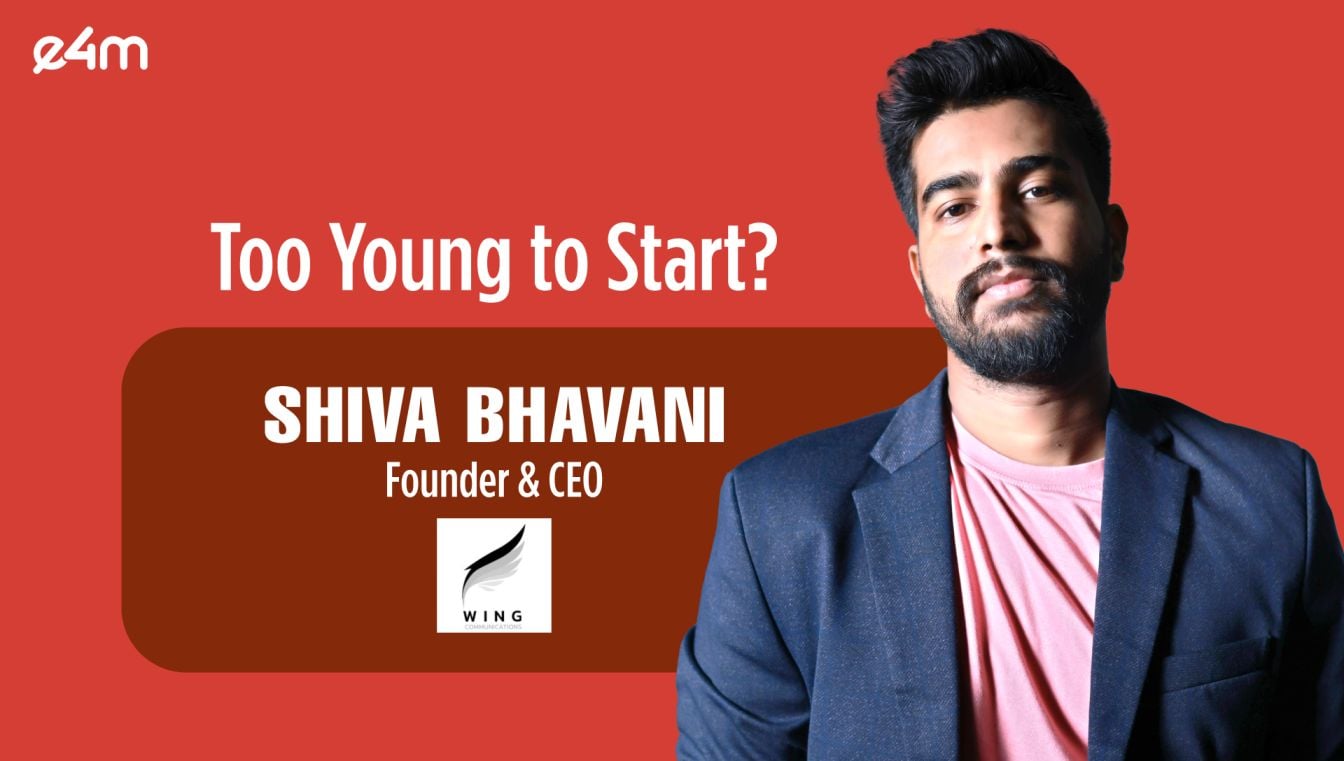

- The agency landscape is evolving, with young founders like Shiva Bhavani of Wing Communications in Hyderabad creating full-service marketing and PR agencies that cater to fast-growing sectors such as technology and healthcare.
- Wing Communications focuses on integrating public relations with digital visibility and content, addressing the demand from startups and high-growth companies for communications that directly contribute to business growth.
- Young agencies, like Wing, often outperform established firms due to their adaptability, speed, and closer understanding of modern audience behaviors, despite facing challenges in gaining initial client trust due to their founders' age and experience.
- The future of the PR industry is expected to favor independent agencies that combine strategic communications with technology and analytics, as they can quickly adapt to emerging sectors and meet the evolving needs of clients.
The agency landscape is changing not just in terms of who is starting businesses, but also where and how these businesses are being built. For young founders, regional markets can offer a very different vantage point. It is constantly shaped by fast-growing businesses, emerging categories and clients looking for communications that can keep pace with their ambitions.
In e4m’s Corp Comm & PR ‘Too Young to Start?’ series, we look at the journeys behind these new-age agencies. In this edition, Shiva Bhavani, Founder & CEO, Wing Communications, takes us through his entrepreneurial journey.
Based out of Hyderabad, Wing Communications has grown into a 40-member, full-service creative marketing and digital PR agency, working across PR strategy, media relations, content and digital communications. Its client mix spans high-growth sectors including technology, healthcare, EV and finance categories where brands are often building their reputation alongside their businesses.
But what does it take to build a communications agency around fast-moving sectors and equally fast-moving clients? How does a young founder navigate the shift from doing the work himself to building a team, winning trust and shaping an agency's point of view? And what changes when PR increasingly sits at the intersection of content, creativity, digital and business growth?
In this conversation, Bhavani speaks about starting and scaling Wing Communications from Hyderabad, the realities of building a 40-member team, working with high-growth brands, and how his experience has shaped his thinking of building an agency and on the future of PR and communications.
Excerpts:
What convinced you there was room for another PR agency in an industry already crowded with established players? What opportunity did others overlook?
When we started Wing Communications, we never believed the market needed "another PR agency." We believed it needed a different kind of communications partner. Many businesses, especially startups and high-growth companies, were looking for agencies that could connect public relations with digital visibility, content, social media, and founder branding instead of treating them as separate functions.
The opportunity we saw was that clients increasingly wanted communications to contribute directly to business growth rather than simply generate media coverage. Reputation today is built across multiple channels, and earned media works best when it is supported by strong digital storytelling and measurable outcomes. That integrated approach was still underserved, particularly for ambitious growth-stage businesses.
How difficult was it to win your first few clients, and did your age or experience ever become a hurdle during client conversations? What almost made you quit?
Winning the first few clients was undoubtedly the hardest phase. Without an extensive portfolio, every conversation depended on our ability to demonstrate strategic thinking rather than rely on past credentials. Naturally, there were occasions when prospective clients questioned whether a younger agency could deliver the same value as an established firm.
Instead of trying to compete on years of existence, we focused on preparation, responsiveness, and delivering measurable results. Once the initial clients experienced that commitment, referrals became our strongest growth engine.
Like every entrepreneur, there were moments when uncertainty felt overwhelming, especially during the early months. But every successful campaign reinforced our belief that consistent execution matters far more than perceived experience.
Where do young agencies genuinely outperform established firms?
Young agencies tend to be far more adaptable. The communications landscape changes rapidly, and we are comfortable experimenting with new formats, integrating AI responsibly, understanding digital platforms, and building campaigns that combine PR, content, SEO, and social media from day one.
We also work with much leaner structures, allowing decisions to be made quickly without multiple layers of approvals. Clients often appreciate that speed because today's opportunities don't wait.
Perhaps most importantly, younger agencies are naturally closer to how modern audiences consume information. That perspective helps us build narratives that feel relevant across both traditional media and digital ecosystems.
Does the industry give enough room for first-generation founders? What assumptions about younger agencies do you wish clients would stop making?
The industry is becoming more open, but there is still an unconscious tendency to associate longevity with capability. Experience certainly matters, but so do innovation, strategic thinking, and the ability to execute consistently.
One assumption we hope disappears is that younger agencies are suitable only for startups or smaller brands. Capability should be judged by the quality of ideas, execution, and outcomes rather than the age of the founders or the number of years an agency has existed.
The communications industry has always evolved through fresh perspectives, and first-generation founders play an important role in driving that evolution.
Many independent agencies begin with the founder's personal reputation. What systems have you built that don't depend on you?
Building a founder-led agency is often unavoidable in the beginning, but it cannot remain founder-dependent forever.
At Wing Communications, we've invested in documented processes, collaborative strategy development, structured editorial planning, quality review systems, and specialised teams across PR, content, digital marketing, and creative communications. This ensures clients receive consistent strategic thinking regardless of who leads a particular project.
We also encourage knowledge sharing internally so expertise is distributed across the organisation instead of residing with a single individual. That creates a stronger business for both clients and employees.
How do you measure your agency's contribution to the industry, whether through employment generation, supporting startups, creating new specialisations, or building talent?
For us, contribution goes beyond revenue or campaign numbers. We measure it through the businesses we've helped build credibility, the founders we've helped find their voice, and the opportunities we've created for young communications professionals to develop meaningful careers.
We particularly enjoy working with emerging companies because communications can genuinely influence their growth trajectory during critical stages. At the same time, investing in young talent and exposing them to integrated communications rather than isolated PR functions helps prepare the next generation of industry professionals.
If our work enables businesses to communicate better and professionals to grow faster, we consider that a meaningful contribution.
Looking ahead, how do you see young independent agencies becoming significant contributors to the PR economy?
The future of the industry will belong to agencies that combine strategic communications with technology, analytics, content, and digital expertise. Independent agencies are well positioned because they can adapt quickly, experiment responsibly, and build highly specialised capabilities without legacy constraints.
As India's startup ecosystem, creator economy, and technology sectors continue to expand, there will be increasing demand for communications partners who understand business growth as well as storytelling.
I believe young independent agencies will not simply compete with larger firms; they will expand the industry itself by serving emerging sectors, developing specialised expertise, creating employment, and raising expectations around measurable communication outcomes.
Read more news about PR and Corporate Communication News, Internet Advertising, Marketing News, Digital Media News, People Movement News
For more updates, be socially connected with us onInstagram, LinkedIn, Twitter, Facebook YouTube & Google News