'When you’re a young agency, every single client is your reputation'
This e4m’s Corp Comm & PR ‘Too Young to Start?’ series features Brand Talk India’s Ruhani Singh Mann on starting early, scaling fast and redefining the path to PR agency ownership
 by
by
Published: Aug 27, 2026 5:37 PM | 12 min read
 Follow Us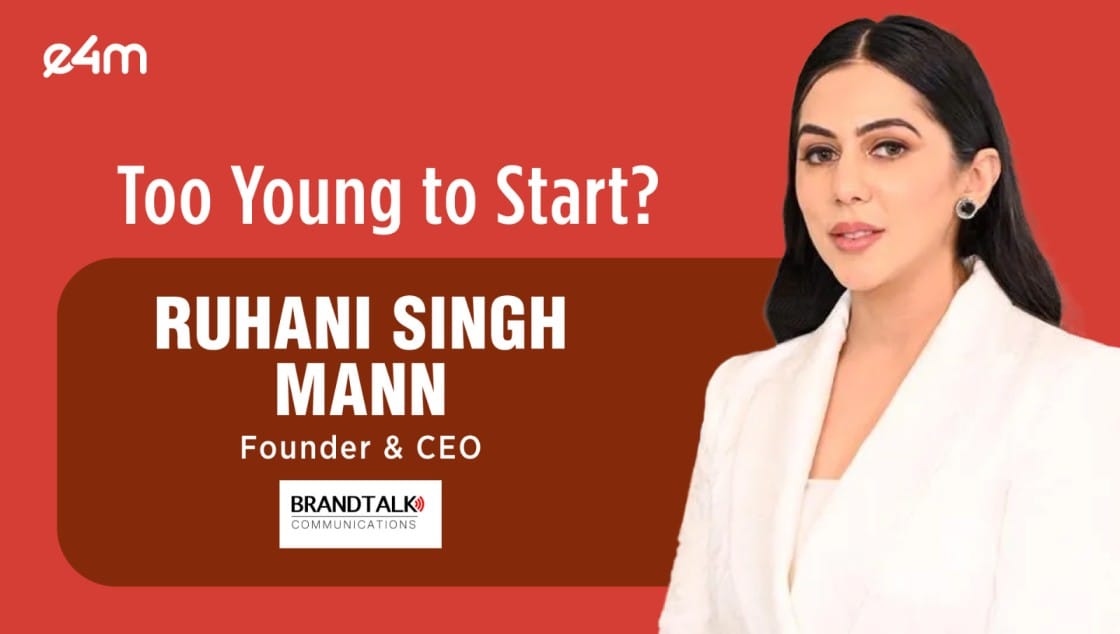

- The emergence of under-30 agency founders is reshaping the public relations (PR) industry, with a focus on agility and tailored communication strategies for clients, as highlighted by Ruhani Singh Mann, Founder & CEO of Brand Talk India.
- Founded in 2021, Brand Talk India has rapidly expanded to a 120-person agency, offering integrated communications services across various sectors, including luxury and lifestyle, while emphasizing the importance of client trust and team expertise.
- Mann discusses the challenges of gaining initial clients, noting that younger agencies often face skepticism due to their age but can outperform established firms through dedication, continuity in client relationships, and a fresh perspective on brand communication.
- The article emphasizes the potential of young independent agencies to significantly contribute to the PR economy by understanding founder-led businesses and adapting to the evolving digital landscape, provided they invest in professionalism and robust operational frameworks.
The rise of under-30 agency founders is raising bigger questions about how PR businesses are built and what clients now value when choosing a communications partner. In e4m’s Corp Comm & PR ‘Too Young to Start?’ series, we go beyond the launch announcements to understand the thinking, challenges and choices behind these new-age firms. In this edition, Ruhani Singh Mann, Founder & CEO, Brand Talk India, takes us through her journey.
Founded in New Delhi in 2021, Brand Talk India has grown from a founder-led start-up into a 120-strong integrated communications agency in four years. What began with PR has expanded into social media, content, strategy, digital communications and brand positioning, with the agency working across luxury, lifestyle, hospitality, F&B, FMCG and fashion.
But what does it take to build that kind of scale when you begin your entrepreneurial journey early? What did Mann have to prove to clients, how did she approach credibility, and what lessons came with moving from being a communications professional to being responsible for an organisation of 120 people?
In this conversation, Mann speaks about taking the entrepreneurial leap, building Brand Talk India, winning client trust, creating a team that combines young talent with seasoned expertise, and what she believes the next generation of PR agency builders can do differently.
Excerpts:
What convinced you there was room for another PR agency in an industry already crowded with established players? What opportunity did others overlook?
Honestly, I didn’t start Brand Talk because I saw a gap in the market. I started it because I kept seeing the same frustration play out - brands with genuinely interesting stories being served templated, one-size-fits-all communication strategies.
The established players had built strong infrastructure, deep media relationships, and impressive client rosters. What they’d sometimes lost along the way was agility. The ability to think from scratch for each client rather than fitting them into a process that already existed.
What I believed – and still believe – is that the most interesting briefs come from founder-led businesses, emerging luxury brands, and companies at genuine inflection
points. These clients don’t need a large agency machine. They need a sharp, senior team that treats their brand with the same intensity the founder does.
That’s the space I saw. Not a gap in the industry directory. A gap in the quality of attention being given to brands that deserved more of it.
How difficult was it to win your first few clients, and did your age or experience ever become a hurdle during client conversations? What almost made you quit?
The first year was genuinely hard - but hard in a way that I think shaped everything that came after it.
You’re pitching without a case study deck. You’re asking someone to trust a name they’ve never heard of. You’re sitting across from a marketing head who’s been in the industry longer than you’ve been working, and you have to give them a reason to take a chance on you. Age came up - not always explicitly, more in the form of extra scrutiny, longer evaluation periods, more questions about process. I understood it. I would have asked the same questions.
But here’s what I didn’t expect - the market moved faster than the scepticism did. Within the first year, Brand Talk had worked with over 60 clients across more than 10 industries. Budweiser, Café Delhi Heights, Adrift Kaya, People of Tomorrow - these weren’t small votes of confidence. These were brands with real standards, real audiences, and real expectations. Every single one of them gave us a chance before we had the portfolio to demand one.
Did I ever want to step back? There were weeks, yes. Moments where the gap between the work coming in and the infrastructure to support it felt uncomfortably wide. But the answer was never to stop - it was to build faster. And every time a brand we’d worked hard to position started being talked about in the right rooms, that was enough.
“When the going gets tough, the tough get going” is a line people put on walls. For us it was just Tuesday.
Where do young agencies genuinely outperform established firms?
Honestly - and I say this with full respect for the larger agencies because many of them are exceptional - it comes down to one thing. Skin in the game.
When you’re a young agency, every single client is your reputation. There’s no portfolio thick enough to absorb a bad result. So you fight differently. You think harder. You stay later. Not because someone told you to - because you genuinely cannot afford not to.
In PR specifically, that intensity shows up in ways that matter.
Large agencies have brilliant people - but those people are often stretched across fifteen accounts. The senior person who won the pitch is rarely the person running your account six months later. At Brand Talk, the people in the room during the pitch are the people doing the work. That’s not a small thing. In PR, relationships and context are everything. When that continuity breaks, the quality of the communication breaks with it.
The second thing is media relationships. Established agencies have deep rolodexes - but journalists and editors today respond to people, not agencies. Young PR professionals who have built their own credibility in specific beats, who text a food editor because they genuinely know them, who understand what a journalist actually needs for a story rather than what a press release gives them - that access is earned differently and it shows in the coverage.
And the third - we are not protecting a legacy positioning. We can tell a client something uncomfortable without worrying about a thirty-year relationship. Sometimes the most valuable thing a PR agency can do is tell a brand the truth about how it’s being perceived. Young agencies are hungrier to do that. And in my experience, clients respect it more than they expect to.
Does the industry give enough room for first-generation founders? What assumptions about younger agencies do you wish clients would stop making?
The industry has been kinder to me than I perhaps expected it to be. And I want to acknowledge that genuinely - because there have been mentors, peers, and yes, clients, who took a chance on Brand Talk early and whose belief made a real difference. I don’t take that lightly.
But I’d be doing a disservice to every young founder building something right now if I didn’t say - there are still assumptions that quietly make the journey harder than it needs to be.
The most common one I encounter is the idea that a younger agency is a stepping stone. That you work with them while you’re growing, and then you graduate to a larger firm once you’ve arrived. I understand where that thinking comes from. What I’d gently push back on is this - Brand Talk is 120 people, operating across luxury, lifestyle, hospitality, consumer, and technology. We have built campaigns that have sat alongside the best work in this industry. At some point, longevity and scale stop being the right measure of capability.
The assumption I’d most warmly ask clients to reconsider is that boutique means junior. It doesn’t. It means the people who won your trust in the room are the people who show up for your brand every single day after. That kind of attention is actually quite rare - and quite valuable.
The industry is genuinely more open than it was. I believe that. I just think we’re one more generation of proof points away from that openness becoming the default rather than the exception.
Many independent agencies begin with the founder’s personal reputation. What systems have you built that don’t depend on you?
This is the question I think every founder should be asked. And I want to answer it honestly- because the real answer isn’t about systems at all. It’s about people.
Brand Talk started on the back of my relationships and my belief in what this agency could become. That’s true. But what it has become - a 120-person agency that delivers consistently, that clients trust, that talent wants to be part of - that is not me. That is the team we have built and the culture we have fought to protect.
The best decision I made as a founder was hiring people who were better than me in their domains and then genuinely getting out of their way. Our account leads don’t support client relationships - they own them. Completely. The client’s trust sits with that person, their instinct, their consistency, their understanding of that brand’s world. I am in the background of that relationship, not the centre of it.
What keeps that working is something I care about deeply - retention. We have people who have grown with Brand Talk from their very first job in communications to leading entire client portfolios today. That continuity is not accidental. It comes from investing in people’s growth before they ask for it, from creating an environment where someone feels genuine ownership over their work, and from being honest with our team about where we are going and why their role in that journey matters.
The systems exist - the frameworks, the processes, the quality standards. But systems without the right people running them are just documents. The reason Brand Talk work.
without me in every room is because the people in those rooms are exceptional. I am proud of them in a way that is genuinely hard to put into words.
That is the only infrastructure worth building.
How do you measure your agency’s contribution to the industry, whether through employment generation, supporting startups, creating new specialisations, or building talent?
Contribution is a word I think about carefully - because it’s easy to measure the things that are easy to count and miss the things that actually matter.
The most visible measure is employment. We are 120 people, and our average team age is 30. That number tells a story I’m genuinely proud of - a room full of young communications professionals who are building careers, developing craft, and learning what it means to do this work with real standards. Many of them are in their first or second serious role. The habits they build here, the rigour they develop in how they approach a brand’s story - that goes with them long after Brand Talk. In a very real sense, we are contributing to the next generation of this industry whether we think of it that way or not.
But what makes our team genuinely unusual is the other end of that spectrum. Sitting alongside those young professionals are consultants who bring over 30 years of experience in communications. That combination - the hunger and cultural instincts of youth alongside the depth and judgment of experience - is something I believe in very strongly. It means our young team isn’t learning from trend reports alone. They’re learning from people who have navigated this industry across decades, across crises, across complete transformations of the media landscape. That kind of mentorship is rare and I protect it fiercely.
The second contribution I’m most proud of is the early bets. We have worked with brands that no large agency would have taken seriously at the stage we met them - founders with a vision and very little else, building something they believed in deeply. We believed in them too. Helping those brands find their voice, build their credibility, and grow into businesses that are now genuinely recognised - those are the relationships that remind me why this work matters.
And the third is simply this - every time a young, Indian, founder-led agency delivers work that sits at the highest level of this industry, it makes the path slightly less steep for the next person attempting something similar. If Brand Talk’s journey makes one more young founder think “this is possible” - that is a contribution I will take quietly and gratefully.
Looking ahead, how do you see young independent agencies becoming significant contributors to the PR economy?
The structural conditions are genuinely in our favour right now.
India is producing more founder-led businesses than at any point in its economic history. These founders are building in categories that didn’t exist a decade ago. They are culturally specific, digitally native, and moving at a speed that traditional agency structures were not built to match.
Young independent agencies are built for exactly this moment. We understand the founder mindset because we are founders. We understand digital-first communication because it’s the only world we’ve built in. And we have the flexibility to specialise deeply in specific sectors rather than trying to serve every category from a single inherited model.
What will determine whether independent agencies become genuinely significant contributors - rather than just alternatives - is whether we invest in our own professionalism. In building real teams, real processes, real thought leadership. In showing up with the same rigour and ambition that we ask of our clients.
The opportunity is extraordinary. Whether we earn it is entirely up to us.
Read more news about PR and Corporate Communication News, Internet Advertising, Marketing News, Digital Media News, People Movement News
For more updates, be socially connected with us onInstagram, LinkedIn, Twitter, Facebook YouTube & Google News